Grooming

Best Slicker Brushes for Dogs of 2026

A slicker brush is a flat pad of fine wire pins, usually on a slightly flexible base, and the whole trick is that the pins reach down to the undercoat without raking the skin. What separates one brush from the next comes down to pin length, how much the pad gives under your hand, whether the tips are ground smooth or left as bare cut ends, and whether the fur lifts out of the pins in one tidy sheet or fights you every time. Get those right and you pull the loose coat off before it lands on the sofa; get them wrong and your dog flinches and you go back to the old brush.

In my house that fight involves a short-haired dog who sheds year-round and a long-haired cat who allows about four minutes of grooming. We spent four months working through 14 slicker brushes on both of them and on a rotating cast of volunteer pets, and every keeper had the same effect: the animal stayed put. One thing worth knowing before you shop — pin length should match the coat, not the size of the dog. The picks below are the ones that never got put away.

1

Paw Brothers Extra Long Slicker

Top Pick
Paw Brothers Extra Long Slicker

All coat types

Our Score 9.4/10
Check Price

Worth Noting

  • Collected hair must be pulled off by hand
Head Size
4.5 x 3 inches
Coat Types
All coat types
Pin Length
1 inch
Pin Material
Stainless steel
Read the full review

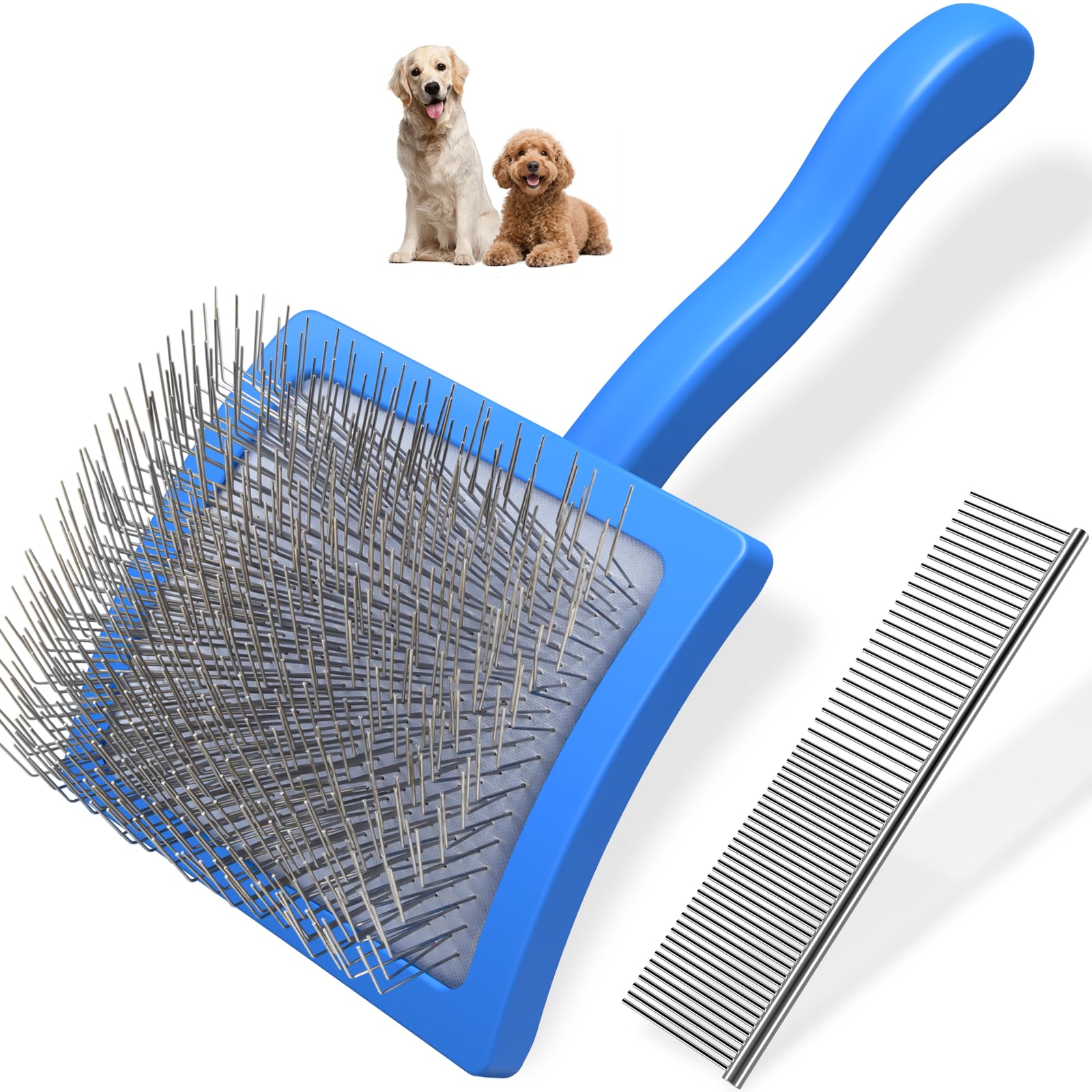
An inch of pin is the number to start with. The Paw Brothers puts a full inch of stainless steel on a 4.5-by-3-inch head, long enough to get under a dense double coat instead of riding across the top of it, and that is why this is the brush we recommend first to most people. Nothing about it is clever: no button, no pivoting head, no claim beyond the length of the pins.

That simplicity is the appeal. The pad is flat, so the hair you collect comes off in a clump in one or two pulls, and there is no mechanism to clog or break. At 4.32 ounces with a 4.75-inch handle, it stays comfortable through the ten-minute sessions a big dog needs in spring.

The range is what makes it our default: doodles, poodles, long-haired mixes and double-coated shepherds all fall inside it, and the same head works on a damp coat or a dry one. What we tell anyone taking it home is that an inch of pin can reach places that don't want reaching. Around the ribs, under the belly and inside the back legs, keep the brush flat against the skin and let the pins part the coat; angled in, they will find the tender spots and your dog will let you know.

Bottom line: The slicker we recommend first: an inch of pin reaches the undercoat on double coats and doodles alike, at a price well below the premium brushes here.

2

Chris Christensen Baby G

Chris Christensen Baby G

Doodle detail work

Our Score 9.4/10
Check Price

Worth Noting

  • Handle can snap at the joint under heavy use
Size
Small
Handle
Wood
Pin Design
Angled, extra-long
Cushioned Pin Pad
Flexible
Read the full review

The Baby G is the most expensive brush on this page, and the one whose price we turned over the longest. It is small, with a wood handle, a flexible cushioned pad and a field of fine angled pins that give under your hand instead of staying rigid.

What that buys shows up on a curly coat. The cushion lets the pins flex and follow the shape of a leg or a head rather than scraping across it, and the density is what gets through the small mats that hide in a doodle's coat. Small is deliberate here: this is the head for ears, feet, muzzles and the topknot, the places where a full-size slicker is too much brush and the dog is least tolerant.

We think a poodle, doodle or bichon owner gets their money's worth, because the pin field and the way it flexes do work that cheaper brushes leave to your wrist. On a short coat none of that applies, and you are paying a great deal for a very small brush.

Bottom line: We think a doodle or poodle owner gets their money's worth here: dense, cushioned pins and a small head made for curly coats and close detail work.

3

Saccison Brush & Comb Set

Saccison Brush & Comb Set

Budget curly coats

Our Score 9.4/10
Check Price

Worth Noting

  • Pins can feel harsh on a sensitive dog
Size
Large
Includes
Slicker brush and metal comb
Pin Angle
≈45°
Pin Length
≈1 inch
Read the full review

The comb is the part of this set worth talking about. A slicker opens tangles; a metal comb tells you whether you actually finished, because it stops dead at a mat the brush slid over. Getting both in one box, for less than most of the single brushes here, is why this set is on the page at all.

The pins run about an inch and sit at roughly 45 degrees, which gets them under the coat while the angle keeps the tips off the skin. Paired with the comb, that is a serious amount of tool, and it makes the set the low-risk way for a doodle owner to find out whether long angled pins suit their dog.

The comb also changes the routine. Brush a section, then run the comb through that same section down to the skin; wherever it catches, go back with the brush. That one-two is what stops a curly coat tightening into mats between grooms, and it is the thing a brush-only purchase never gives you.

Bottom line: The best value in this group for a curly coat: an inch of angled pin plus the metal comb that proves you reached the skin.

4

Coastal Safari Cat Slicker

Coastal Safari Cat Slicker

Cats, small pets

Our Score 9.4/10
Check Price

Worth Noting

  • Too small to cover a big dog quickly
Model
W419
Cleaning
Push-button self-cleaning
Dimensions
2 x 5 x 8.75 inches
Pin Material
Coated stainless steel
Read the full review

If there is a cat in the house as well as a dog, this is the brush that earns its keep. The head is small, which sounds like a limitation until you are trying to get under a chin, around a muzzle or down the front of a front leg, and it is the reason we reach for this one on cats, puppies and the fiddly parts of a bigger dog.

The pins are coated stainless with no rubber tips, and that is the part to understand before you buy. Coated pins part a short coat cleanly and do not scratch, but they do not cushion a heavy stroke, so the pressure is yours to manage: short, light passes, letting the pins find the hair. Press hard and a thin-skinned cat will leave.

The button sits under your thumb and the head pops clean in a second, which matters when the animal has decided the session is over. It is also small enough to live in the drawer with the cat toys, which is where a brush used twice a day belongs.

Bottom line: We keep this one for cats, small dogs and detail work: a small self-cleaning head that fits under a chin and coated pins that reward a light hand.

5

Augwind 3-Piece Grooming Kit

Augwind 3-Piece Grooming Kit

Multi-tool starter kit

Our Score 9.4/10
Check Price

Worth Noting

Includes
Slicker, rake, flea comb
Warranty
2 years
Rake Teeth
9 and 17
Package Dimensions
7.24 x 4.72 x 2.83 inches
Read the full review

Three tools arrive in one box: a self-cleaning slicker, a double-sided rake and a flea comb. That is more than most people need on day one and exactly what a first-time owner of a heavy shedder ends up buying piecemeal over the first year.

The rake is the one that surprises you. The nine-tooth side breaks up knots, the seventeen-tooth side drags out undercoat, and on a husky or a German shepherd it does work the slicker cannot: the slicker smooths the coat, the rake empties it.

The slicker itself is a standard push-button model — press, the pins retract, the hair drops off. The flea comb is fine-toothed, which makes it a decent face-and-dander tool as well as a flea check, though it is the least-used of the three unless your dog is picking things up in tall grass.

As a starter kit we think it is genuinely good: one purchase, three jobs covered, and nothing in the box that is a token extra. If you already own a long-pinned slicker you like, you are buying this for the rake, and that is still a fair reason.

Bottom line: The kit we hand a first-time owner: a slicker, a rake and a flea comb that between them cover most of a heavy coat.

6

Swihauk Self Cleaning

Swihauk Self Cleaning

Everyday shedding

Our Score 9.2/10
Check Price

Worth Noting

Handle
Lightweight TPR
Cleaning
Push-button retractable
Pin Tips
Rounded plastic
Pin Material
Stainless steel
Read the full review

Press the button and the pins retract into the head, and the mat of hair you have just collected slides off in one piece. That is the pitch, and on a dog that sheds steadily it is the difference between brushing for five minutes and brushing for five minutes and then picking hair out of a brush for five more.

We keep it for everyday upkeep. The pins are stainless with rounded plastic tips, so you can work over a ribcage without the dog flinching, and the TPR handle is light enough that a two-minute session doesn't feel like a chore. This is the brush that lives by the sofa rather than in the grooming box, which is a compliment: the brush you use daily does more about shedding than the one you get out on Sundays.

Where it fits is a short or medium coat, a cat, or a dog that is new to being brushed, because nothing about the rounded tips or the light head feels like a tool. The trade is pin length. On a long or curly coat it smooths the surface and leaves the layer that actually mats, so a doodle needs one of the long-pinned brushes here alongside it.

Bottom line: Our pick for everyday shedding on short and medium coats: a button drops the hair in one piece and the rounded pins are gentle enough for daily use.

7

Glendan Slicker Brush

Glendan Slicker Brush

Small dogs, detail

Our Score 9.2/10
Check Price

Worth Noting

  • Fur packs into the middle of the pad
Head
180° rotating
Weight
3.17 oz
Warranty
12 months
Dimensions
7.87 x 4.72 x 1.57 inches
Read the full review

The head pivots through 180 degrees. That reads like a spec-sheet gimmick and turns out to be useful in exactly two places: the inside of a back leg and the curve of a chest, where a fixed head has to be angled awkwardly to make contact at all.

The rest is conventional. It weighs 3.17 ounces, the handle is anti-slip, the pin tips carry small massage beads, and the whole brush is compact — a size that suits a chihuahua, a maltese or a cat rather than a shepherd.

On a dog that is new to grooming the combination is forgiving: light, gentle at the tips and small enough that you can work a paw without wrestling the rest of the dog. The twelve-month warranty is a small thing that most brushes here do not offer.

We think it is a sensible first brush for a small dog or a cat. It is not the tool for a heavy undercoat, and the head does not cover much ground at once, but for a weekly ten-minute session on a little dog it does everything asked of it.

Bottom line: A gentle, inexpensive brush for a small dog or a cat, with a pivoting head that earns its keep around legs and chests.

8

Pecute Self-Cleaning Slicker

Pecute Self-Cleaning Slicker

Short, double coats

Our Score 9.0/10
Check Price

Worth Noting

  • Small head means more strokes on a big dog
Handle
Non-slip TPR
Weight
3.1 oz
Pin Angle
135°
Dimensions
6.7 x 3.7 x 2 inches
Read the full review

3.1 ounces doesn't sound like much until you have spent ten minutes brushing a labrador with something heavier. The Pecute is light, small enough to keep in a kitchen drawer, and wrapped in a non-slip TPR grip that stays put even when your hand is covered in loose fur.

The pins are stainless, bent at 135 degrees and capped at the tips, a combination that catches hair on the pull and comes away without dragging on the way back. At 6.7 inches long overall it is a compact brush rather than a body-sized one, which suits detail work and smaller dogs.

For a short or double coat this is the budget brush we point people to: it empties with a click, it is light enough to use daily, and a husky or a shepherd in coat-blowing season is exactly its territory. Curly coats are where it stops, because the pins are too fine and too short to work through a doodle's curl, and you will be shopping for a long-pinned brush again.

Bottom line: A light, inexpensive self-cleaner for short and double coats; if your dog is curly, put the money toward a longer pin instead.

How We Tested 14 Slicker Brushes

I built the shortlist by reading specs and a lot of owner reviews, then narrowing by pin length, pin spacing, pad size, handle shape, price per brush, and whether the pins had rounded tips or bare cut ends. Fourteen brushes made the cut. Each one got four months of weekly sessions on a 45-pound shedding dog, a long-haired cat who hates grooming, and a short-haired cat with thin, sensitive skin, and several went home with volunteers whose pets wear very different coats.

Sessions started on the living room rug after a muddy walk and moved to the back seat of the car, the kitchen floor during a spring blowout, and the bath mat after a rinse. I brushed each pet for a fixed five minutes, gathered the fur into a bag, and compared piles: some brushes produced a cloud in two minutes, others pulled almost nothing while leaving the coat looking smooth. Then I ran a hand over the coat to feel whether the undercoat had actually lifted or was just flattened down.

Cleaning got its own test. I timed how long it took to pull fur out of the pins, whether it peeled away in one sheet or had to be picked out with a fingernail, and whether a self-cleaning mechanism still retracted smoothly by the tenth use. Grip with wet hands, wrist angle, and pad size all got noted, since a broad pad is fast on a big dog's flank and useless on a cat's cheek. I watched how each pet reacted session after session, counted bent pins and checked pin tips for rust after four months, and weighed all of it against what the brush cost.

How to Choose Slicker Brushes for Dogs

Start with pin length, not pin count

An inch of pin gets under a double coat or a doodle's curl; half an inch polishes the surface and leaves the layer that mats untouched. If your dog has a short, smooth coat, a shorter pin is easier to control and less likely to scrape skin. The trap is buying on looks: a dense field of short pins looks serious and does very little on a shepherd in spring. The Paw Brothers' single inch is why it leads this group, and the Swihauk's shorter pins are why it stays on short coats.

If the coat curls, budget for a comb as well

A slicker opens tangles; it cannot prove a coat is mat-free. On a poodle, doodle or bichon, run a metal comb down to the skin after brushing, because that is what finds the knot the brush slid over. Work in sections and comb behind the brush. Where the comb stops, you have a mat that needs a dematting tool rather than more slicker work. The Saccison set pairs both tools, which is why we rate it for curly coats.

Self-cleaning buttons versus a flat pad

A push-button head retracts the pins and drops the collected hair in one piece. That is a genuine convenience if you brush daily, and it adds weight plus one more part in the way. A flat pad has no moving parts at all; you pull the hair off in a clump or two. Neither wins in the abstract. Brush a heavy shedder twice a week and the flat pad is simpler; brush a short-coated dog every day and the button earns its place.

Head size, weight and your own hand

Head size is coverage against control. A small head works around ears, feet, muzzles and a cat's chin; a large one crosses a labrador's flank in fewer strokes. Weight matters more than people expect, because a long session with a heavy brush is a wrist workout — the lightest picks here sit around three ounces. Hold a brush the way you will hold it on a dog: if your grip is cramped in the shop, it will be cramped at home.

What the extra money buys

At the top of this group you are paying for a dense pin field set in a cushioned pad and a handle shaped for close work, and you notice both on a coat that mats. The inexpensive self-cleaners do the same basic job with shorter pins and more plastic. Our rule: a curly or easily matted coat justifies the premium once, while a short or double coat is well served by a mid-priced brush with long pins.

Frequently Asked Questions

Final Verdict

Start with the Paw Brothers Extra Long Slicker. An inch of stainless pin, a light body and a pad that clears in a couple of pulls make it the brush that covers the widest range of coats here, and it is the one we recommend before any of the more expensive options.

Two changes move you elsewhere. For a doodle or a poodle, the Chris Christensen Baby G's small, dense, cushioned head is built for that coat specifically, and the difference shows around faces and legs. For a short-coated dog you brush every day, the Swihauk's button saves more time than either of them.