Feeding & Watering

Best Three-Bowl Dog Feeders of 2026

A three-bowl dog feeder looks like a simple piece of furniture until you live with a dog that inhales dinner and another that drinks like a paddle wheel. The right one keeps food and water in one place, raises the bowls to a comfortable height, and holds its ground when a wet muzzle sends water flying. It also has to survive daily scrubbing, occasional chewing, and an assembly process that shouldn’t require a second person. What it fixes is simple: fewer sliding bowls, less crouching, and a cleaner feeding corner.

I’ve fed dogs from mismatched bowls on a towel, and I know the difference a stable, properly sized station makes. Over eight months, we tested a dozen three-bowl feeders, comparing height settings, bowl size, spill resistance, ease of cleaning, assembly, adjustability, water filtration, and build quality against price. One thing first-time buyers miss: a feeder that’s too tall can be as awkward as one that’s too low, so measure your dog’s elbow height before you fall for a sleek frame. The picks below are the ones that earned their floor space.

1

SHAINFUN Metal Elevated Feeder

Top Pick
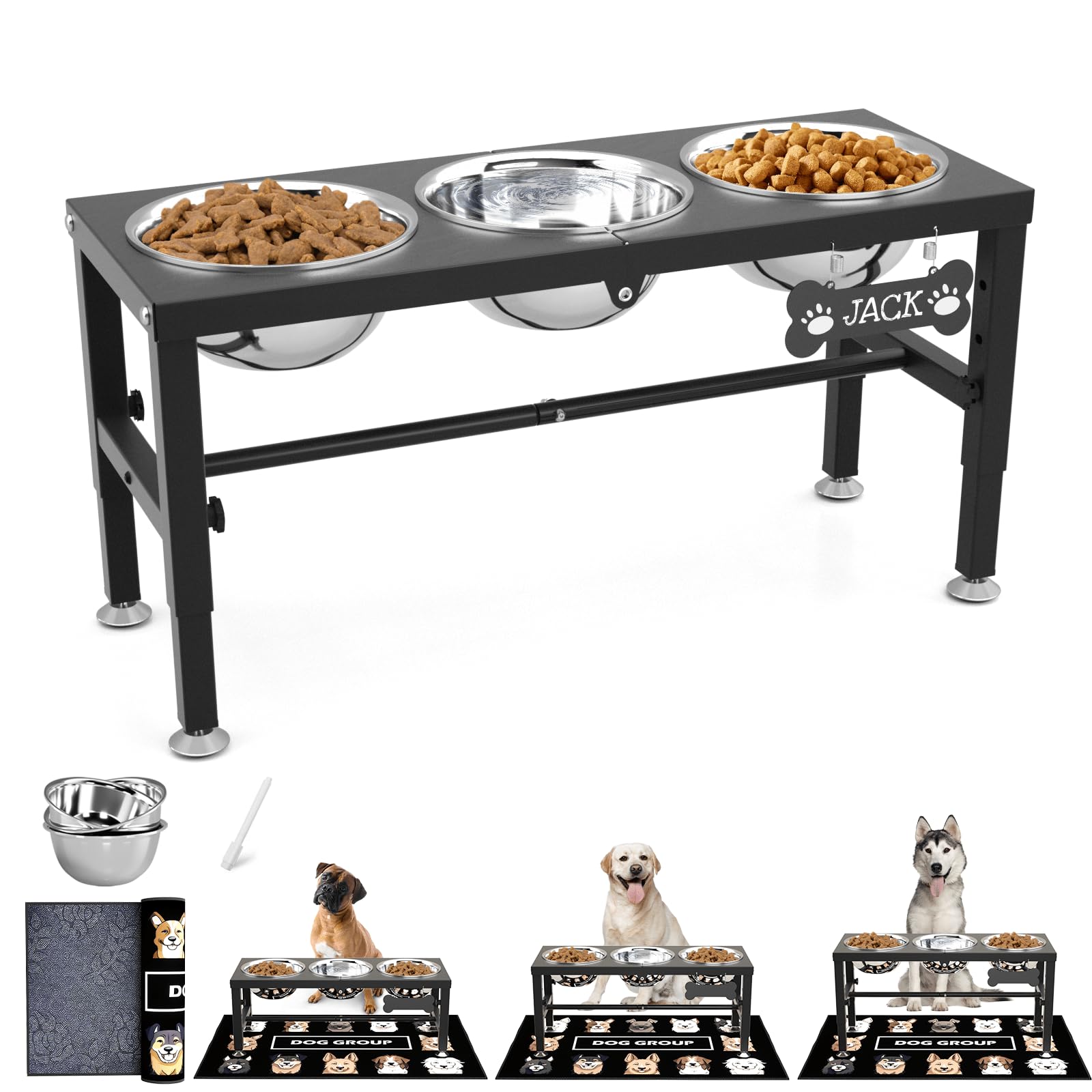
SHAINFUN Metal Elevated Feeder

Multi-dog homes

Our Score 9.0/10
Check Price

Worth Noting

  • Large footprint in a small kitchen
  • Costs more than the plastic picks here
Bowls
Three 58-oz stainless steel bowls
Frame
Powder-coated metal
Height
Adjustable; 8.7 in and up
Footprint
24.4 x 9.4 in
Read the full review

Three 58-ounce stainless bowls in a powder-coated metal frame is the clearest answer here to a multi-dog household. The SHAINFUN gives each bowl enough room that a Labrador can drink without elbowing the dog next to it, and the 24.4-inch span is the reason. It is a station, not a compact mat.

We like the height adjustment more than we expected to. The lowest listed setting is 8.7 inches, and the frame climbs from there, so the same feeder can stay with a dog from adolescence into a slower senior phase. The metal legs feel sturdier than the plastic stands in this group, and the included 19.7-by-31.5-inch mat catches the splash zone. The stainless bowls lift out for a daily rinse, and the frame goes together with a few bolts.

This is not the feeder for a toy breed. The bowls are deep and broad, and the station is sized for medium and large dogs; a small dog will be eating from a mixing bowl. For two or three big dogs, that scale is the whole point. It is the station we trust with the messiest dinner.

Bottom line: For multi-dog homes with medium or large dogs, this is the three-bowl feeder we recommend: big stainless bowls, a stable metal frame, and height adjustment that earns its keep.

2

Decflow 3-in-1 Elevated Feeder

Decflow 3-in-1 Elevated Feeder

Travel and apartments

Our Score 9.0/10
Check Price

Worth Noting

  • Floating water cover can be pawed loose
Bowls
5-cup stainless, 5-cup slow-feed, 50-oz water
Height
4 adjustable settings
Foldable
Yes
Footprint
16.5 x 10.6 in
Read the full review

A feeder that folds is the reason to look at the Decflow. The stand collapses into a flatter package, so it can go in a car trunk or a closet between meals. At 16.5 by 10.6 inches, it holds three bowls: a 5-cup stainless bowl, a 5-cup slow-feed bowl, and a 50-ounce water bowl with a floating cover. For an apartment or a weekend trip, that is a useful combination.

We found the four height settings easy to live with. The stand felt stable on a level floor, and the anti-slip pads kept it from skating. The bowls lift out for cleaning, and the folding mechanism is simple enough that we did not dread setting it up. Five-cup bowls are fine for a small or medium dog; a giant breed will need refills.

For travelers and small kitchens, that trade-off is worth it. The Decflow is the one here that can disappear into a closet, and the three bowls cover food, water, and a slower meal without a separate slow-feeder purchase. For a giant breed, one of the bigger metal stations is the better fit.

Bottom line: We reach for this when the feeder has to fold away or travel; its four heights and three bowls make it the most flexible small-space pick here, provided your dog is not giant.

3

ADENGL Slow Feeder Station

ADENGL Slow Feeder Station

Large dogs

Our Score 9.0/10
Check Price

Worth Noting

  • Large footprint in tight spaces
Bowls
Two stainless steel, one slow-feed
Frame
Heavy-duty iron
Included
Name plate and non-slip mat
Footprint
24.4 x 9.4 in
Read the full review

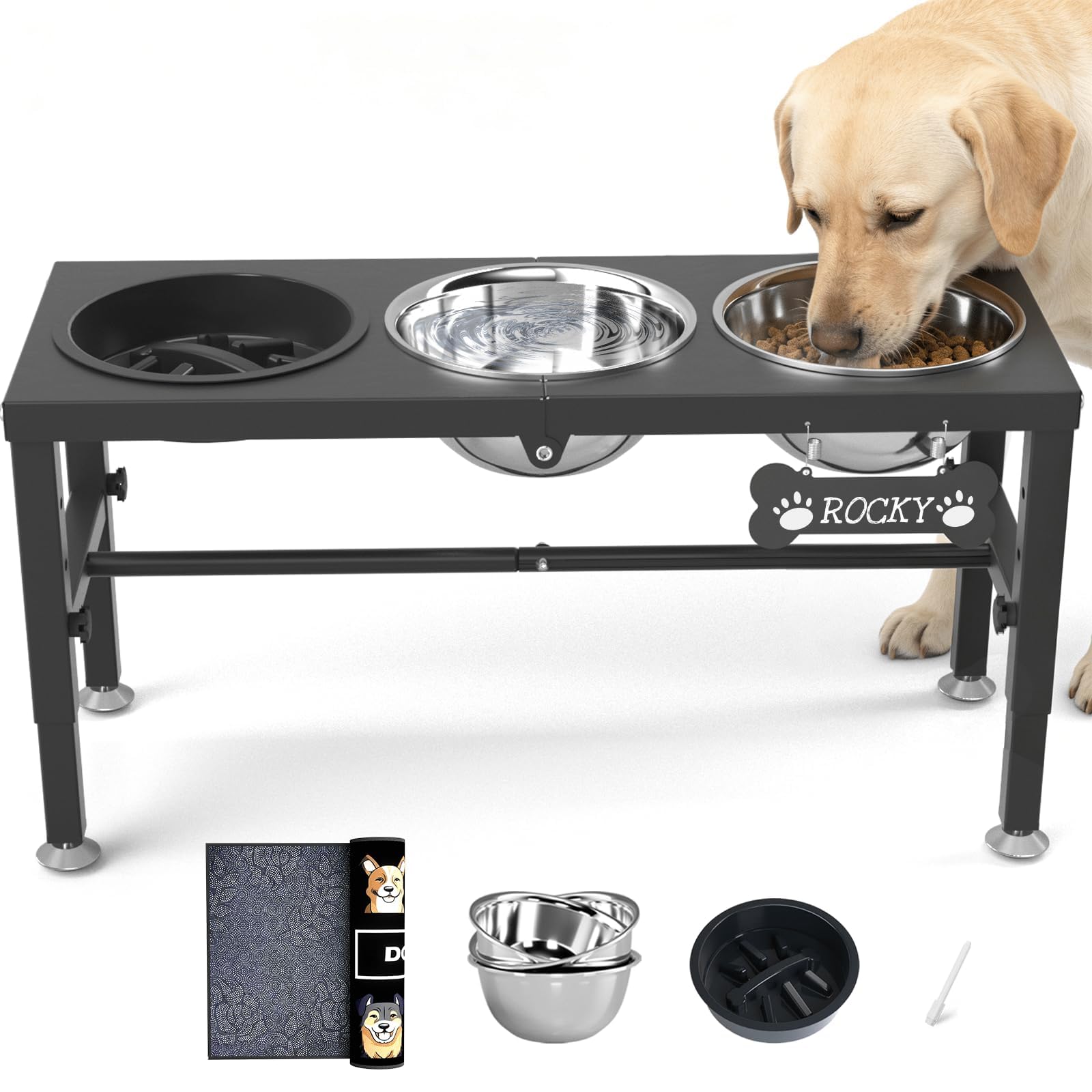
A built-in slow feeder sits alongside two deep stainless bowls on a powder-coated iron frame. The ADENGL is a three-bowl station for large dogs, with a 24.4-inch span and a 12.2-inch height. The slow feeder is the feature that separates it from the other metal stands here.

We like the slow feeder for a dog that inhales dinner. The maze gives a fast eater something to work around, and the two standard bowls are deep enough for a large dog's meal. The iron frame feels substantial, and the included mat and hanging nameplate are nice touches. The nameplate is charming, though the marker smudges when it gets wet.

This is a large-dog station, not a universal one. A small dog will be reaching up to the bowls. For a big dog that eats like a vacuum, the slow feeder earns its keep.

Bottom line: We like this best for a large dog that eats too fast: the built-in slow feeder and deep stainless bowls are the reason to choose it over the other metal stations.

4

URPOWER Elevated Dog Feeder

URPOWER Elevated Dog Feeder

Small dogs

Our Score 9.0/10
Check Price

Worth Noting

  • Bowl can shift in its holder
  • Water can splash past the guards
Bowls
Two stainless steel, one slow-feed/water bowl
Height
4 adjustable settings
Included
Silicone mats
Footprint
14.37 x 8.78 in
Read the full review

Small dogs are the whole point of the URPOWER. The stand starts low and has four height settings, so a Yorkie and a 30-pound beagle can both eat without stretching. The footprint is 14.37 by 8.78 inches, compact enough for a kitchen corner. It comes with two stainless bowls and a slow-feeder/water bowl setup, plus silicone mats. The raised edges are designed to keep food and water from mixing.

We appreciated the slow feeder for a puppy that gulps. The height settings give it a longer useful life than a fixed plastic stand, and the bowls lift out for a quick rinse. Bowl size is the catch: the bowls are small, and a bigger eater will need refills. For a small dog or a pair of small dogs, that is a manageable trade-off.

The plastic stand is light enough to move from room to room, which is handy for travel or a puppy pen. It is not the station for a lab or a dog that attacks the water bowl; the metal feeders here are the better fit. For a terrier or a pair of small dogs, this is the sensible buy.

Bottom line: For a small dog and a tight budget, this is the feeder we recommend: four heights, a slow feeder, and a compact footprint, with bowls that need refilling sooner.

How We Tested Three-Bowl Dog Feeders

We started by pulling together the three-bowl feeders that kept showing up in owner reviews and store aisles, then narrowed the list by bowl capacity, height range, replacement-part availability, and price. A dozen made the cut, and we used each one for eight months in a real kitchen feeding corner—through morning scrambles, evening meals, and the inevitable post-walk drink.

Out of the box, I assembled each feeder solo and timed it, noting whether the instructions made sense, whether the legs locked squarely, and whether the whole thing wobbled once the bowls went in. I changed every height setting and watched my dogs eat at each one, checking for crouching, stretched necks, or a muzzle knocking the bowl lip. I also measured how much kibble and water each bowl actually held, then filled them to the brim and watched what happened when a dog backed away with a mouthful and shook.

Cleaning came next: I hand-washed every part, ran the dishwasher-safe pieces through repeated cycles, and looked into seams and corners for stuck kibble. For feeders with a water filter, I checked that the cartridge seated without leaking, how slowly water moved through it, and whether replacements were easy to find. After eight months, I inspected welds, bowl edges, plastic joints, and feet for rust, cracks, looseness, and chew marks, and compared what each feeder included—spare bowls, non-slip feet, filters—against what it cost.

How to Choose Three-Bowl Dog Feeders

Decide What the Third Bowl Is For

Three bowls can mean three dogs eating at once, or food, water, and a slow feeder for one dog. Some 3-in-1 sets also give you three bowls to rotate rather than three bowls in the stand at the same time. Decide which you need before you shop. For two dogs, a station with three separate seating positions keeps everyone from crowding; for one dog, a spare slow-feeder bowl is only useful if you actually swap it in.

Size the Bowls to the Dog

Capacity matters more than the photo. A 5-cup bowl is fine for a small or medium dog; a 58-ounce bowl gives a large dog more room between refills. If you have a giant breed, check the water capacity too, because a deep food bowl and a shallow water bowl often travel together. The SHAINFUN's three 58-ounce bowls are the biggest in this group; the Decflow's 5-cup bowls are better suited to smaller dogs. Match the bowl to the eater, not to the number of bowls.

Set the Height for a Level Neck

Adjustable height is the difference between a feeder that grows with a puppy and one that ends up on a shelf. A dog should eat with the neck roughly level, not reaching down or craning up. Measure from the floor to your dog's lower chest while it stands, then look for a bowl rim near that height. We put adjustable height near the top of the list for that reason. The URPOWER's four settings and the SHAINFUN's adjustable metal frame cover more dogs than a fixed stand; for a small dog, the lowest setting matters as much as the highest.

Plan for Stability, Spills, and Cleaning

Large dogs test a stand. Metal frames resist flex better than light plastic, and a wide base or non-slip feet keeps the station from skating. A mat helps, but it needs to be bigger than the splash zone; the SHAINFUN's mat is the largest here. We prefer removable stainless bowls for daily rinsing, especially over plastic slow feeders with deep ridges. If the feeder will travel, a folding stand such as the Decflow earns its keep; if it stays put, prioritize stability and simple cleanup.

Frequently Asked Questions

Final Verdict

For most multi-dog homes, the SHAINFUN is the three-bowl feeder we recommend. Its three 58-ounce stainless bowls, adjustable metal frame, and large mat solve the main problem: keeping big, eager dogs from crowding one small bowl. The trade-off is floor space, but that is the cost of giving three dogs room to eat.

If the feeder has to fold away between meals, the Decflow is the better buy; its smaller bowls suit small and medium dogs. For a large dog that inhales dinner, the ADENGL's built-in slow feeder is the reason to choose it instead.