Feeding & Watering

Best Automatic Dog Feeders of 2026

The pitch for an automatic feeder is a small miracle: you sleep past 6:30, your dog eats on time, and a weekend away doesn't require a neighbor with a key. Then the reality sets in — a hopper that dumps half its contents into the bowl, an auger that jams the one morning you're out of town, a schedule that quietly forgets itself after a power flicker. What a good feeder actually buys you is boring: the same measured portion, at the same time, every day, without you standing there.

After seven months with 11 feeders in my team's kitchens, I can tell you the spec sheet predicts almost none of it. Hopper capacity means little once kibble size enters the picture, and the "cup" on most dials is a volume guess, not a weight. What separated the good ones was setup I could finish without the manual, portions that held steady feed after feed, and a drum that kept turning through a week of real kibble and one deliberately pulled plug. The picks below are the ones I'd leave running with confidence.

1

Roffie 7L Automatic Feeder

Top Pick
Roffie 7L Automatic Feeder

Big appetites

Our Score 9.2/10
Check Price

Worth Noting

  • Battery-only power with no cord or adapter
  • Light 5.1-pound body can be shifted by a pushy eater
Power
Battery
Capacity
7 liters (29 cups)
Warranty
2 years
Meals Per Day
Up to 4
Read the full review

Twenty-nine cups is the number that earns this feeder its place. A 7-liter hopper holds more kibble than anything else in this guide except the Frienhund, and the top cover seats down as a seal to keep the food fresh. The listing puts a full hopper at a few days to a week depending on appetite, which for one medium dog is a genuine holiday from refilling.

Four meals a day and a portion range running to nearly 40 settings give you the same kind of control as the Voluas, and the 10-second voice clip works the same way: record it, and the sound does the recruiting. What we keep coming back to, though, is the warranty. Two years is the longest coverage here, on a device whose whole job is to keep working while nobody's home.

The trade is power. This one is battery powered, so there's no cord for a puppy to chew and no outlet to plan around, but the feeder's reliability becomes a maintenance task. Fresh cells on a date you choose, rather than on the day the low-battery warning appears, is the difference between this unit working and this unit failing quietly.

It stands 15.2 inches tall, which is worth checking against the shelf or cabinet it will live under, and the hopper, bowl, and rotor all lift out for washing. Between the capacity and the four-meal programming, it's the feeder that asks the least of you between refills — as long as the batteries are somebody's job.

Bottom line: For bigger appetites and longer trips, we recommend the Roffie: a 29-cup hopper, four programmable meals, and a two-year warranty — the longest coverage in this guide.
2

Pawzone Gravity Feeder Set

Pawzone Gravity Feeder Set

Food and water

Our Score 9.0/10
Check Price

Worth Noting

  • Water can overflow if the bowl seal isn't seated
Bowls
Stainless steel
Holds
About 11 pounds of food, 5 liters of water
Capacity
1.3 gallons each
Raised Base
2.8 to 5.6 inches
Read the full review

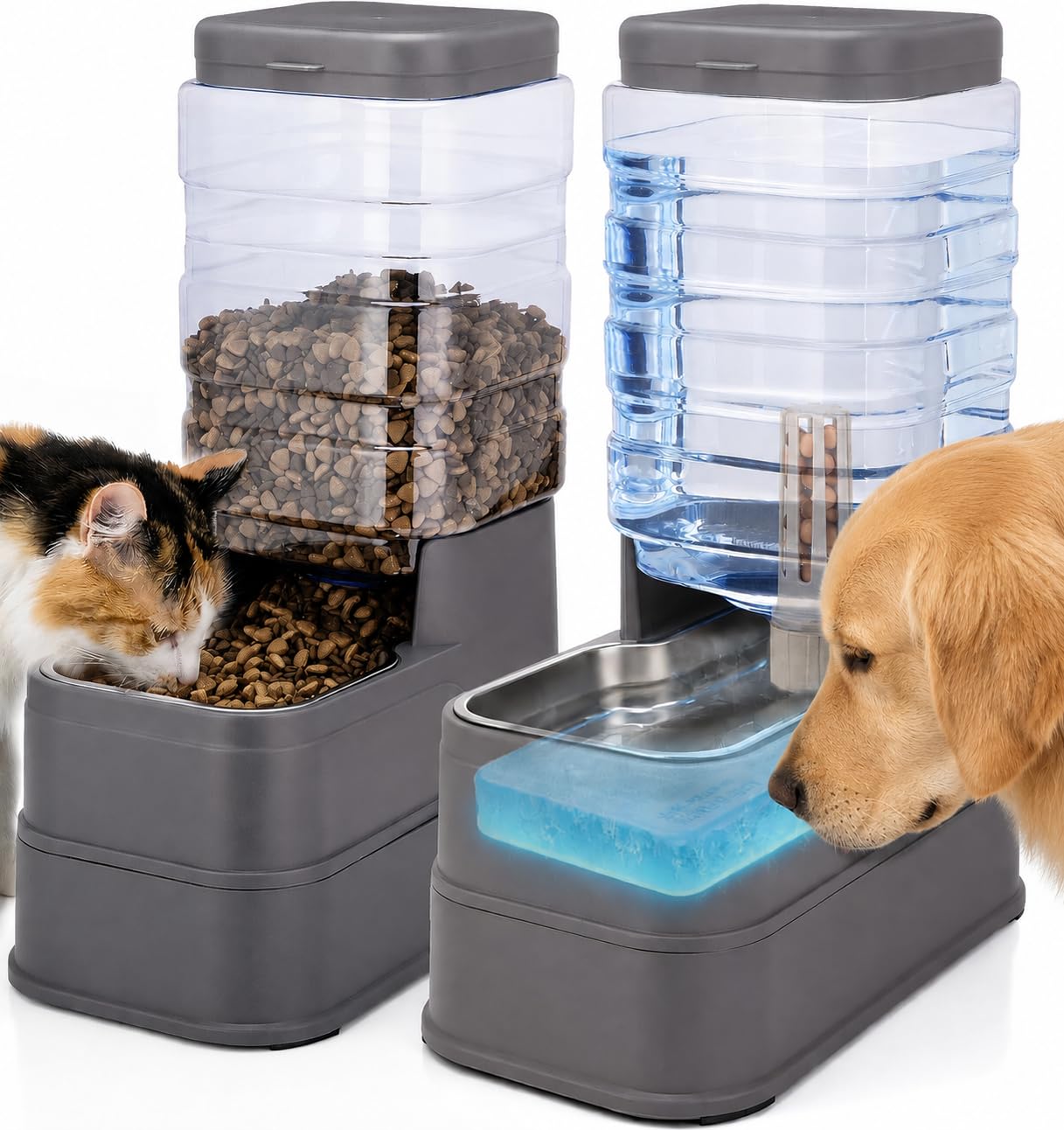
Nothing to plug in, nothing to program, nothing to connect. The Pawzone set is two gravity towers — one for kibble, one for water — that refill their own bowls as your dog empties them. For a household that just wants both bowls to stay full, this is the least fragile design in the guide: no motor, no auger, no clock to drift.

The set is more thoughtful than most gravity feeders. Both bowls are stainless, the base raises them 2.8 inches, or 5.6 with the extra riser fitted, and the water side takes a reusable ice pack and a stone filter. Each tower holds 1.3 gallons; the food side takes about 11 pounds of kibble and the water side about 5 liters, and the siphon tops the bowl up quietly enough to sit in a hallway.

We recommend it for free-feeding households, with two honest limits. Kibble can bridge in the chute and needs a shake before it drops, and the water tower will overflow across the floor if the bowl seal isn't seated squarely after a refill. Neither is a defect so much as gravity's price. If your dog is on a measured diet, a timed feeder is the right answer; if you top up bowls and leave for the weekend, this set covers both.

Bottom line: If you want food and water handled without a cord or an app, we recommend the Pawzone set: stainless bowls, a raised base, and two 1.3-gallon towers that refill themselves.

3

Voluas 4L Automatic Feeder

Voluas 4L Automatic Feeder

Everyday feeding

Our Score 8.8/10
Check Price

Worth Noting

  • Four-liter hopper is a short supply for large dogs
Power
Adapter or 3 D batteries
Capacity
4 liters
Footprint
7.4 x 7.4 x 11.25 in
Meals And Portions
1–4 meals, 0–40 portions
Read the full review

The feature that settled this one for us is the power bay. Voluas runs on a 5V adapter and holds three D batteries behind it, so a chewed cord or a tripped outlet doesn't cost your dog a meal. In a category where the real fear is a silent failure at 6 a.m., that redundancy matters more than any app. The recurring gripe here is portion size, not meals that never arrived.

Programming covers up to four meals a day with as many as 40 portions in each, and the range is finer than most dogs need — which is both the appeal and the irritation. A single portion is a small drop, so a proper dinner can mean stacking a double-digit number of them. You set it once, but plan on ten minutes with a measuring cup for the first meal rather than trusting the number on the screen.

Two details earned more appreciation than we expected. The 10-second recording plays before the food drops, so the clip becomes the cue and the bowl becomes the place your dog waits. And the unit is 7.4 inches square with a bowl and hopper that lift out for washing, so it sits against a wall without claiming a walkway. There's no account, no app, and no WiFi password involved, which is a quieter virtue than it sounds when the alternative is a feeder that's offline at dinner.

Power runs through a 5V USB adapter, so check where the outlet sits before you commit to a corner. Otherwise this is the least fussy timed feeder we tested: fill it, set four times, and the machine does the part of dog ownership that has a clock attached.

Bottom line: We recommend the Voluas as the default feeder: adapter-plus-battery power keeps meals coming through an outage, four programmable meals cover most routines, and it has the strongest record here on actually dispensing them.

4

Frienhund 7L Camera Feeder

Frienhund 7L Camera Feeder

Checking in remotely

Our Score 8.8/10
Check Price

Worth Noting

  • Camera can be fussy about connecting to WiFi
WiFi
2.4 and 5 GHz
Camera
2K with night vision
Capacity
7 liters (29 cups)
Meals Per Day
Up to 15
Read the full review

A camera on a dog feeder sounds like a gadget until you're three states away wondering whether the bowl is empty. The Frienhund's 2K camera adds night vision and two-way audio, and it points down at the bowl, so what you're checking is dinner rather than the kitchen. That's the case for paying more than a plain timed feeder: not the schedule, the proof.

The feeding hardware holds up its end. Seven liters of kibble, up to 15 meals a day with as many as 20 portions in each, and scheduling through the app make this the widest programming range in the group — genuinely useful for a dog on small, frequent meals or one who inhales a single large one. The stainless bowl lifts out for washing, and the clear hopper lets you check the level without opening it.

Setup is where it can go wrong. The unit lists dual-band 2.4 and 5 GHz support, yet the camera is the part that can need coaxing onto a network, and some end up on 2.4 GHz regardless. Get it online and watch a live feed in the first week, while returning it is still simple. Once it's connected, the view is the bowl and the top of your dog's head — enough to confirm dinner landed, not enough to survey the room.

Bottom line: We recommend the Frienhund to people who travel and want to see the bowl, not just trust it: 7 liters, 15 programmable meals, and a night-vision camera in one unit.

5

Pet Lodge 50-lb Steel Feeder

Pet Lodge 50-lb Steel Feeder

Outdoor kennels

Our Score 8.8/10
Check Price

Worth Noting

  • No warranty coverage
  • Steel can arrive dented
Body
Galvanized steel
Capacity
50 lb
Warranty
None
Feed Style
Gravity chute, magnetized door
Read the full review

Galvanized steel, a 50-pound hopper, and no power supply at all. The Pet Lodge is the one feeder here built to live outdoors, and it's shaped around a dog that eats in a run, a barn aisle, or a yard rather than beside the refrigerator.

The mechanism is as simple as it gets. The dog noses the magnetized door open, eats from the angled chute, and gravity pulls more kibble down as the pile drops. It arrives assembled and can be bolted to a wall or frame, which is worth doing once the hopper is full. It's also sold in 12- and 25-pound versions if 50 pounds is more food than your household turns over.

The door is the part to watch. The magnet is supposed to swing it shut behind the dog and keep rodents and wildlife out of the food, but it can hang open once it's been pushed through — and an open door is a free-feeding station with a pest invitation attached. Check that it drops closed on its own during setup, and again after a few weeks of use.

We rank it well above the plastic gravity sets for outdoor work: the food sits inside a chew-proof box instead of under a snap-on lid, and 50 pounds means a kennel isn't being refilled every few days. Under cover, where the chute stays dry, it's the most sensible feeder in this guide for a run or a barn. Indoors, it's a lot of steel for one dog.

Bottom line: We recommend the Pet Lodge for outdoor kennels and big dogs: 50 pounds of kibble in a chew-proof steel body that needs no power, batteries, or app.

6

Andoll 4L Timed Feeder

Andoll 4L Timed Feeder

Tight budgets

Our Score 8.8/10
Check Price

Worth Noting

  • Can stop working within six months
Bowl
Stainless steel
Power
Adapter or 3 AA batteries
Capacity
4 liters
Voice Recording
10 seconds
Read the full review

Start with the caveat: this is the feeder with the shakiest long-term record in the group. The day-to-day picture is strong — it dispenses when it's told to, setup takes minutes, and the lid locks down hard enough that a determined dog can't pry it up — but a cluster of failures lands inside the first six months. That isn't a reason to walk past it. It's a reason to test it hard while the one-year warranty still covers you.

What you get at the bottom of the price range here is more than we expected: a 4-liter hopper, adapter power with three AA batteries behind it, a 10-second recording that plays three times before each drop, and a swinging paddle inside the hopper designed to keep kibble from bridging over the chute. The stainless tray lifts out for washing, and the lid is the pest barrier the listing promises.

The thing to measure before you buy is the portion. The increments are coarse and the smallest meal runs large, which suits a 30-pound dog and overwhelms a Yorkie. Run a test dispense into a measuring cup on day one and compare it with what you normally put in the bowl — if the minimum dose is already over your dog's dinner, this is the wrong feeder no matter the price.

Bottom line: For a first timed feeder on a tight budget, we recommend the Andoll: simple programming, a locking lid, and battery backup — provided you test it hard in the first month.

7

Imipaw 3L Timed Feeder

Imipaw 3L Timed Feeder

Small spaces

Our Score 8.8/10
Check Price

Worth Noting

  • Can fail within the first few months
Power
Adapter or 3 D batteries
Capacity
3 liters (12 cups)
Meals And Portions
6 meals, 20 portions per day
Read the full review

Three liters is the right size for a small kitchen and one small dog. The Imipaw holds 12 cups of kibble, ships with a placemat, and tucks into a corner — the kind of feeder you stop noticing rather than one you plan a room around.

Six meals a day with up to 20 portions, an LCD setup with no account to create, and dual power: a 5V adapter with three D batteries behind it. There's a desiccant bag in the hopper to keep kibble crisp and an anti-clog rotor designed to keep food moving down the chute.

The clock is the thing to watch. Timekeeping is where this one gives ground — schedules that drift over weeks, which quietly turns a 6 a.m. meal into 7:30. Check the displayed time against your phone once a week; if it's slipping, reset it and keep checking. That's a two-minute habit rather than a dealbreaker, but it's the difference between a feeder you trust on a trip and one you don't.

We keep the Imipaw on the list because it's a tidy, inexpensive small-space feeder that does the basic job without an app, and because the drift is manageable when someone is home to notice it. For a week away, the Voluas is the safer choice: the same job, with a record that doesn't include a wandering clock.

Bottom line: For a small kitchen and one small dog, we recommend the Imipaw: 3 liters, six meals, dual power, and a desiccant bag — as long as you check the clock weekly.

8

Yuposl 4L Timed Feeder

Yuposl 4L Timed Feeder

Food thieves

Our Score 8.6/10
Check Price

Worth Noting

  • Buttons need firm presses to register
  • Lid is stiff to lift at refill time
Bowl
Stainless steel
Power
Adapter or 3 D batteries
Capacity
4 liters (16.9 cups)
Meals Per Day
1 to 6
Read the full review

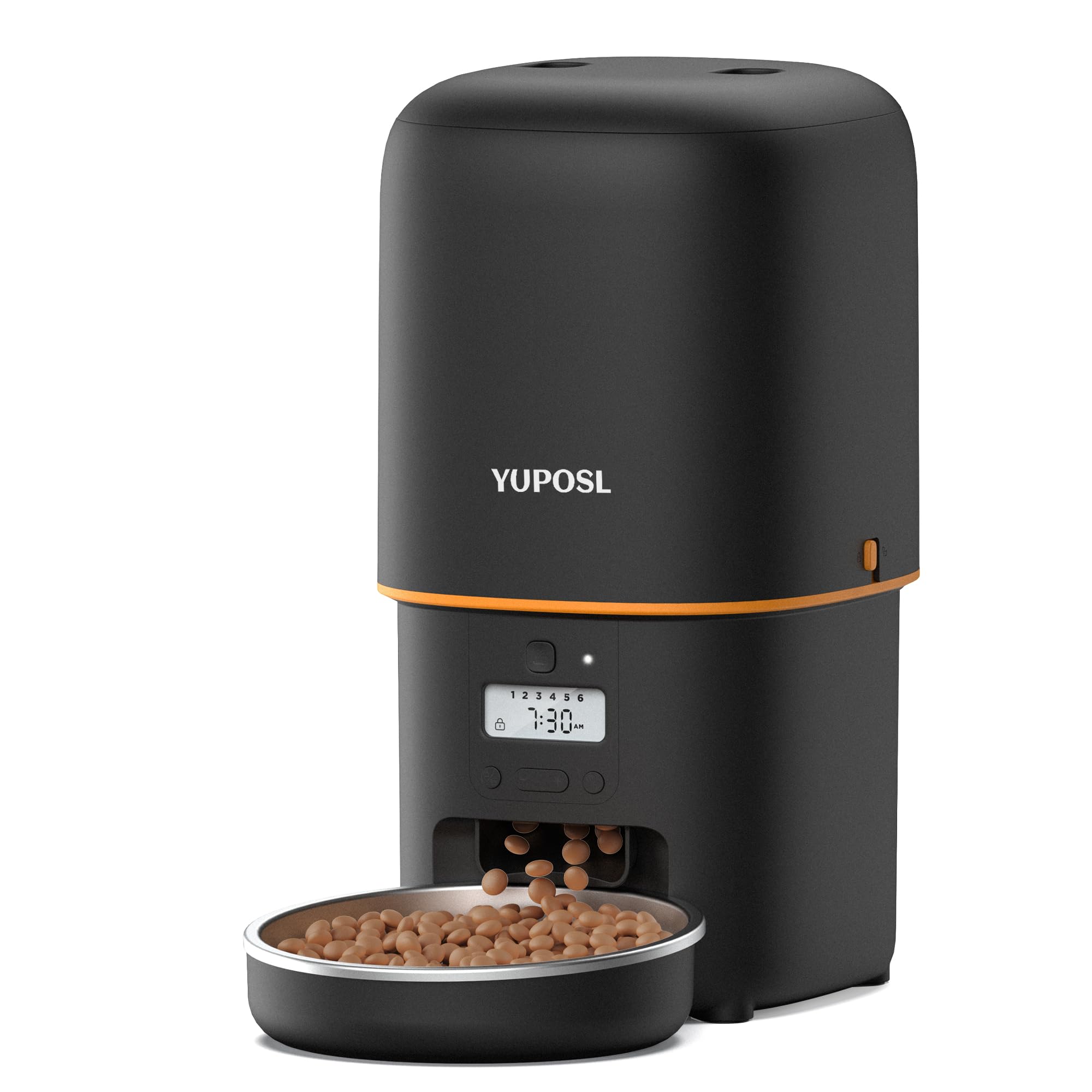
Yuposl's pitch is the seal. A silicone rotor and a spring-lock lid are meant to keep a clever dog out of the hopper and the kibble fresh between meals, and the stainless bowl is a step up from the plastic trays most feeders at this level use.

The schedule is refreshingly plain: one to six meals a day, portions set on the LCD, no account to create and no app to keep updated. Power comes from an adapter or three D batteries, which the listing rates at more than 180 days — long enough that changing cells should be an annual chore rather than a monthly one.

Where it gives ground is the portion. Increments are small, so a real meal takes several of them, and the first week is a calibration exercise rather than a setup. Once it's dialed in, the seal is the reason to choose it over the cheaper feeders: this is the one we point to when the problem is a dog who has learned to open a hopper, rather than a schedule that needs micromanaging.

Bottom line: We recommend the Yuposl for dogs that raid the hopper: a spring-lock lid, a sealed rotor, and a stainless bowl, plus six meals a day set on a plain LCD.

How We Tested Automatic Dog Feeders

We started by pulling every feeder we could find that met a basic bar: a hopper holding at least a few days of food, portions adjustable in small increments, and some form of battery backup or memory so a power blip doesn't wipe the schedule. From there we narrowed by price, counter footprint, and whether programming could be done on the unit itself or required an app. Eleven made the cut, and they ran in real homes for seven months, feeding dogs from a 12-pound terrier mix to a 70-pound Lab at their normal meal times.

Setup was timed with a stopwatch and no manual for the first ten minutes: how many steps to the first scheduled meal, and whether I could fix a mistyped meal time without starting over. For portion size, I weighed every dispensed meal on a kitchen scale across ten consecutive feeds at both the smallest and a mid-range setting, then logged the spread. Programmability got the same treatment — four meals a day, one of them at 2 a.m., plus a check for clock drift after a week.

Reliability testing was mostly unkind. I unplugged each feeder mid-cycle, pulled the battery backup, and timed how long the settings survived; I also filled hoppers with a mix of small and large kibble to see which augers choked. Durability came down to seven months of daily wear — bowl and hopper washed weekly, lid latches opened twice a day, seals checked for cracking. Food capacity got measured in days rather than cups, based on the actual dog's portion, and I noted how much counter the base ate up. Value was the last call: what the feeder did reliably against what it cost, not what the box promised.

How to Choose Automatic Dog Feeders

Timed or gravity: decide how much control you want

A timed feeder holds kibble in a hopper and drops a set amount at set times. That's the right machine if your dog is on a measured diet, eats too fast, or needs a day split into smaller meals — and it's the only way to keep a schedule while you're out. A gravity feeder lets kibble fall into the bowl as your dog empties it: no portion control at all, but also no motor, no clock, and very little to fail.

We reach for gravity for free-fed dogs, weekend top-ups, and outdoor setups, and for a timed unit everywhere else. If your dog has ever been put on a diet by a veterinarian, gravity isn't the answer — it's a bottomless bowl.

Read the portion settings, not the meal count

Six meals a day sounds generous until you learn that a portion is a small drop. Increments vary widely between models: on some, a proper dinner for a 30-pound dog takes a double-digit number of portions, which is fine once it's programmed and maddening while you're setting it up.

Work out what your dog eats in cups, then check that the feeder's smallest and largest portions can land near that number. And calibrate rather than trust the display: run a test dispense into a measuring cup on day one and compare it with the bowl you'd normally put down.

Power is the reliability question

A timed feeder that loses power loses the schedule, so look for an adapter with a battery bay behind it — the Voluas and the Andoll both run that way — and treat the cells as part of the routine rather than an emergency measure.

Battery-only models like the Roffie free you from cords and outlets, which matters if the feeder lives somewhere a puppy can reach a cable, but fresh cells then become a chore you schedule. Gravity feeders need no power at all, which is why they turn up in kennels and barns.

Match the hopper to your week

Capacity is days of food, not a spec-sheet boast. Three to four liters is several days for a small or medium dog and a short runway for a big one; seven liters covers a longer trip, and 50 pounds of steel is a kennel-sized answer.

The trap is that a full hopper is only half the job. An empty water bowl, a bridged chute, or a door that won't shut undoes all of it, so however big the hopper, plan a check-in for anything longer than a long weekend.

Size, stability, and a lid your dog can't open

A feeder is furniture with food in it, so measure the corner before you buy and think about what a determined dog will do to it. Light units slide and tip; a raised base, a corner, or a wall fixing solves most of it.

Lid security matters more than it sounds. Spring-lock lids and sealing rotors are what stop a clever dog helping itself at 2 a.m., and on a gravity set the magnetized door is what keeps rodents out of the food. Stiff lids are the price of that security, and worth paying.

Frequently Asked Questions

Final Verdict

The Voluas is the feeder we recommend first. Adapter power with a battery backup means an outage doesn't cost a meal, four programmable meals cover most routines, and the recurring complaint is portion size rather than a feeder that didn't fire.

If your dog is at the bigger end, or you're away often enough that refills matter, the Roffie's 29-cup hopper and two-year warranty justify the step up — just put fresh batteries on the calendar. Feeding happens outdoors in a run, and nothing here beats 50 pounds of galvanized steel.