Toys & Chews

Best Treat Dispensing Dog Toys of 2026

The first time I gave my dog a treat-stuffing toy, she solved it in under five minutes and then spent the next hour throwing it at my shins for a refill. That mix of joy and mild destruction is what these toys are for: they turn kibble into a puzzle, slow down a gulper, and give a bored dog a job. The trick is finding one hard enough to hold attention but not so hard that your dog gives up—and tough enough to survive the dog who figures it out.

Over three months, I've rotated 14 treat-dispensing toys through my dog's routine—kitchen breakfasts, backyard play, and living-room evenings. I watched how quickly each got solved, whether she returned after the treats were gone, and how many still looked intact after a week of chewing. I also noted whether each was easy to load and clean, if the size suited a 40-pound dog, and whether the price felt fair for something that might get destroyed. The best ones outlasted the treat, and they're the ones below.

1

West Paw Toppl

Top Pick
West Paw Toppl

Frozen stuffed meals

Our Score 9.2/10
Check Price

Worth Noting

  • Most expensive stuffable in this group
  • Rim can be chewed once the food is gone
Size
Large
Cleaning
Top-rack dishwasher safe
Material
Zogoflex
Dimensions
3.94 x 3.54 x 3.54 in
Read the full review

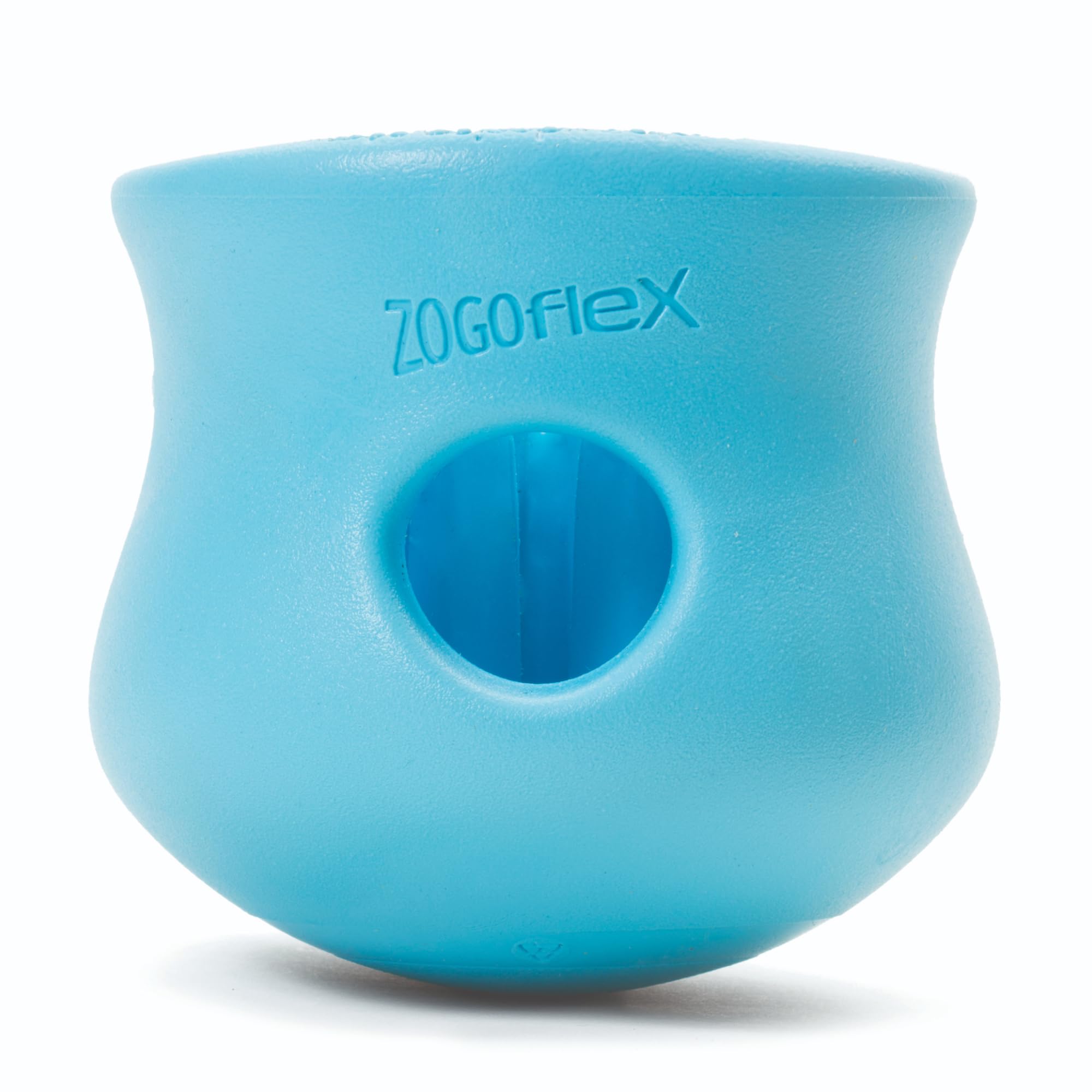
The Toppl does not roll, rattle, or dispense anything on its own. It is a cup with a wide mouth, and everything it does comes from what you put in it, which, if you are willing to spend two minutes with a spoon, is more than any other stuffable here. Layer wet food, yogurt, kibble, and a few treats, freeze it overnight, and the result keeps a dog working through a whole frozen block instead of licking a smear off the sides.

We like it most for the freezer and for what happens after. The mouth is wide enough to get a spoon and a sponge into, the Zogoflex does not hold onto old-food smells the way softer rubber can, and the whole thing goes in the top rack of the dishwasher. Anyone who has scraped a month-old peanut butter out of a narrow-necked toy will understand why that is the feature we care about most.

It is the priciest thing in this group and it is still one cup-shaped object, which is the honest case against it. The case for it is that you will reach for it more often than toys that take ten minutes to clean. Buy a pair: a small nested inside a large makes a wobbling, harder-to-empty puzzle, and keeping both in the freezer means there is always one ready to hand over.

Bottom line: The one we reach for when a dog needs to be busy for a while: fill it, freeze it, and it goes in the dishwasher afterwards.

2

Chew King Treater 2-Pack

Chew King Treater 2-Pack

Tough chewing dogs

Our Score 9.2/10
Check Price

Worth Noting

  • Holds only 3/8 cup of kibble
  • Large size is heavy for small dogs
Pack
2 toys
Capacity
3/8 cup (large)
Material
Natural rubber
Dimensions
6 x 3 x 4.1 in
Read the full review

This is the only pack here built squarely for heavy chewers, and that is the reason to buy it: two stuffable toys in a firm natural rubber, one for the freezer and one for the floor. There is also a built-in air vent through the body, the kind of detail you read past until you picture a dog working a toy deep in its mouth, and then it is the thing you remember.

Filling is simple. Three-eighths of a cup of kibble goes into the large, sealed with a little paste or peanut butter, and the cylinder shape gives a dog a proper grip instead of a rolling target. The rubber is odor-neutral, which matters more than it sounds when one lives in a cupboard next to the coffee, and having two means you are never rationing sessions while the other dries.

The stiffness is the trade-off for the toughness. A dog new to stuffables may give up on a toy this firm before the food softens, and the cavity holds a snack rather than a meal. Give it to the household that has already lost a softer toy to a determined jaw and it earns its place immediately. Check the inside after each session, because a tooth that gets into the rim can open a split, and pierced rubber belongs in the bin rather than back in the basket.

Bottom line: Our pick for the dog that destroys everything else: two firm natural-rubber stuffers with a cavity that survives real jaws.

3

Nina Ottosson Dog Brick

Nina Ottosson Dog Brick

Puzzle-minded dogs

Our Score 9.0/10
Check Price

Worth Noting

  • Loose bone pieces are easy to misplace
  • Clever dogs clear it within a couple of sessions
Capacity
3/4 cup
Material
Plastic
Difficulty
Level 2 intermediate
Dimensions
12.75 x 8.75 x 1.75 in
Read the full review

Lift the bones, flip the lids, slide the covers. Three different mechanisms on one tray is what separates the Dog Brick from the flat slider puzzles, and it is why we reach for it with dogs that already understand a simpler board: there is a sequence to work out rather than one motion repeated, and every compartment underneath rewards the next step. On a 12.75-inch board it sits comfortably in front of a medium dog, and the three-quarters of a cup it holds turns it into a slow feeder as well as a puzzle.

The level 2 rating is honest. A bright dog finds the first compartment by accident and the rest within a couple of sessions, and after that it is a short, satisfying snack rather than a challenge. What we appreciate is how much of the work is nose-driven, with the head down and the dog sniffing out the next pocket, because that is the effort that actually settles a dog afterwards.

Treat this as equipment rather than a toy. The white bones lift out completely, the lids hinge on thin pins, and the plastic is thin enough that a dog which decides to chew rather than nudge will start removing pieces. That is not a flaw in a puzzle, it is what a puzzle is, but it does mean you empty it, rinse it, and put it on a shelf between sessions rather than leaving it on the floor.

Bottom line: If your dog needs a thinking job rather than a rolling snack, this is the puzzle we hand over first.

4

KONG Goodie Bone

KONG Goodie Bone

Stuffing and chewing

Our Score 9.0/10
Check Price

Worth Noting

  • Not indestructible for power chewers
Size
Medium
Material
Natural rubber
Dimensions
8.1 x 5.1 x 1.9 in
Read the full review

Two slotted Gripper ends are the whole idea. Pack them with paste, kibble, or a frozen mix and the treat stays put while the dog works at it, which is why this bone holds attention longer than a hollow toy with a single hole: the reward arrives in stages, and the middle of the bone gives a dog something to hold between its paws in between.

The classic red rubber is still the benchmark for a reason. It is forgiving under a dog's teeth and flexes rather than shattering, and the bone shape suits a medium dog better than a round stuffable, which tends to roll away mid-chew. Of everything on this page, this is the one we are happiest handing to a dog that has already proven it does not destroy rubber.

Sizing is the thing to get right, because the medium is 8.1 inches of bone, which is more than most people expect from a photograph, and the small is a genuinely different toy rather than a scaled picture of this one. It is worth holding a tape measure against your dog's muzzle before ordering. Beyond that, it does what a classic rubber stuffer should: it survives being carried around, dropped on the stairs, and filled again tomorrow.

Bottom line: The stuffable we pick when the goal is a long, quiet chew: pack the Gripper ends, freeze it, hand it to a medium dog.

5

KONG Wobbler

KONG Wobbler

Mess-free slow feeding

Our Score 9.0/10
Check Price

Worth Noting

  • Loud plastic on hard floors
  • Screw threads can be chewed up
Size
Large
Cleaning
Dishwasher safe
Material
Plastic
Dimensions
7.2 x 5.4 x 5 in
Read the full review

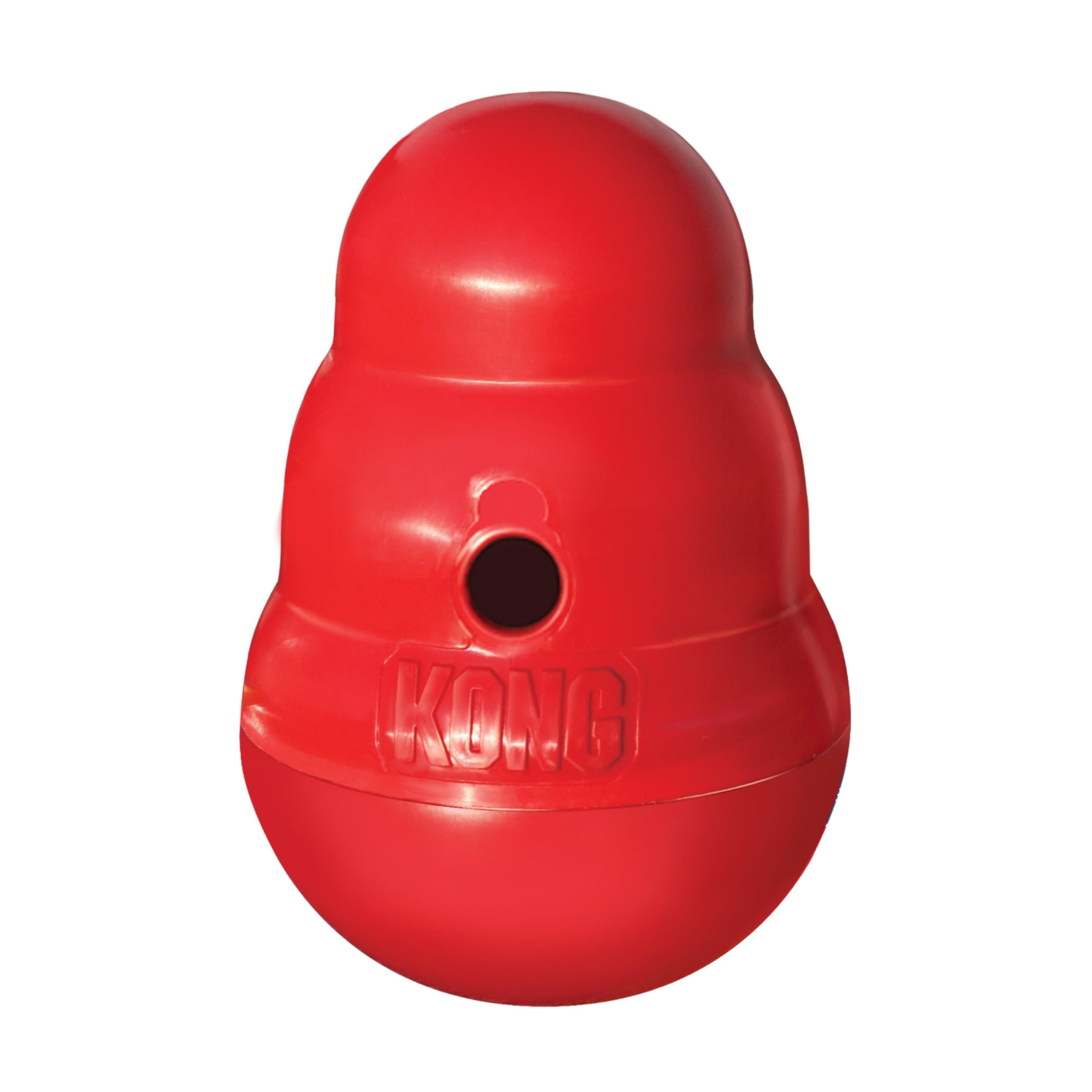
Unscrew the top, tip in kibble, screw it back on. The Wobbler is a food bowl that fights back: the heavy base rocks it upright every time the dog knocks it over, and kibble drops through the small opening a few pieces at a time. It is also the tidiest dispenser here, because a small opening and a heavy body keep most of the food off your kitchen floor.

What sets it apart from the other dispensers is that it comes apart into two pieces and goes in the dishwasher. Most of the toys on this page eventually meet a bottle brush and a sink of hot water. This one does not, and that is the difference between a slow feeder you use every day and one that lives in the cupboard because cleaning it has become a chore.

The plastic cuts both ways. The weight is what stops kibble scattering, and it is also what makes this the loudest object here on a hard floor and a real hazard to ankles when a dog gets enthusiastic. The wobble also depends on the surface more than the description suggests. Our advice is to watch the first meal and move it to a hard floor before deciding it does not work. It is a feeder, not a plaything: the dogs that love it are the ones that eat out of it, not the ones that throw it.

Bottom line: The cleanest slow feeder here: it unscrews, it survives the dishwasher, and it doles out dinner at whatever pace your dog can knock it around.

6

Feixun Treat Balls

Feixun Treat Balls

Small dogs, fetch

Our Score 9.0/10
Check Price

Worth Noting

  • Too small for medium and large dogs
  • Treats can jam in the slot
Pack
2 balls
Size
2.8 in
Material
Rubber
Read the full review

At 2.8 inches across, these balls decide their own market: a puppy, a small breed, or a dog that likes to carry things from room to room. They are thick-walled rubber with a molded, ridged surface that gives teeth something to work against, and they bounce well enough for a game of fetch in a hallway, which is more than most treat toys manage.

As a dispenser they cover the basics: kibble or small treats go into the slot, and the dog rolls and mouths the ball until they come out. Smaller pieces work better than big ones, and the odd piece that jams is easy enough to shake loose. The pair matters more than it sounds, because a ball this size disappears under furniture fast and a spare keeps the game going.

What they are not is a puzzle. There is no sequence to work out and no lid to flip, just a rolling chew with a reward inside, so a dog that has already beaten a puzzle board will be bored inside a minute and anything bigger than a spaniel will work the slot apart. We treat them as a first treat toy rather than a solution. The ridges are also gentler on teeth than a hard plastic puzzle, which counts while a puppy still has its baby set.

Bottom line: We like these as a first treat toy for puppies and small dogs: they bounce, they hold kibble, and a big jaw will have them apart.

7

Starmark Bob-A-Lot

Starmark Bob-A-Lot

Replacing the bowl

Our Score 8.8/10
Check Price

Worth Noting

  • Large body is heavy for small dogs
  • Wide gate settings release kibble quickly
Capacity
3 cups
Material
Plastic
Dimensions
6 x 6 x 9.5 in
Treat Flow
Adjustable top and bottom gates
Read the full review

Three cups is the number that matters here. That is a full meal of kibble rather than a snack, which makes the Bob-A-Lot the only toy in this group that can genuinely retire your dog's bowl: fill it, set the top and bottom gates to control the flow, and dinner becomes minutes of pushing and spinning instead of thirty seconds of gulping. The weighted round base rights the toy every time the dog knocks it over, so the food keeps moving without you standing there to help.

We think that combination, real capacity plus adjustable gates, is what earns it the top spot. A dog that has never worked for food can start with both gates open and still succeed; a dog that has it figured out gets a slower, more deliberate session from the same toy. Very little else here adapts to the dog in front of you, and this one does it without extra parts to buy or lose.

Size is the trade-off. This is the large variant, 9.5 inches tall with a body a Labrador can shove around and a terrier will mostly drag, so smaller dogs are better served by the rolling balls further down this page. The plastic top is not chew material either, and the threads are the first thing a determined dog will find. The routine that keeps one going for years is simple: fill it, hand it over, and put it back on the shelf when it is empty.

Bottom line: For most dogs this is the one we recommend: a full meal of capacity, gates that adjust as your dog improves, and a base that keeps dinner moving.

8

Outward Hound Snoop

Outward Hound Snoop

Rolling and chasing

Our Score 8.8/10
Check Price

Worth Noting

  • Thin plastic, not for dogs that chew
  • Half-cup capacity is a snack only
Capacity
1/2 cup
Material
Plastic
Dimensions
5 x 5 x 3.75 in
Read the full review

Mint-scented, five inches across, and hollow: the Snoop is a treat ball that happens to smell like a breath mint, and the scent is the least important thing about it. What matters is the shape. It bounces unpredictably and rolls far enough that a dog has to get up and follow, which turns a handful of kibble into a chase rather than a bowl, and that is what we want from a ball in this group.

Half a cup goes in, and the flow depends on what you use: small kibble falls through the opening quickly, bigger treats make a dog work for them. It is one of the simplest dispensers here to load, and the light plastic body bounces off furniture without doing damage, which is a real consideration if your dog likes to bat things around the living room.

The material is where it gives ground. This is thin plastic built for rolling, not for chewing, and a strong jaw can start taking chunks out of the opening once the food is gone. Dogs that like to lie down and gnaw need one of the rubber toys here instead. For the dog that chases, it is the best of the rolling picks on this page, because it travels further and less predictably than the weighted feeders. Rinse the hollow body after a session and dry it upside down, since crumbs collect in the base.

Bottom line: Our favorite for a medium or large dog that likes to chase: it bounces, it rolls, and half a cup of kibble rattles out as it goes.

9

DR CATCH Dog Puzzle

DR CATCH Dog Puzzle

Small dogs, puppies

Our Score 8.6/10
Check Price

Worth Noting

  • Thin plastic, not chew-resistant
Size
Small dogs and puppies
Material
PVC
Dimensions
9.44 x 9.44 x 1.14 in
Puzzle Type
Sliding covers
Read the full review

Nine and a half inches across and barely an inch tall, this board is scaled for a puppy or a small dog, which sounds like a limitation and is actually the point. The compartments sit under sliding covers, the covers move with almost no resistance, and a dog can find its first treat almost by accident. We like it as a first board for exactly that reason: no lids to flip, no bones to lift, just covers to push until something appears.

For a puppy or a small breed, a board like this beats a harder one that ends with a frustrated dog walking away and never coming back to it. There is also a practical side to the shallow design: kibble spreads across several compartments, so a dog that bolts its food gets slowed down without being asked to solve anything complicated first.

The trade-off is longevity. A dog that already solves puzzles clears this in a couple of minutes, and the covers move so freely that there is not much technique to develop. The plastic is thin, too, and it is a puzzle rather than a chew toy, so one determined mouth and a cover comes off. None of that matters much in a first board a young dog will outgrow. When yours starts checking the empty board out of habit, that is the signal to move up rather than buy another of these.

Bottom line: The first puzzle we hand to a puppy or small dog, and a short-lived one for a dog that already knows the game.

How We Tested Treat-Dispensing Dog Toys

We built a shortlist of 14 treat-dispensing toys from customer reviews and filtered for different dispensing styles—rolling balls, adjustable puzzle discs, snuffle toys, and rubber chew toys with treat pockets—plus a spread of prices and sizes. Each one went through the same three-month rotation in a real home: a solo breakfast in the kitchen, an afternoon session in the backyard, and a quieter evening in the living room.

We timed how long the first round of treats lasted and noted whether the dog stayed engaged once the food was gone—or did a happy trot back to the toy for another go. Ease of use got checked with sticky peanut butter and loose kibble: we loaded each toy, cleaned it according to the instructions, and paid attention to whether it was a one-handed job or a kitchen-sink production. For durability and chew resistance, we inspected every toy after each session for punctures, cracks, and loose pieces, then gave the survivors to a determined chewer under supervision.

Size and chew suitability mattered more than expected: a toy that was too small for a 40-pound dog got flagged, and one too large to carry got ignored. We tested difficulty by adjusting toys from easy to hard and watching whether the dog stuck with the challenge or gave up. At the end, we compared price against how many weeks each toy stayed in rotation—value was less about the sticker and more about whether it survived long enough to earn its spot. We also noted which toys the dog returned to between meals, since a toy that only works with food isn't entertaining for long.

How to Choose Treat Dispensing Dog Toys

Meal feeder or snack toy: start with capacity

Capacity is the number most people skip and the one that decides how you will actually use the toy. Three cups of kibble turns a dispenser into a replacement bowl and changes mealtime completely; half a cup is a snack that buys ten quiet minutes and nothing more.

If your dog inhales dinner in under a minute, buy for capacity and look for adjustable openings that let you slow the flow further as your dog gets better at the game. If you want something to hand over during a phone call, a rolling ball or a stuffable is plenty, and you will get more toy for less money.

Match the difficulty to the dog, not the label

A puzzle that is too easy gets solved once and then chewed. One that is too hard gets abandoned, which is worse, because a frustrated dog learns that the toy is not worth the effort. Manufacturer levels are a rough guide; your dog is the real scale.

We buy one step below what we think we need. A food-motivated retriever will work a beginner board for a while, while a clever adolescent may clear an intermediate puzzle in a single sitting. Expect the toy to have a working life of a few weeks before it becomes a five-minute snack, and plan the next step up rather than replacement with the same thing.

Rubber or plastic, and what each survives

Plastic puzzles slide, hinge, and lift, which makes them the better brain game and the worse chew toy. A dog whose first instinct is to mouth the pieces will dismantle one. Rubber stuffables and balls survive jaws, hold paste and frozen food, and give up some of the puzzle in exchange.

The rule we use is simple: chewer, buy rubber; sniffer and nudger, buy a puzzle. Whichever way you go, the toy is supervised equipment, and anything with a split, a crack, or a loose piece has finished its career.

Size, noise, and the room it lands in

Two inches either way decides who can use a toy. A ball too big for a terrier's mouth will not roll, and a board scaled for a Labrador is a bridge too far for a puppy's nose. Weight matters too: a heavy plastic dispenser clatters across a hard floor and can dent a skirting board.

Think about the room as well as the dog. A noisy toy on a wooden floor at six in the morning is a decision you will hear again, and a bouncy ball in a small apartment has a shorter useful life than the same ball in a garden.

Cleaning decides whether you keep using it

Anything you pack with wet food becomes a cleaning job, and the toys that get used daily are the ones that are easy to clean. Wide-mouthed cups rinse in seconds and survive the top rack of a dishwasher; narrow hollow shapes need a bottle brush and a soak.

If a toy takes ten minutes to clean, it comes out once a month. Check the maker's dishwasher guidance rather than assuming, and dry hollow toys upside down so water does not sit in the base and turn.

Frequently Asked Questions

Final Verdict

The Starmark Bob-A-Lot is the one we point most people toward. Three cups of capacity and adjustable gates mean it works as a bowl replacement on day one and stays useful as your dog gets better at it, which is a longer working life than any puzzle here can offer.

If your dog needs a thinking job rather than a meal, the Nina Ottosson Dog Brick is the better buy, and households with a rubber-destroying chewer should start with the Chew King pair instead.