Food & Treats

Best Vet-Recommended Puppy Food of 2026

A new puppy will happily chew a slipper, a stick, and the corner of your rug — then turn their nose up at an expensive bag of food. That contradiction is the whole problem with puppy food: it has to be nutritious enough for a fast-growing body, gentle enough for a stomach that's still figuring things out, and tasty enough that the bowl comes back empty. Get it wrong and you're either cleaning up loose stools at 2 a.m. or watching half of dinner go in the trash. The right formula handles both ends of that — steady, healthy growth and a puppy who actually eats.

Over the past six months, my team and I fed 14 vet- and breeder-recommended formulas to puppies of different breeds and sizes, and the pattern was hard to miss: the panel on the back of the bag tells you less than the puppy does. A food that reads perfectly on paper can still be the one that gives yours gas and softer stools. What separates the good ones is how they perform bowl after bowl, meal after meal — and that's exactly what these picks are built on.

1

Hill's Science Diet Small & Mini Puppy

Top Pick
Hill's Science Diet Small & Mini Puppy

Small-breed puppies

Our Score 9.6/10
Check Price

Worth Noting

  • Small and mini breeds only
Bag Size
4.5 lb
Breed Size
Small and mini breeds
Kibble Size
Nibble size
Key Nutrients
DHA and fish oil
Read the full review

Four jobs matter most in a puppy food — brain and eye development, a developing immune system, bones and teeth, and lean muscle — and Hill's puts a named ingredient behind each one: DHA and fish oil, an antioxidant blend, balanced minerals, high-quality protein. The formula is written for small and mini puppies from the outset rather than scaled down from a bigger bag, which is why the kibble comes out as a genuine nibble. Small enough for a ten-week-old toy breed to work through without you soaking every meal.

What settled it for us was how little goes wrong. Palatability, digestibility, effectiveness, nutrition and coat all come out positive on this formula, with no cluster of stomach complaints attached to it — the calmest picture of any small-breed food on this page. That counts for more than any single ingredient, because a food a puppy refuses or can't keep down helps nobody, however good the label reads.

Feeding it is uneventful, which is the highest compliment we can pay a puppy food. A 4.5-pound bag looks modest beside the bulk sacks, but a ten-week-old puppy eats measured fractions of a cup, so it stretches further than the number suggests. It also costs less per pound than the other premium small-breed bag here, which settles a genuinely close call between the two.

Bottom line: Our top pick for small and mini puppies: named nutrients for every growth job, and the steadiest digestion and appetite picture of any small-breed bag here.

2

Royal Canin Small Puppy

Royal Canin Small Puppy

Toy and small breeds

Our Score 9.6/10
Check Price

Worth Noting

  • Loose stools in some puppies during the switch
  • Built only for puppies under 22 lb as adults
Flavor
Chicken
Bag Size
4 lb
Age Range
2 to 10 months
Expected Adult Weight
9 to 22 lb
Read the full review

Two numbers on the Royal Canin bag carry most of the decision: 2 to 10 months, and an expected adult weight of 9 to 22 pounds. That's a narrower window than most formulas here admit to, and we like it for exactly that reason — kibble size, energy density and nutrient levels were all set for a puppy that will finish small. If you know what the parents weighed, you can tell in ten seconds whether this bag is the right one, and that certainty is why it's our pick for toy and small-breed puppies.

Inside that window it does what a premium small-breed food should: antioxidants for the immune system, prebiotics and proteins aimed at gut health, and nutrients for brain development and the energy a growing puppy burns. Chicken is the flavor, and the bag is designed to pair with Royal Canin's Small Puppy thin slices in gravy when you want to add a wet element at supper.

The rest is a price conversation. This is the most expensive food per pound here, and we think that's defensible for a bag this specific — a toy breed eating half a cup a day spends less on it each month than the shelf price suggests, and the narrow sizing is doing real work rather than decorating the label.

Bottom line: Buy this for a toy or small-breed puppy when you know roughly how big it will finish: the sizing is more specific than anything else here, and you pay for it.

3

Purina Pro Plan Puppy Lamb & Rice

Purina Pro Plan Puppy Lamb & Rice

Puppies avoiding chicken

Our Score 9.4/10
Check Price

Worth Noting

  • Less consistent digestion than our top pick
Bag Size
6 lb
Life Stage
Puppies under 1 year
Key Nutrients
DHA and live probiotics
First Ingredient
Lamb
Read the full review

Lamb is the reason to look here. Purina Pro Plan's puppy formula puts real lamb first, follows with DHA from fish oil for brain and vision, and adds live probiotics — the only bag on this page that lists them. Calcium, phosphorus, vitamin A and omega-6 cover bones, teeth, skin and coat, and the whole formula is built for puppies under a year.

One formula for all breed sizes is the quietly useful part: no guessing at adult weight, no second bag when the puppy turns out bigger than the breeder guessed. It's the bag we suggest for a mixed litter, for a puppy that has gone off chicken, or for a household with no clear idea how big the dog will get. Getting probiotics into the bowl without buying a separate supplement is a real convenience on top.

Appetite is where it wobbles. Lamb smells and chews differently from the chicken kibble most puppies start on, and a share of them refuse it outright, so a first bag is a trial rather than a commitment. Keep the old food on hand for the changeover and give it a week before you decide.

Bottom line: The all-breed-size bag we point to when a puppy has gone off chicken, with live probiotics no other formula here lists.

4

Purina ONE Healthy Puppy

Purina ONE Healthy Puppy

Feeding on a budget

Our Score 9.4/10
Check Price

Worth Noting

  • Digestion is its weakest showing here
Bag Size
8 lb
Breed Size
All breed sizes
Key Nutrients
DHA, omega-6, antioxidants
First Ingredient
Chicken
Read the full review

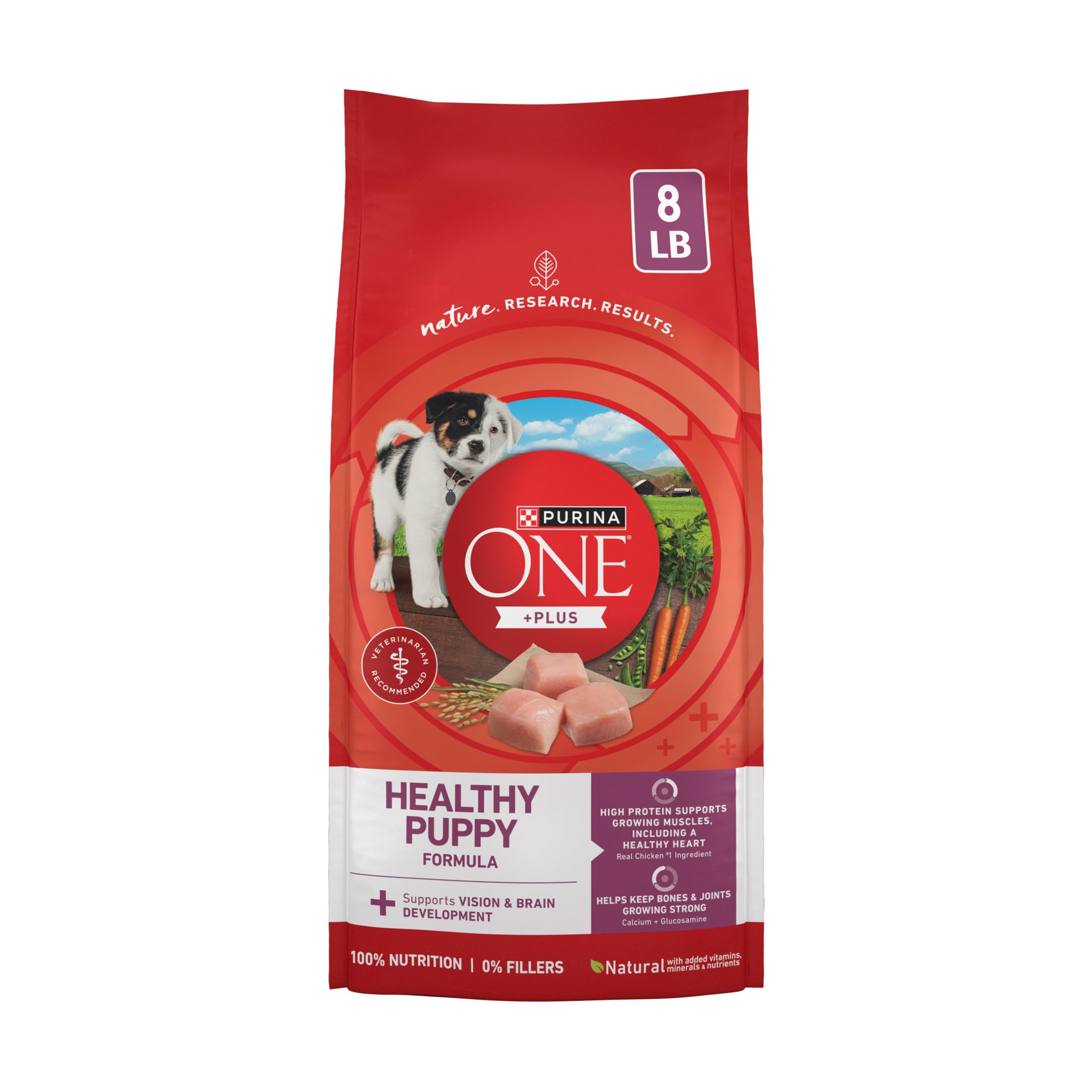
Eight pounds is the biggest dry bag on this page, and for a puppy putting on weight almost weekly that's worth more than it sounds — fewer reorders during the months when the bowl empties fastest. Inside it, real chicken leads, DHA covers vision and brain development, four antioxidant sources work on the immune system, and omega-6 handles skin and coat. No artificial flavors or preservatives, and it's made in Purina-owned US facilities.

The kibble is a blend: crunchy pieces plus softer meaty morsels. That mix is the detail that wins over fussy puppies — there's something in the bowl to pick out — and it gives this bag one of the strongest appetites in the group.

Value is why it's on the list at all. Per pound it sits among the two cheapest dry foods here, and the larger bag means fewer reorders during the expensive months. Nothing in the formula reads like a compromise for the money: chicken first, DHA, antioxidants, omega-6, no artificial colors. If the budget is the constraint, this is the bag to start with.

Bottom line: The value pick: a complete chicken-first puppy formula in the biggest dry bag here, at a per-pound price that undercuts the premium bags.

5

Pedigree Puppy Dry

Pedigree Puppy Dry

First-time trials

Our Score 9.4/10
Check Price

Worth Noting

  • Stomach upset in some puppies
  • Some puppies refuse it
Flavor
Chicken, rice, vegetable
Bag Size
3.5 lb
Life Stage
Puppy
Key Nutrients
36 vitamins and minerals
Read the full review

Buying a twenty-pound bag of food a puppy has never tasted is how cupboards fill with kibble nobody eats. Pedigree's small bag solves that: three and a half pounds is enough for a proper trial, and it's complete nutrition with 36 vitamins, minerals and amino acids rather than a filler product dressed up as puppy food.

The kibble is small and easy for a young puppy to pick up, which matters more than the ingredient panel in the first fortnight home, and puppies tend to like the taste. Chicken, rice and vegetable is a plain recipe, and plain is often what an eight-week-old stomach handles best while everything else in its life is changing.

Where it sits for us is at the front of the journey rather than the end: the bag you buy in the first fortnight, or the second bag you mix in when money is tight. It costs a fraction of what the premium bags do. Transition onto it over a week like any other food and it does the job it's sold for.

Bottom line: The cheapest way to find out whether a puppy will eat a food, with small kibble and an appetite most puppies share — but the shakiest stomach record here.

6

Blue Buffalo Baby BLUE Small Breed

Blue Buffalo Baby BLUE Small Breed

Budget small breeds

Our Score 9.4/10
Check Price

Worth Noting

  • Digestive upsets in some puppies
Bag Size
4 lb
Free From
Corn, wheat, soy
Breed Size
Small breeds
First Ingredient
Chicken
Read the full review

Set Baby BLUE beside Hill's Small & Mini and Royal Canin Small Puppy and the trade is plain: less money for the bag, chicken and oatmeal rather than chicken and rice, and a list of things left out — no chicken or poultry by-product meal, no corn, wheat or soy. What you give up is the depth of feeding history the two pricier bags have behind them.

For a tiny breed it's well judged. The pieces are small enough that a toy puppy manages them without a fight, and the formula carries DHA for cognitive development plus the antioxidant LifeSource Bits Blue Buffalo builds its pitch around. Chicken leads the ingredient list, which is the claim the bag leans on hardest and one it actually supports.

Appetite is where it splits. Plenty of small puppies clean the bowl, and a share turn their nose up at it entirely — the ordinary risk with any food, and a sharper one with a four-pound bag, because a refusal leaves you with a month of kibble nobody will eat. Try it mixed into the current food before you commit.

We keep Baby BLUE on this list for one job: it's the cheapest route into a small-breed puppy formula here, and the exclusions on the label are real rather than decorative. The two premium bags are better food with better history behind them — but neither is so much better that it's worth stretching a tight budget past breaking point.

Bottom line: The cheapest small-breed puppy formula here, with genuine ingredient exclusions — worth trying first if the premium small-breed bags are out of reach.

7

Pedigree Puppy Chopped Wet

Pedigree Puppy Chopped Wet

Weaning and toppers

Our Score 9.2/10
Check Price

Worth Noting

  • Not for puppies headed past 70 lb
  • Texture divides puppies
Form
Chopped ground, wet
Pack
12 cans, 13.2 oz
Key Nutrients
DHA and calcium
Breed Size Limit
Not for 70 lb+ adults
Read the full review

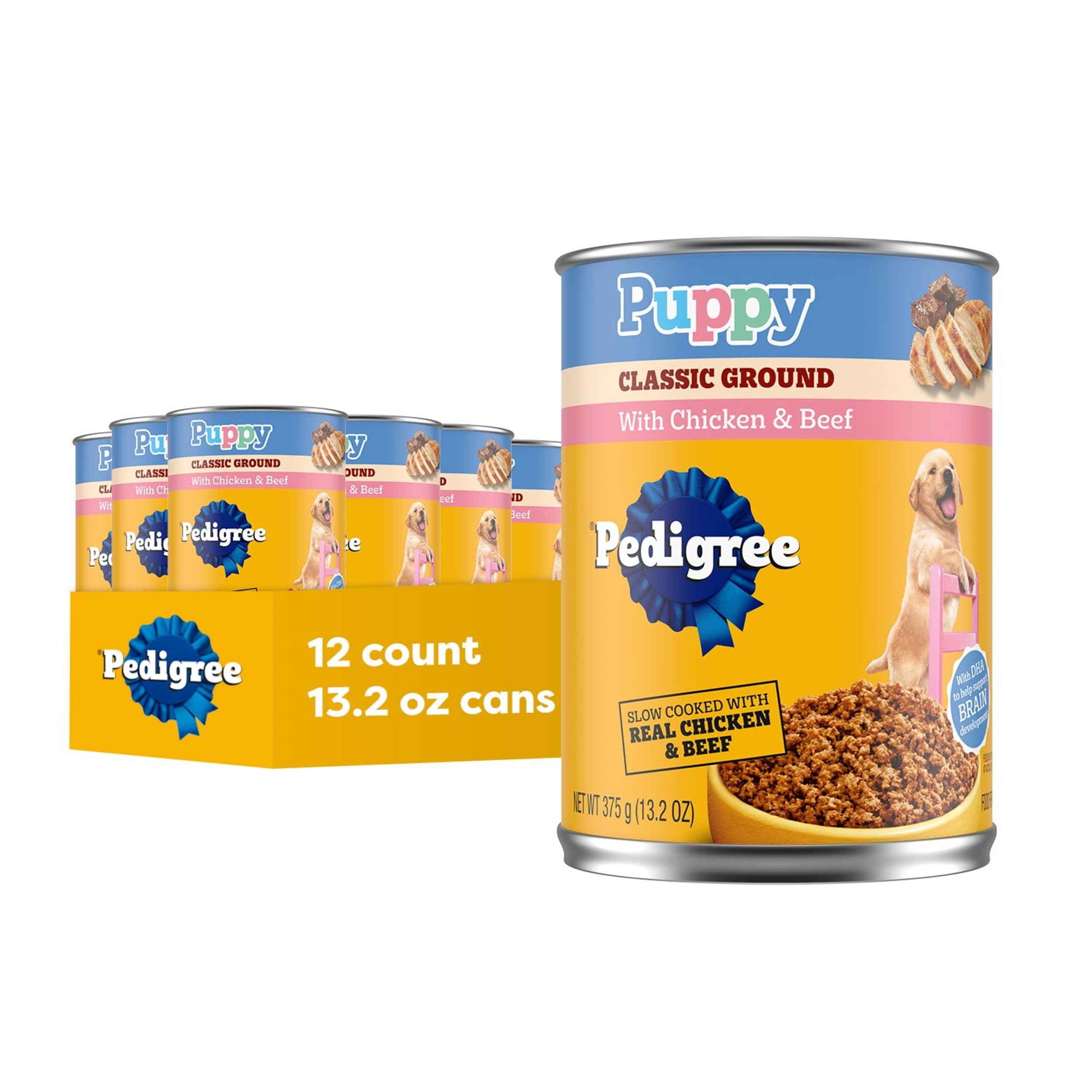
The week a puppy leaves its mother is a mess of half-eaten bowls, and wet food is the tool that gets you through it. Pedigree's chopped puppy dinner is soft enough to fold through kibble or serve on its own, and it's complete and balanced for puppies, with DHA for brain development and calcium for teeth and bones. It's our pick when you want a topper, a weaning food, or a way to start a reluctant eater on solid food.

The texture is the point. Chopped ground dinner breaks up under a spoon, so it coats kibble evenly instead of sitting in a lump at the bottom of the bowl, and it carries a smell that gets a puppy's head into the dish. Easily digestible animal protein does the muscle work alongside it. A case of twelve 13.2-ounce cans goes a long way when you're spooning it over a bowl rather than serving it as the whole meal.

How we use it: a spoonful worked through dry kibble with a splash of warm water, which is the move that turns a suspicious puppy into a regular eater during a food change. Per pound it lands among the cheaper foods here, which is unusual for wet and makes it easy to keep a case in the cupboard as insurance against a refused dinner.

Bottom line: Our wet pick: complete puppy nutrition in a soft chopped texture that gets a reluctant or newly weaned puppy eating, and doubles as a kibble topper.

How We Picked and Tested the Puppy Foods

We started with roughly 40 formulas that veterinarians and breeders we work with bring up again and again, then read the guaranteed analysis on every one and confirmed each carried an AAFCO feeding statement for growth or all life stages. Price per pound and how easy the bag was to find locally did the rest of the sorting, which left us with 14 formulas to feed over six months.

Every formula went through the same routine: a seven-to-ten-day transition mixed into whatever the puppy was already eating, then at least three weeks of exclusive feeding, with meals at the same times each day in the same bowl. We noted how quickly the bowl emptied, whether the puppy needed coaxing to start, and how much was left after ten minutes — pickup is the clearest test of palatability there is. During each switch we kept a shared log of stool quality, gas, and any stomach irritation, because a formula that's too rich shows up there long before it shows up anywhere else.

Each puppy was weighed every two weeks on the same scale, and we compared that curve against the body condition guidance our vet reviewers use, along with energy level and coat condition. We also worked out cost per day rather than cost per bag, using each label's feeding chart for the puppy's expected adult weight, since a cheaper bag you have to feed twice as much of isn't cheaper at all. Foods that produced loose stools or a puppy who picked at the bowl got cut regardless of how good the numbers looked.

How to Choose the Right Vet-Recommended Puppy Food

Start with the growth claim

A puppy food earns its place by stating complete and balanced nutrition for growth, or for all life stages. That sentence is the difference between a diet and a supplement: it means protein, calcium, phosphorus and vitamins are proportioned for a growing skeleton rather than an adult one. Everything else on the front of the bag is marketing.

One trap: complete for puppies can still carry an exclusion. Pedigree's chopped wet food is complete for puppies except those expected to reach 70 pounds or more as adults, which tells you the formula wasn't built for a fast-growing large breed. Read the fine print, not the badge.

Match the bag to the adult dog

Adult size decides more about the right bag than the puppy's current weight. Royal Canin's Small Puppy is explicit — written for puppies expected to finish between 9 and 22 pounds — and that narrowness buys a kibble and nutrient profile tuned to a small frame.

Large-breed puppies are the case to be careful with: they need a formula labeled for large-breed growth, where calcium and calories are controlled for a skeleton that will carry far more weight. If you don't know how big the dog will get, an all-breed-size formula is the sensible middle path for now, and your vet can narrow it once the growth curve is visible.

Kibble size is a real specification

A toy-breed puppy and a Labrador puppy are working with very different mouths, and a kibble that's too big turns mealtime into a wrestling match. Small-breed formulas such as Hill's Small & Mini and Blue Buffalo's Baby BLUE are built around a small piece on purpose.

If you end up with a larger kibble for a tiny puppy, a splash of warm water for the first few weeks softens it enough to manage. Check before you buy rather than after — kibble size is one of the few things you can't fix by adjusting how much you feed.

Change foods over a week, not overnight

Loose stools are the most common complaint in this category, and the switch is usually the reason rather than the food. A puppy's gut needs time to adjust to a new protein and fat level.

Mix a quarter of the new food into the old for three days, then half and half for three, then three-quarters — roughly ten days end to end. If stools stay loose past that, or a puppy starts vomiting, stop and talk to your vet instead of pushing through.

Compare cost per pound, and buy small first

Bag price hides the number that matters. A premium small-breed food costs several times what a budget bag does per pound, and a puppy eats more during its first six months than it ever will again.

Work out the per-pound figure before you commit, then start with the smallest bag on offer — Pedigree's 3.5-pound bag and Blue Buffalo's 4-pound bag exist for exactly this. Once you know the food suits, moving to the biggest bag you can store is the cheapest way to feed it.

Frequently Asked Questions

Final Verdict

For small and mini puppies, Hill's Science Diet Small & Mini is the bag we recommend first: every growth nutrient is accounted for, the kibble suits a small mouth, and the digestion and appetite picture is the steadiest in this group.

If your puppy is headed for a bigger frame, Purina Pro Plan's lamb formula covers all breed sizes with probiotics and DHA. And when the budget makes the decision, Purina ONE's eight-pound bag is where to start.