Feeding & Watering

Best Automatic Dog Feeders for Large Dogs of 2026

My Labrador does not care that it's Saturday. For years, sleeping past six meant a 90-pound dog standing over the bed, breathing at me until I gave in. An automatic feeder is meant to buy back that hour and keep dinner on time when a meeting runs long — but a large dog asks more of one than a small dog does: bigger kibble, bigger portions, a hopper that holds more than two days of food, and a lid that survives a determined nose.

Over the past seven months, my team and I have fed 12 of these machines to two big dogs and one very insistent foster, and the gaps show up fast — usually at 6 a.m., when something jams. One thing I'd tell any first-time buyer: the 'cup' in a feeder's app is rarely a real cup, so portion size is something you settle with a kitchen scale rather than the numbers on the box. The picks below are the ones that kept their schedule without anyone standing over them.

1

Nityers 15L Automatic Feeder

Top Pick
Nityers 15L Automatic Feeder

Most large dogs

Our Score 9.0/10
Check Price

Worth Noting

  • Kibble above 23 mm is outside its range
  • Five separate parts to take apart for cleaning
Power
AC adapter plus battery backup
Capacity
15 liters (63 cups)
Kibble Size
2-23 mm
Largest Meal
50 portions (6.25 cups)
Read the full review

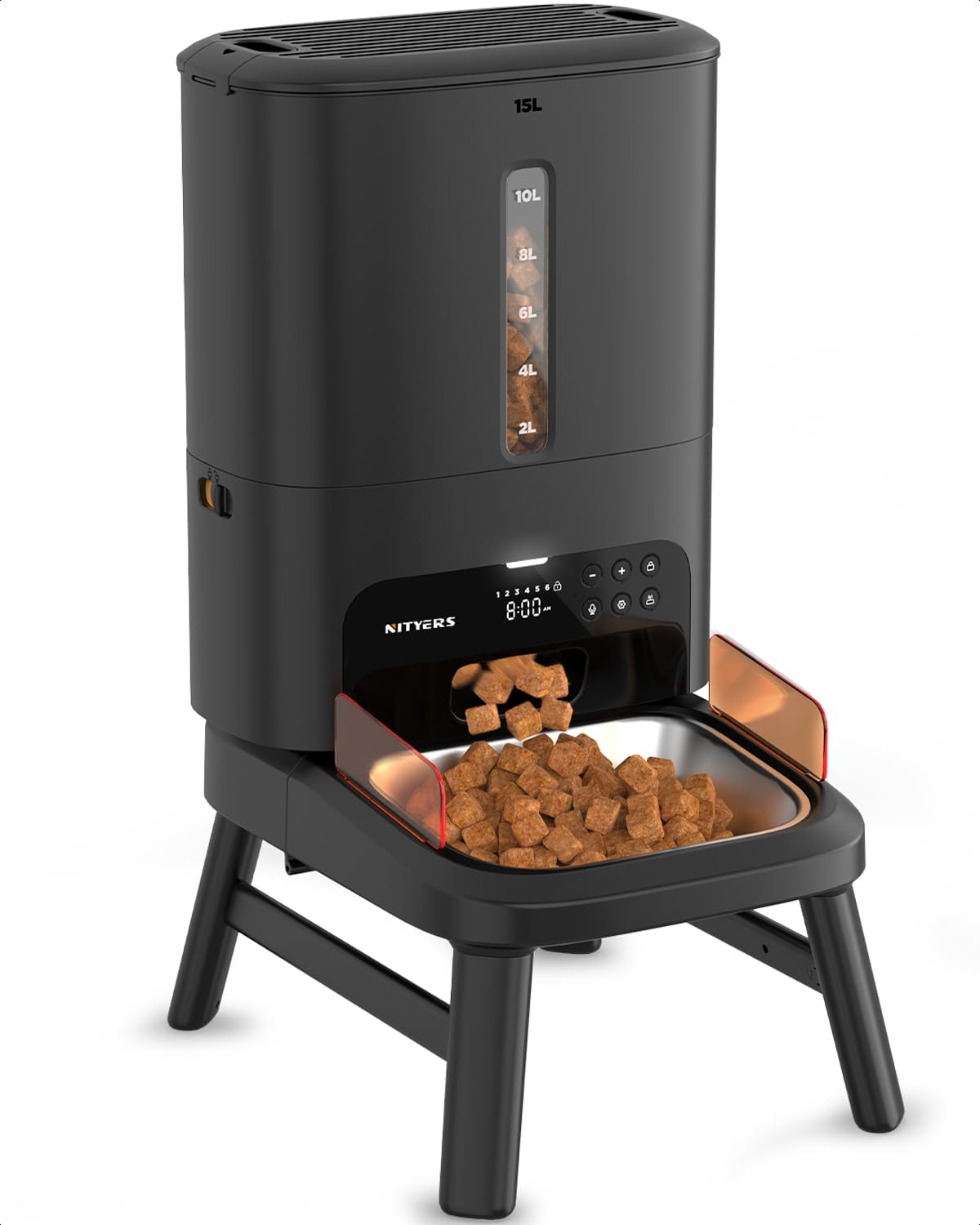
Kibble size is the specification that quietly decides this purchase, so we start there: the Nityers takes dry food from 2 to 23 mm. That covers the wide, chunky pieces large-breed formulas tend to use, and it is the main reason this one holds the top spot. A feeder that jams on your dog's food is a bowl with extra steps.

The hopper is 15 liters, about 63 cups, and it drops up to 50 portions in a single meal. A portion is an eighth of a cup, so that is 6.25 cups in one go, which means a giant breed's dinner arrives in one cycle instead of four. The stand goes together two ways, low or raised, and the stainless bowl sits in a tray you can lift out.

There is no Wi-Fi, no app and no account: six meals a day are set on the panel, and battery backup holds the schedule through a power blink. If you have ever had a smart feeder forget everything after a router reset, that reads as a feature rather than a gap. What you give up is remote feeding and any view of the bowl, and we did not miss either.

Bottom line: This is the one we tell large-dog households to buy first: a 15-liter hopper, a chute that takes big kibble, and no app to babysit.

2

DOGNESS 11L Cordless Feeder

DOGNESS 11L Cordless Feeder

No-outlet setups

Our Score 9.0/10
Check Price

Worth Noting

  • Smallest hopper here at 11 liters
  • Melamine bowls instead of stainless steel
Power
Built-in rechargeable battery
Capacity
11 liters (45 cups)
Meals Per Day
Up to 4
Portions Per Meal
Up to 39
Read the full review

Cordless is the whole idea here, and it is a good one: an 11-liter feeder with a built-in rechargeable battery that goes wherever the dog eats. No outlet, no cable across the kitchen floor, no drawer of AA batteries to keep stocked. If your feeding spot is not near a socket, this is the shortlist.

Capacity is the trade. Eleven liters is about 45 cups, the smallest hopper in this group, which for a serious eater means a refill roughly every week and a half rather than every three weeks. It will drop up to 39 portions in a meal across four meals a day, and the anti-jam channel uses two rotors rather than the usual single paddle.

Programming is buttons and a screen, four meals a day, no app at all, and the schedule holds while the unit is unplugged. The bowls are melamine rather than stainless; they wipe clean fine, but a determined chewer will make faster work of them than steel.

Bottom line: Buy this one when the feeding spot has no outlet; the battery and the 11-liter hopper trade capacity for freedom.

3

GADFISH 60 lb Steel Feeder

GADFISH 60 lb Steel Feeder

Outdoor multi-dog

Our Score 9.0/10
Check Price

Worth Noting

  • Free-feeding only, with no timer or portions
Door
Lockable
Build
Aluminum-coated galvanized steel
Power
None required
Capacity
60 pounds of kibble
Read the full review

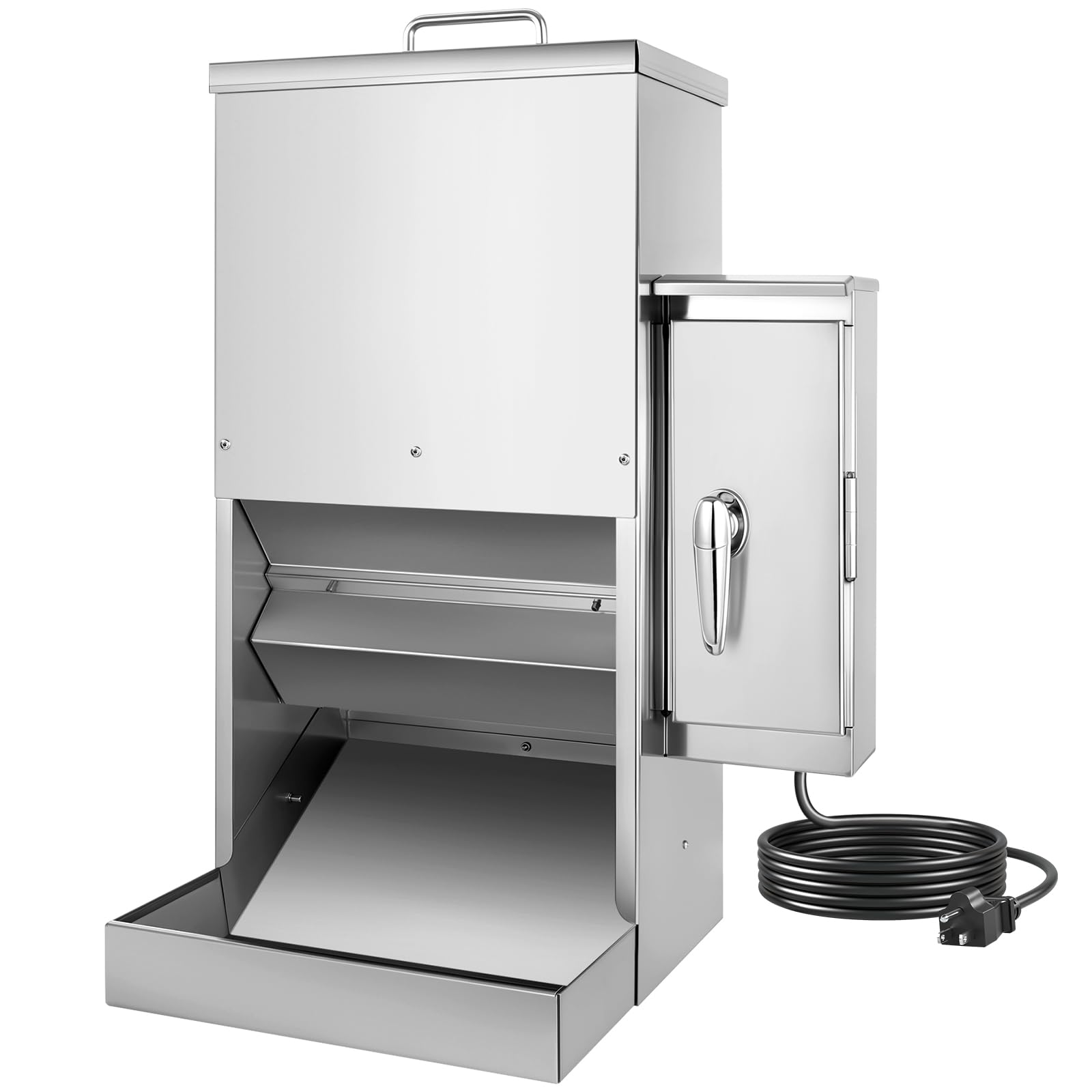
Sixty pounds of kibble is a different scale of feeder. This is a galvanized steel bin with a clear window so you can see how much is left without opening it, a magnet-held plate at the feeding port that a dog noses aside, and a lockable door for the outdoor life.

It is not timed. Nothing here drops on a schedule; the dog eats when it pushes the plate, and food slides down an angled chute to top up the tray. That is exactly right for a kennel run, a barn, or a three-dog household where the bowl is empty by lunchtime, and exactly wrong for a single dog that would work through the whole bin. Check the door and plate alignment when it arrives, since a bent flap is the one thing that stops it doing its job.

What we like most is how little there is to go wrong: aluminum-coated steel, no cord, no battery, no app. It takes a 50-pound bag with room left over, and there is nothing electronic in it to fail in the rain.

Bottom line: For a kennel, a run, or three dogs sharing a bowl, this steel bin holds a whole bag and never needs charging.

4

Gwozn 15L Camera Feeder

Gwozn 15L Camera Feeder

Checking in remotely

Our Score 8.8/10
Check Price

Worth Noting

  • Hand-wash only, no dishwasher-safe parts
Camera
1080p with night vision
Capacity
15 liters (63 cups)
Kibble Size
Up to 23 mm
Connectivity
2.4/5 GHz Wi-Fi app
Read the full review

Watching kibble actually land in the bowl is oddly reassuring, and it is the reason to look closely at this one. The Gwozn puts a 1080p camera with night vision and two-way audio above a 15-liter hopper that takes kibble up to 23 mm.

We rate it the best camera feeder in this group. Capacity matches our top pick cup for cup, the app runs on either Wi-Fi band, which matters more than it sounds given how many feeders are stuck on 2.4 GHz, and meals and portion sizes are set from the phone. The two-year warranty is a genuine plus on a machine with electronics in it.

The trade is dependence. Schedules, portions and the camera all sit behind the app, so a weak signal at the feeding spot turns into a feeding problem. Pair the unit somewhere with real coverage before you trust it with dinner works.

Bottom line: Our pick if you want eyes on the bowl: the same 15-liter capacity as the top feeder, plus a camera that actually shows you the food.

5

Dokoo 15L Vacuum Feeder

Dokoo 15L Vacuum Feeder

Kibble freshness

Our Score 8.8/10
Check Price

Worth Noting

  • No app, camera or remote feeding
  • Premium price for the same capacity
Capacity
15 liters
Kibble Size
2-22 mm
Food Storage
Vacuum-sealed hopper
Meals Per Day
Up to 6
Read the full review

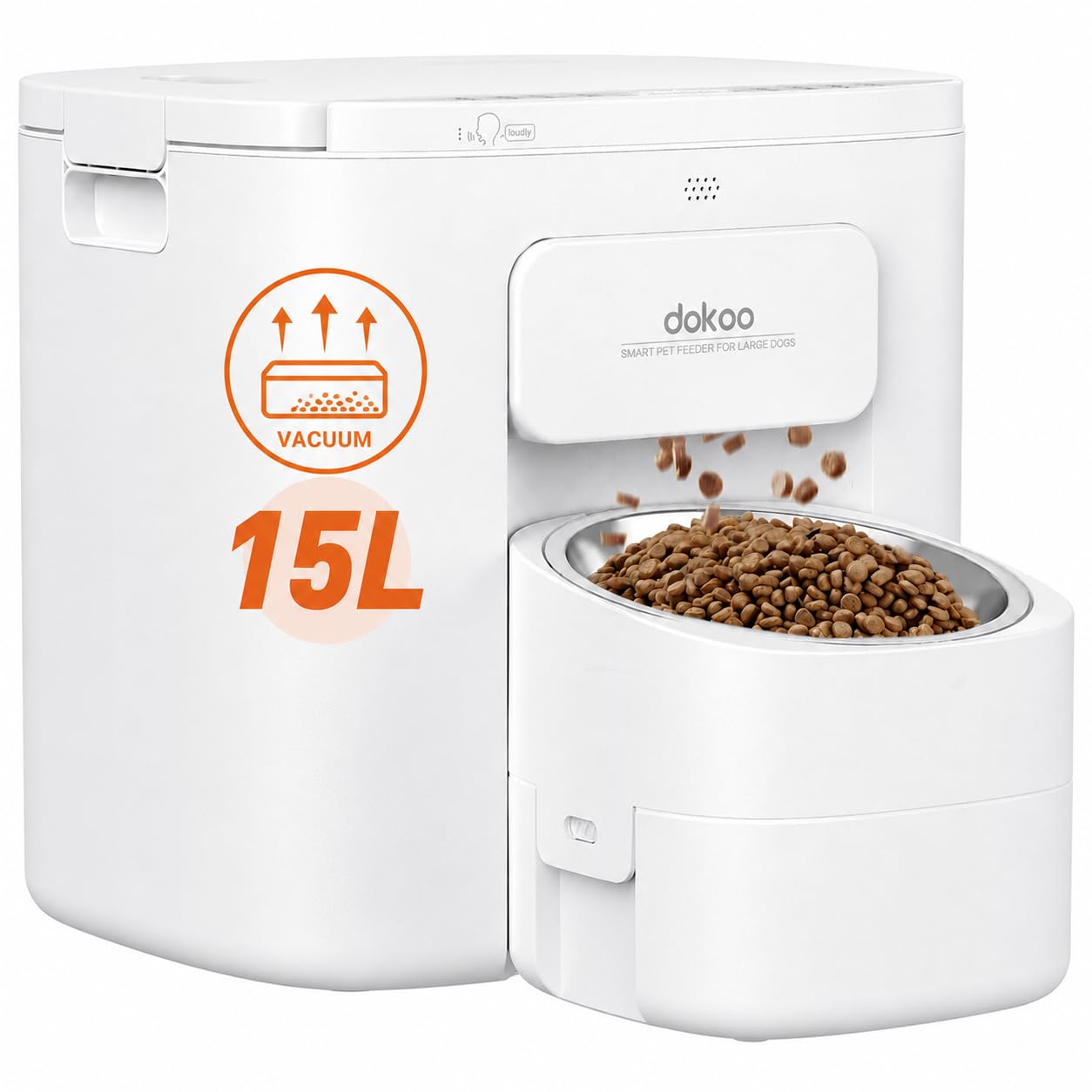
Nothing else in this roundup reseals the food. The Dokoo pulls a vacuum on the hopper after every meal and holds it until the next one, which is a strange thing to get excited about until you have poured a stale cup of kibble into a bowl and watched a big dog sniff it and walk away.

We think it earns its premium in households that buy the big bag, because the bigger the bag the longer it sits open. Fifteen liters takes an entire large bag, and the seal means the last cup smells like the first. Programming happens on the unit's own screen, six meals a day with one to 20 portions each, so there is no account to manage and no router involved.

At just under 20 pounds empty it is not a machine you slide around to sweep under, so decide where it lives before the first fill. And the vacuum only pays off if you are buying bulk in the first place; for a household working through a small bag each week, it is solving a problem you do not have.

Bottom line: Pay the premium if kibble freshness matters: nothing else here reseals the hopper after every meal, and it runs without Wi-Fi.

6

MOLLY&CODY 14L WiFi Feeder

MOLLY&CODY 14L WiFi Feeder

App control

Our Score 8.4/10
Check Price

Worth Noting

  • Wi-Fi pairing is the weak point
  • Portions set in units, not cups
Capacity
14 liters (60 cups)
Connectivity
2.4 GHz Wi-Fi app
Meals Per Day
Up to 6
Portions Per Meal
1-60
Read the full review

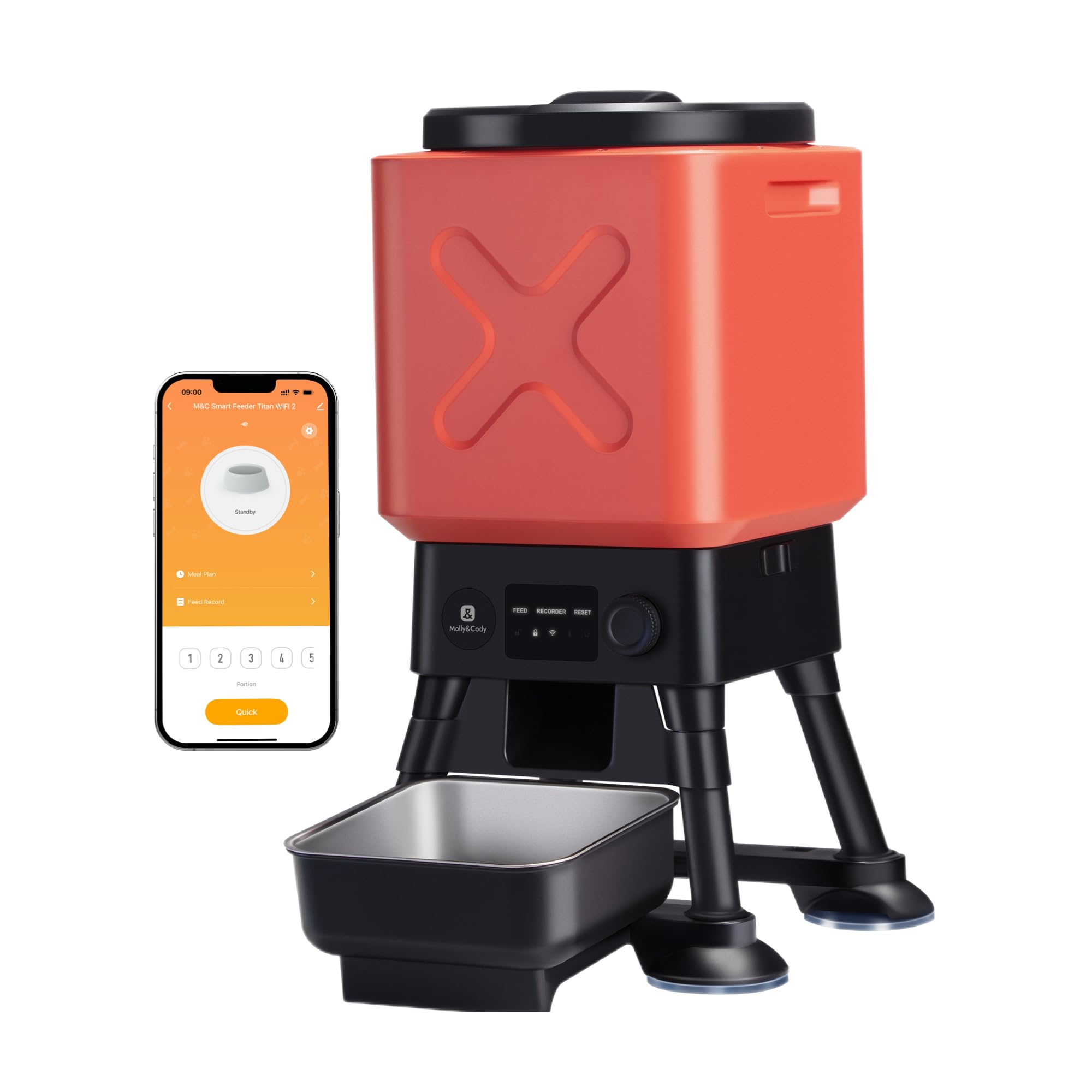
Fourteen liters works out to roughly 60 cups, and that is the number that matters: enough kibble that refilling becomes a fortnightly chore instead of a daily one. The base is wider and heavier than most, with suction cups underneath, and the stainless bowl snaps into its holder rather than rattling around loose.

The app is the point of it. Six meals a day, portions from one to 60, a feed-now button for the office, and a ten-second recording that plays at mealtimes. What to sort out first is the connection: get it onto a 2.4 GHz network with real signal at the spot you have chosen, because a feeder that will not join the network is an expensive storage bin.

We came away thinking this is the app feeder for someone who wants remote control without paying premium money. There is no camera, and the portions are counted in units rather than cups, so keep a measuring cup by the bin for the first week while you work out what your dog's dinner actually looks like.

Bottom line: We recommend it to anyone who wants to feed from their phone without spending premium money, once the Wi-Fi is sorted.

7

ChiPak 16L Stainless Feeder

ChiPak 16L Stainless Feeder

Outdoor kennel

Our Score 8.4/10
Check Price

Worth Noting

  • No app, camera or feeding history
  • Dispense time set in seconds, not cups
Build
Stainless steel
Capacity
16 liters
Dispense Time
1-999 seconds
Feeding Settings
4 timed groups
Read the full review

Stainless steel is unusual in this category, and it is the reason to look at this one: a 16-liter hopper inside a welded steel body that shrugs off weather and a dog leaning on it. It is the most solidly built feeder we are covering, and it is priced like it.

Programming is old-school, and we mean that kindly. Four timed groups, each dispensing for anywhere from one to 999 seconds, all set on the unit with no app and no Wi-Fi. You tune the dispense time until the bowl looks right, which is cruder than typing cups into a phone and completely immune to a router problem.

It sits on the floor or screws to a wall using the included expansion bolts, and it is rated for indoor or outdoor use, which puts it in a small group here. For a big dog, the wall option is the interesting one: bolted down, it stops being something that can be shoved across a run.

What it is not is a portion-control machine. There is no app, no camera, no feeding history, and the timer is the only intelligence in it. We point people here when they want a schedule and a steel box and nothing else.

Bottom line: We point outdoor households here when they want a timer instead of a free-feed bin: stainless steel, wall-mountable, no app anywhere.

8

Yakry 12L Camera Feeder

Yakry 12L Camera Feeder

Budget camera feeding

Our Score 8.2/10
Check Price

Worth Noting

  • Bowl is shallow for wide kibble
  • Hopper small for giant breeds
Camera
1080p with night vision
Capacity
12 liters (50 cups)
Kibble Size
Up to 20 mm
Connectivity
2.4/5 GHz Wi-Fi app
Read the full review

Twelve liters and a camera, on the least expensive unit we are recommending: that is the pitch, and it mostly holds up. The hopper takes kibble up to 20 mm, the bowl lifts out for washing, and the lid seals with a desiccant pack so a big bag does not go soft before it is finished.

The camera is the same 1080p unit with night vision and two-way audio that the pricier machines carry, and it is genuinely useful for a dog that eats while you are at work: you can watch the bowl fill and hear whether the dog actually turned up.

Twelve liters is where it starts to strain for a giant breed. That is around 50 cups, comfortable for a Labrador and tight for anything much over 100 pounds, and the bowl is shallower than the rest of this group, so a wide kibble can pile up rather than spread out.

For us it is the value pick among the camera feeders. Measure the first few drops against a cup, because portion accuracy is the thing to verify before you trust it with a whole day's food.

Bottom line: The cheapest way into a camera feeder, as long as your dog is Lab-sized rather than giant.

How We Tested Large-Breed Automatic Feeders

We started with 40-odd feeders on paper and cut anything that couldn't hold at least 20 cups of kibble, couldn't be programmed in portions finer than half a cup, or listed a maximum kibble size smaller than the big-breed formulas most of our dogs actually eat. That left 12. Each one ran on a twice-daily schedule for a minimum of three weeks — several for the full stretch — through seven months of near-continuous use across two large dogs and one foster.

Setup was timed from the moment the box opened to the first scheduled meal, first without the manual and then with it, because a feeder you can't program in ten minutes is one you'll stop using. We weighed ten dispensed portions per feeder on a kitchen scale at the small, medium, and large settings and compared the real weight against whatever the app called a cup. Capacity got checked the honest way: fill the hopper, dispense until empty, count the cups. For jamming, we ran each unit on large-breed kibble and then on the crushed dust at the bottom of the bag, logging every stall and how much food came out when it did.

Connectivity got its own test — we pulled the router for an hour midweek to see whether the schedule held or the dog went hungry. Cameras were judged by whether I could actually see a 90-pound dog's face at bowl level, at night, from a work meeting. Lid security was less scientific: I pushed, and then I let the Labrador try. Throughout, we tracked value by weighing what each feeder cost against its real capacity and how often it fed the right amount without being babysat.

How to Choose Automatic Dog Feeders for Large Dogs

Match the meal, not the hopper

A 15-liter hopper sounds enormous until you work out that a big dog eats four or five cups a day. What matters at dinner is the largest single drop the machine can deliver: our top pick puts 6.25 cups into the bowl in one cycle, while others cap out near a cup and need several cycles to build a meal. Check the per-meal maximum and the portion unit before anything else.

Then measure once. Fill a measuring cup with the first few drops so you know what six portions actually looks like in your dog's bowl. Units vary between brands, and guessing is how dogs get fed half a dinner.

Kibble size is where feeders fail

Large-breed formulas come in wide, flat pieces, and a chute built for small kibble will jam on them, usually at 6 a.m. on the morning you leave. The feeders here state a range: 18 mm at the tightest, 23 mm at the widest. Measure a piece of your dog's food against a ruler rather than guessing from the bag.

If your kibble runs over 23 mm, or you mix in freeze-dried chunks, a gravity bin with a wide chute is the safer shape of feeder. An auger and a rotor are what jam; a hole is not.

Timed or gravity?

Automatic covers two different machines. A timed feeder drops a set amount on a schedule; a gravity feeder keeps a tray topped up and lets the dog decide. Timed suits one dog on a weight plan, a dog on medication timing, or a household that is out for twelve hours.

Gravity suits kennels, outdoor runs and multi-dog homes where the bowl is empty by lunchtime anyway. If your dog would eat until the bin is empty, gravity is the wrong design, and no amount of steel fixes that.

App control, and what it costs you

A Wi-Fi feeder lets you feed from anywhere and watch the bowl, and it adds two dependencies: your network and the app. Pairing is where these units most often stumble, and a feeder that will not join the network is a storage bin. Put it somewhere with real signal before you rely on it.

Check one thing on the listing: whether scheduling or portion features sit behind a subscription. The panel-programmed feeders here, our top pick included, give up remote feeding and never drop a schedule because a router rebooted.

Height, stability and cleaning

A tall dog should not eat with its neck at an angle, so a raised stand matters, and the better feeders here let you choose the height. Stability counts just as much: a 90-pound dog leaning on a light hopper will move it, so look for a wide base, suction feet or wall-mounting hardware.

Then think about cleaning honestly. A hopper that comes apart into five pieces gets washed monthly at best, and stainless bowls stay sanitary longer than melamine ones.

Frequently Asked Questions

Final Verdict

Buy the Nityers if you want one feeder that gets out of the way. It swallows the kibble large breeds actually eat, holds a full bag, and puts a whole meal in the bowl in one cycle without an app in the middle. For a dog that eats at home on a schedule, nothing here does the job more simply.

If you want eyes on the bowl, the Gwozn matches its capacity and adds a camera. If you buy food in bulk and hate stale kibble, the Dokoo's vacuum seal is the one feature worth the premium.