Grooming

Best Dog Brushes for Golden Retrievers of 2026

There's a particular look a golden retriever gives you when a brush pulls — a half-inch step sideways, ears back, tail still going because they want to be good about it. I've earned that look plenty of times with tools that yanked more than they gathered. The reason you're shopping is the coat: a dense undercoat that lets go by the handful twice a year, plus feathered ears, tail, and leg fringes that tangle if you breathe on them wrong. The right brush lifts that loose undercoat out at the root instead of dragging it across the skin, and it does it without turning your dog into a hide-and-seek champion every time the drawer opens.

Over the past four months, my team and I ran 14 brushes through an entire spring blowout — slickers, undercoat rakes, deshedding blades, and a couple of oddballs — on my golden and two others. Here's the thing first-time golden owners don't find out until it's too late: no single brush handles the whole dog. The tool that's perfect down the back is often too aggressive for the tail feathering and completely useless on the pants. Value matters here too, but cheap is only a bargain if the pins survive a season of undercoat, which is exactly what we kept track of. Below are the ones that earned a permanent spot in the grooming bin.

1

FURminator Long Hair DeShedding Tool

Top Pick
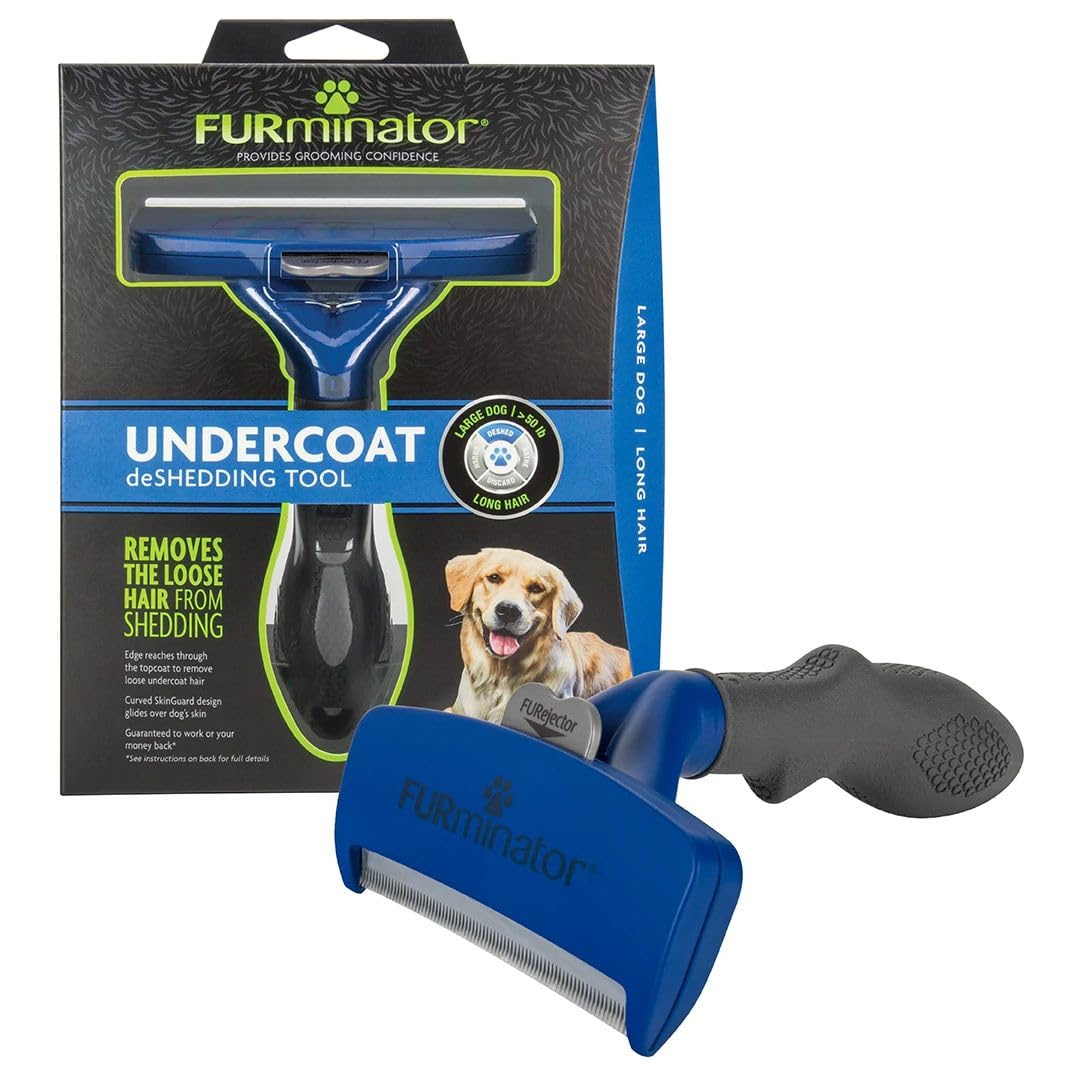
FURminator Long Hair DeShedding Tool

Full deshedding sessions

Our Score 9.4/10
Check Price

Worth Noting

  • Won't clear the leg and tail feathering on its own
Dog Size
Over 50 pounds
Coat Type
Long hair
Hair Release
FUREjector button
Bristle Material
Stainless steel
Read the full review

Of the eight tools on this page, this is the one whose specifications read as if they were written for a golden retriever: a blade made for long coats, mounted on a head sized for dogs over fifty pounds. Most adult goldens clear that weight without trying, which is why it is our default recommendation for the breed rather than just another good deshedder.

The working edge sits under a row of stainless teeth and does its job below the topcoat, lifting loose undercoat you cannot see and cannot reach with a pin brush. What we appreciated most is the FUREjector button — one push and the collected fur drops off the head instead of being teased out by hand, which keeps a long session moving. Metal handle, stainless head: the right materials for something that gets used hard twice a year and lightly the rest of the time.

The reservation is the blade. A tool that reaches undercoat this efficiently will thin a coat if you lean on it, so short, light passes, and when the head comes up clean, that coat is done for the day; the listing's own "when used as directed" line is doing real work. For a dog brushed once a week that caution costs you nothing. It is absent-minded daily use that gets people into trouble.

Bottom line: We make it the first tool a golden household should buy: a long-coat blade on a head sized for large dogs, pulling undercoat the slickers here only skim.

2

Paw Brothers Extra Long Slicker

Paw Brothers Extra Long Slicker

Deep feathering

Our Score 9.4/10
Check Price

Worth Noting

  • Short 4.75-inch handle
Head Size
4.5 x 3 inches
Pin Length
1 inch
Handle Length
4.75 inches
Bristle Material
Stainless steel
Read the full review

One inch of pin is the number that matters here. On a golden's ruff and chest the fur is deep enough that a short pin skims the surface and comes away looking like it did something, while a full inch of stainless reaches down to the skin line where the loose undercoat actually sits.

The head is 4.5 by 3 inches with the pins set flat rather than into a cushioned pad, so there is very little give. That is the trade: a firm pad works through a dense coat without bouncing, and it only works if your hand does not add pressure. We brush with the weight of the arm and let the pins find their own depth.

Where it earns its place is the finish. Worked in lines down the flank, up the legs and along the tail, it separates feathering that a rake leaves clumped and the coat lies flat instead of looking aired out. The difference shows halfway through a session rather than at the end.

For the money, this is the slicker we point most golden households to. It will not replace a deshedder — no slicker will — but as the second tool in the kit it does the job that makes a dog look groomed, at a fraction of what the premium brush here costs.

Bottom line: We reach for this when the ruff and tail feathering have never really been brushed through — an inch of pin gets to the skin line.

3

Chris Christensen Big G Slicker

Chris Christensen Big G Slicker

Groomed finish

Our Score 9.4/10
Check Price

Worth Noting

  • Most expensive brush in this set
  • Wood handle joint takes the strain
Pad
Flexible cushioned
Size
Large
Handle
Wood, ergonomic grip
Pin Type
Angled stainless steel
Read the full review

This is the most expensive brush in the set by a wide margin, and the only one that makes a golden look like it has been to a groomer rather than merely brushed.

The reason is the pin field: extra long, angled, and set into a flexible cushioned pad so each pin flexes instead of stabbing. On a coat with feathering, that combination separates hair rather than compressing it, which is why the leg furnishings and the tail come out fluffy instead of flattened. It detangles long-coated breeds and works fine knots out of the spots a rake skips.

It is also the easiest of these to hold for a long session. The wood handle sits in the hand, the angled pins mean you are not fighting the direction of the coat, and the brush is light enough that you are not aware of it after ten minutes.

The reservation is price, and what that price promises. At this level we expect the handle joint to outlast several dogs' worth of coats, and a wood handle on a long-pinned head is exactly where a brush like this takes stress. Buy it for the finish, and buy it knowing a much cheaper slicker will do most of the same work.

Bottom line: Worth the outlay if you want a groomed finish rather than just less hair; the handle joint is where our reservation sits.

4

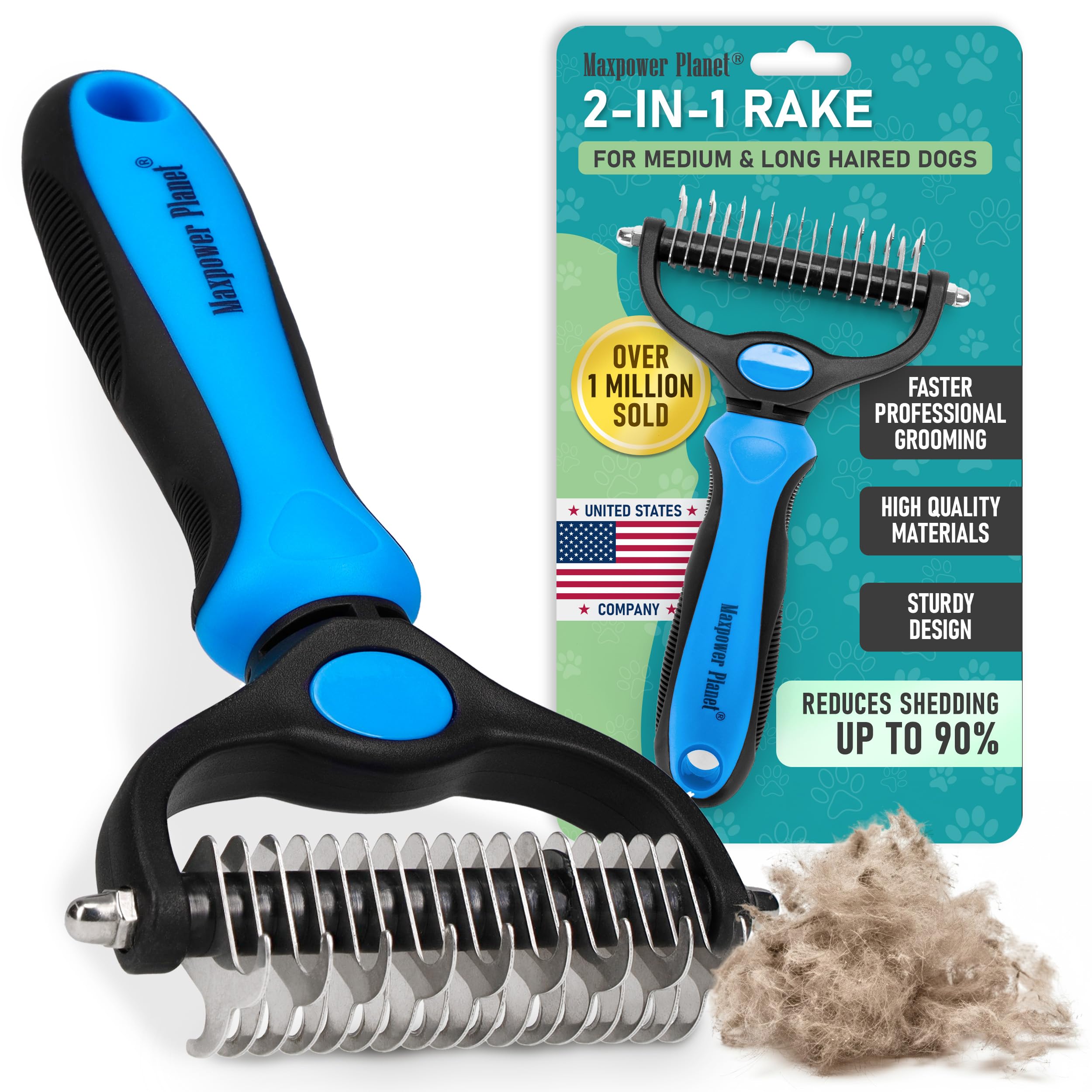
Maxpower Planet Grooming Rake

Maxpower Planet Grooming Rake

Budget undercoat work

Our Score 9.2/10
Check Price

Worth Noting

  • Fur has to be pulled off the teeth by hand
Teeth
9-tooth side for mats
Design
Dual-sided undercoat rake
Handle
Non-slip rubber base
Item Weight
4 oz
Read the full review

Two rows of teeth on one handle is the entire idea: a nine-tooth side for the mats that form behind the ears and under the collar, and a finer row for the ordinary pass down the back and flanks. For a breed that grows a dense undercoat and then lets go of it twice a year, that covers most of what a rake needs to do.

At four ounces it is a tool we can hold through a whole dog without shifting grip, and the rubber base on the handle keeps it steady when the coat is thick enough to tug back. We rate it the best value in this set — the teeth are sharpened and finely rounded, the head is compact enough to steer around a shoulder, and it costs the least of the undercoat tools here.

One thing to know before you lean into it: those teeth are sharpened, so the edge of a mat is where they work best. Tease the mat apart from the outside rather than digging at the middle, let the teeth do the separating, and this stays a pleasant tool for the dog. Use it like a scraper and you will get a look over the shoulder.

Bottom line: Our budget pick for real undercoat removal: two tooth rows, four ounces of tool, and nothing fussy to break.

5

FURminator Grooming Rake

FURminator Grooming Rake

Daily gentle raking

Our Score 9.2/10
Check Price

Worth Noting

  • Wide head is clumsy around the face and ears
Teeth
Rotating metal teeth
Best For
Thick, dense double coats
Dimensions
6.5 x 2 x 9.65 inches
Item Weight
6.56 oz
Read the full review

There is no blade here and nothing sharpened. This is a row of metal teeth that rotate in their setting, and that single design choice decides where it belongs in a golden's routine.

Rotating teeth ride over a tangle instead of catching in it, so the tool keeps moving even when the coat is thick and the dog is shifting its feet. We found it best on a coat that is already mat-free, where the job is simply to keep the undercoat moving before it ends up on the rug. It is also light for its size, so a long pass down a big dog does not turn into a forearm workout.

The case for it over a blade tool is the dog, not the coat. A golden that flinches at a scraper will stand for this, and a tool the dog tolerates gets used, which beats a more efficient one that stays in the drawer. This is the second FURminator in our set and we have no argument with that — the two do genuinely different jobs, and this is the one that gets picked up on an ordinary Tuesday.

Bottom line: A gentle daily rake for the golden that hates being groomed: no blade edge, no snagging, and enough width to be quick.

6

SleekEZ Deshedding Tool

SleekEZ Deshedding Tool

Coat and couch

Our Score 9.2/10
Check Price

Worth Noting

  • Stops dead on a mat
Coat Types
Short, medium and long
Dimensions
5.5 x 3 x 1.5 inches
Item Weight
3.53 oz
Working Edge
Narrow toothed strip
Read the full review

There are no pins on this one. The working edge is a single narrow toothed strip on a compact body, and you draw it through the coat at an angle rather than brushing with it. It is a different action from everything else here, closer to carding than to brushing, and it takes a session or two before the wrist finds the right angle.

Used shallow, it grabs the tips of the loose hair and pulls it free without the tugging a pin brush can produce, and on a dense undercoat the amount that comes up the first time is startling. It also earns a second life in a golden household: the same strip pulls hair off the couch, the car seat and the stair carpet, which is not why you buy it but is why it stops living in a drawer.

The catch is that it is a blade in effect, and that edge is sharp enough to catch a finger if you slip, so keep the angle shallow and your fingers behind the body rather than wrapped around the head. Treat it as the tool for a coat that is already comb-able and it will surprise you; hand it to someone who brushes like they are scrubbing a pan and it will not.

Bottom line: We keep this as a second tool rather than a first: a strip that scrapes undercoat free at an angle and then earns its keep on the couch.

7

Docrok Grooming Combo

Docrok Grooming Combo

Starter kit

Our Score 9.0/10
Check Price

Worth Noting

Comb
2-in-1 double-sided
Rake
2-in-1 double-sided
Pieces
2
Material
Stainless steel teeth
Read the full review

Two tools arrive here and between them they cover the two halves of a golden's coat: a double-sided rake with a wide side for matting and a dense side for deshedding, plus a double-sided metal comb with a wide side for smoothing and a dense side for loose hair on the legs, head and tail. That is the pair a golden actually needs.

The comb is the part we underrated. A slicker will glide straight over a mat that has formed flat against the skin behind an ear; a metal comb stops dead on it, which is why we run one through after every brushing session rather than trusting how the coat looks. The rake does the heavy work, the comb tells you whether you finished, and neither takes up much room in a drawer. The teeth are firm enough to feel on a bony old dog, so start light and let the dog set the pace.

Bottom line: We think a rake plus a comb is the right way to start, because the comb catches what a slicker slides straight over.

8

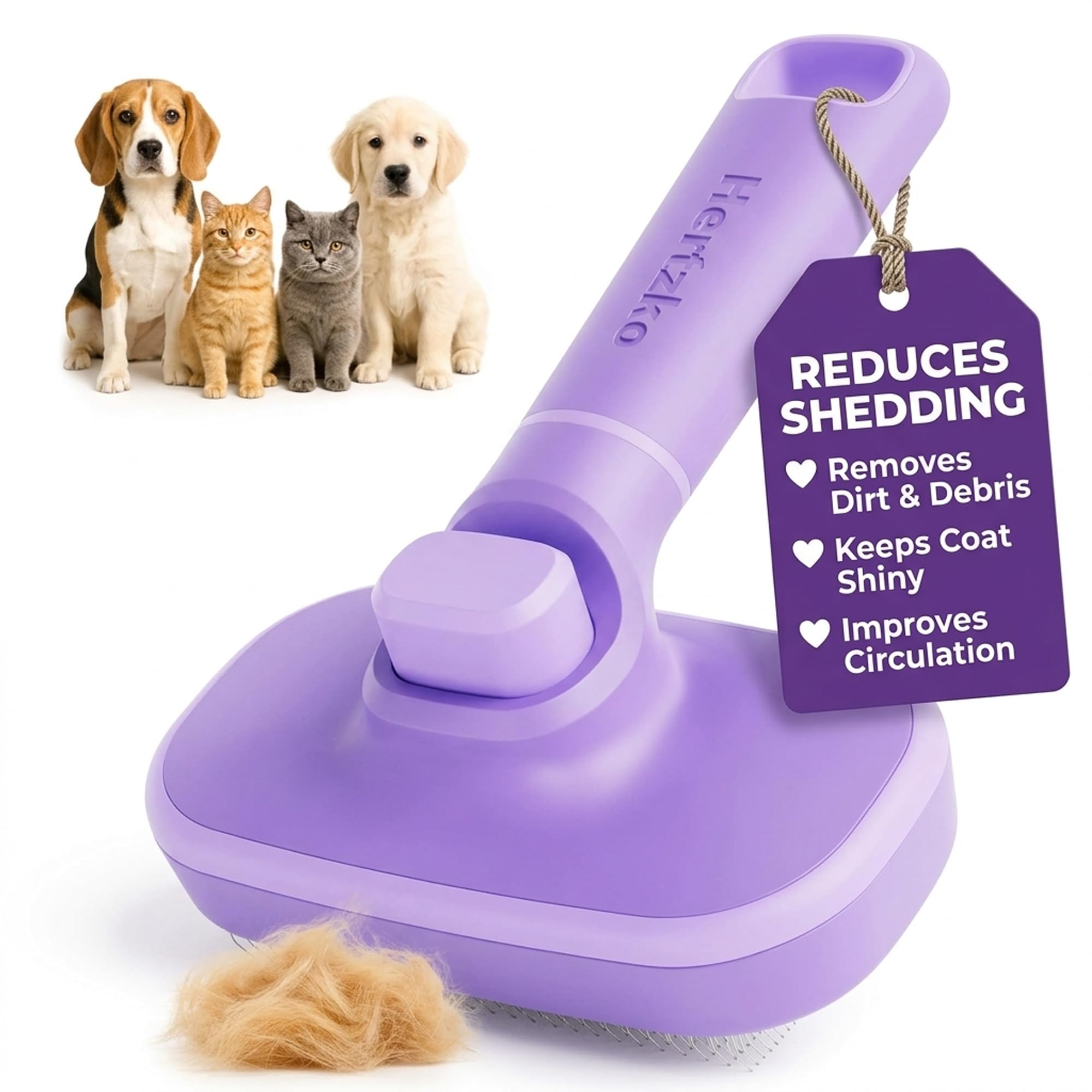
Hertzko Self Cleaning Slicker

Hertzko Self Cleaning Slicker

Quick daily passes

Our Score 9.0/10
Check Price

Worth Noting

  • Fine pins do little for the undercoat
Bristles
Retractable fine pins
Cleaning
Push-button retraction
Dimensions
5.8 x 3 x 10 inches
Item Weight
3.2 oz
Read the full review

This is the brush that lives by the front door. Fine angled pins, a light body and a button that retracts the pin head so the fur lifts off in a sheet — for a dog that will give you five minutes and no more, that speed is the whole value.

We used it as the finishing pass after a rake, and the retraction is what makes it pleasant: press, the pins drop into the head, and the fur comes away in one piece instead of being picked out row by row. That button is also the part that decides how long the brush stays useful. It is the one moving component, and when it stiffens you are back to digging fur out with your fingers.

Its advantage over the long-pinned slicker here is pace. Light, quick passes along the back and down the tail, and you are done before your golden loses interest — which for a lot of dogs is the difference between a brushed coat and a coat that never gets brushed at all.

Bottom line: Our pick for a dog with a short attention span, provided you go light with those fine pins.

How We Tested the Best Brushes for Golden Retrievers

We started with more than 30 brushes pulled from groomer recommendations, breed club forums, vet tech advice, and review sections, then filtered by pin type and length, handle shape, self-cleaning mechanisms, and price. That narrowed it to 14 models, from basic slickers to pricier deshedding tools.

Testing ran four months and deliberately spanned a spring coat blowout, with three goldens of different coat types — a two-year-old in full coat, a five-year-old, and a senior with a thinner, coarser coat. Brushes got used where they actually get used: on the living room rug during evening TV, on the back porch after a muddy walk, in the car hatch after a lake day, and at bath time when the coat was wet and matted.

Every session followed the same routine. We brushed for ten minutes, gathered what came off on a towel, and compared piles session to session to see which tools were actually reaching the undercoat. Then we cleaned each brush: how much hair stayed woven into the pins, whether the retract button cleared the pad in one press or left a mat behind, whether it dumped hair back onto the dog. We pressed every self-cleaning button at least 20 times over the test and noted which ones stuck, sprang late, or needed two thumbs.

Durability got checked after each session — bent pin tips, missing heads, handles that flexed under a two-handed grip. We also ran a hand over the brushed area afterward to feel for scratches, and watched whether the dog leaned in or stood up and left. Brushes earned their price only if they pulled a real amount of undercoat and were still working smoothly at the end of four months.

How to Choose Dog Brushes for Golden Retrievers

Two tools, two jobs

The hair on your floor is undercoat, and no pin brush reaches it. That is work for a rake, a blade deshedder or a toothed strip — tools that get below the topcoat and pull the loose grey fluff out in tufts. Slickers and combs do the other half: they separate the feathering on the legs and tail, lift the coat off the skin, and leave the dog looking finished rather than aired out.

If the budget only stretches to one tool, buy the undercoat tool. If it stretches to two, pair a rake with a long-pinned slicker, and add a plain metal comb as well — the comb is what tells you whether you actually finished.

Pin and tooth length is the number that matters

A golden's coat is deepest at the ruff, the chest and the tail. A slicker with short pins glides over that depth and comes up looking productive while the undercoat underneath is untouched. Look for pins around an inch if you want to reach the skin line, and teeth long enough and widely enough spaced to pass through the topcoat instead of riding on top of it.

The trap is a brush that feels smooth. Smooth usually means it is skating. Part the coat with your hand and look at the skin: if there is still loose grey fluff down there after a session, your tool never reached it.

Decide how aggressive a tool you want

Undercoat tools sit on a scale. Rotating-tooth rakes are the gentlest and the ones a fidgety dog will accept. Fixed rakes with sharpened teeth break up mats as well as loose coat. Blade deshedders are the most efficient and the easiest to overdo, because a blade worked hard in one spot will thin a coat rather than just empty it.

Our rule of thumb: a blade tool for the twice-yearly coat blow, a rake for the weeks in between, and a strip or a slicker for the finish. Nothing here needs to be a daily blade tool, and light short passes with a clear stopping point — the head coming up clean — keep it that way.

Mats, and the comb test

Goldens mat where fur is long and friction is constant: behind the ears, under the collar, in the armpits and around the base of the tail. A slicker passes straight over a flat mat, so the reliable check is a metal comb drawn through the coat — when it stops, you have found one.

Work a mat in small increments from its edge outward rather than dragging at the middle of it, and keep scissors away from anything sitting against skin, where a dog's skin can fold into the blades. A mat that is tight to the body is a groomer's job, and paying for that once beats the alternative.

Frequently Asked Questions

Final Verdict

Start with the FURminator long-hair deshedder. It is the tool specified for a coat like this one, and the undercoat it lifts is the hair you are currently vacuuming off the rug. Then add a slicker for the feathering: the Paw Brothers if you want the most reach for the money, the Chris Christensen if you want the finish a groomer gets.

If only one tool fits the budget, make it the deshedder. The topcoat can wait a month; the undercoat will not.