Grooming

Best Dog Brushes for Goldendoodles of 2026

A goldendoodle coat is a trap disguised as a teddy bear. That soft wavy topcoat hides a dense, curly undercoat that mats at the collar, behind the ears, and under the front legs, usually before you notice anything is wrong. The right brush is what stands between a relaxed ten minutes on the rug and a shaved-down dog plus a groomer's bill, while the wrong one glides over the surface and lets the knot tighten underneath.

I've brushed my own doodle long enough to know the second pass is where most tools lose the argument. Over the past four months my team and I put 14 brushes through it, from slickers and undercoat rakes to combs and a few dematting tools we were skeptical of. What separated them wasn't the price tag. It was whether the pins actually reached the skin, whether my dog leaned in or stood up and left, and whether the brush still worked after a month of wet, muddy, post-walk sessions. One piece of wisdom before you scroll: almost no single brush does the whole job, and most doodle owners end up keeping two.

1

Chris Christensen Big G

Top Pick
Chris Christensen Big G

Daily doodle grooming

Our Score 9.4/10
Check Price

Worth Noting

  • Premium price for one brush
Size
Large
Coat Type
Thick, curly
Pin Design
Extra-long, angled
Pin Density
30% more pins
Read the full review

The first thing we noticed about the Big G is how much pin surface there is: the head is packed with extra-long angled pins, and the flexible cushion lets them give instead of scrape. That combination is exactly what a Goldendoodle coat needs, because the coat is dense enough that a short-pin slicker can skate over the top. We used it as the deep pass on wavy and curly coats and found it reaches closer to the skin without the hard scratch we associate with cheap slickers.

The angled pins and flexible pad help the brush follow the dog's shape rather than fight it. The large head covers a shoulder or leg in a few strokes, which makes line brushing feel less tedious, though it can feel bulky around ears and paws. We kept a lighter touch in those spots and used a comb to check the finish.

The handle is the part to watch; a break takes the brush out of rotation. For a Goldendoodle that mats easily, the dense pin head earns its keep, and we treat this as the serious slicker in the kit. If you want one brush for the deep work, this is the one we reach for first.

Bottom line: We recommend the Big G as the default for Goldendoodle households who want one serious slicker: its dense angled pins and flexible pad do the deep work that keeps mats from taking over.

2

Paw Brothers Extra Long Slicker

Paw Brothers Extra Long Slicker

Value-minded households

Our Score 9.4/10
Check Price

Worth Noting

  • Firmer than cushioned premium slickers
Head Size
4.5 x 3 inches
Pin Length
1 inch
Handle Length
4.75 inches
Bristle Material
Stainless steel
Read the full review

The surprise with the Paw Brothers slicker is how much brush you get for a midrange price: a 4.5-by-3-inch head, one-inch stainless pins, and a handle long enough to keep your hand out of the coat. We expected a basic backup brush and found a serious daily tool.

Those long pins are the point. They part the coat instead of riding on top, which is what makes this a practical slicker for a doodle that mats at the armpits and behind the ears. The flat head is easy to line brush, and the stainless handle feels businesslike in the hand. It does not have the flexible cushion of the Big G, so we keep a lighter wrist over ribs and hips and let the pins do the work. The head is large enough for a standard Goldendoodle, but not so large that it feels clumsy on legs.

What we appreciate most is the honesty of the design: no button, no battery, no extra pieces, just a long-pin slicker that covers the core job. It is the brush we point to when someone wants the doodle-specific pin length without paying premium money. The trade-off is a firmer, less forgiving feel on sensitive dogs.

Bottom line: We point value-minded Goldendoodle households here: the long pins do the core detangling job without extra parts, and the lower cost leaves room for a comb.

3

Saccison Slicker and Comb

Saccison Slicker and Comb

Budget doodle kit

Our Score 9.4/10
Check Price

Worth Noting

  • Pins are less dense than premium slickers
Size
Large
Includes
Slicker and metal comb
Pin Angle
About 45 degrees
Pin Length
About 1 inch
Read the full review

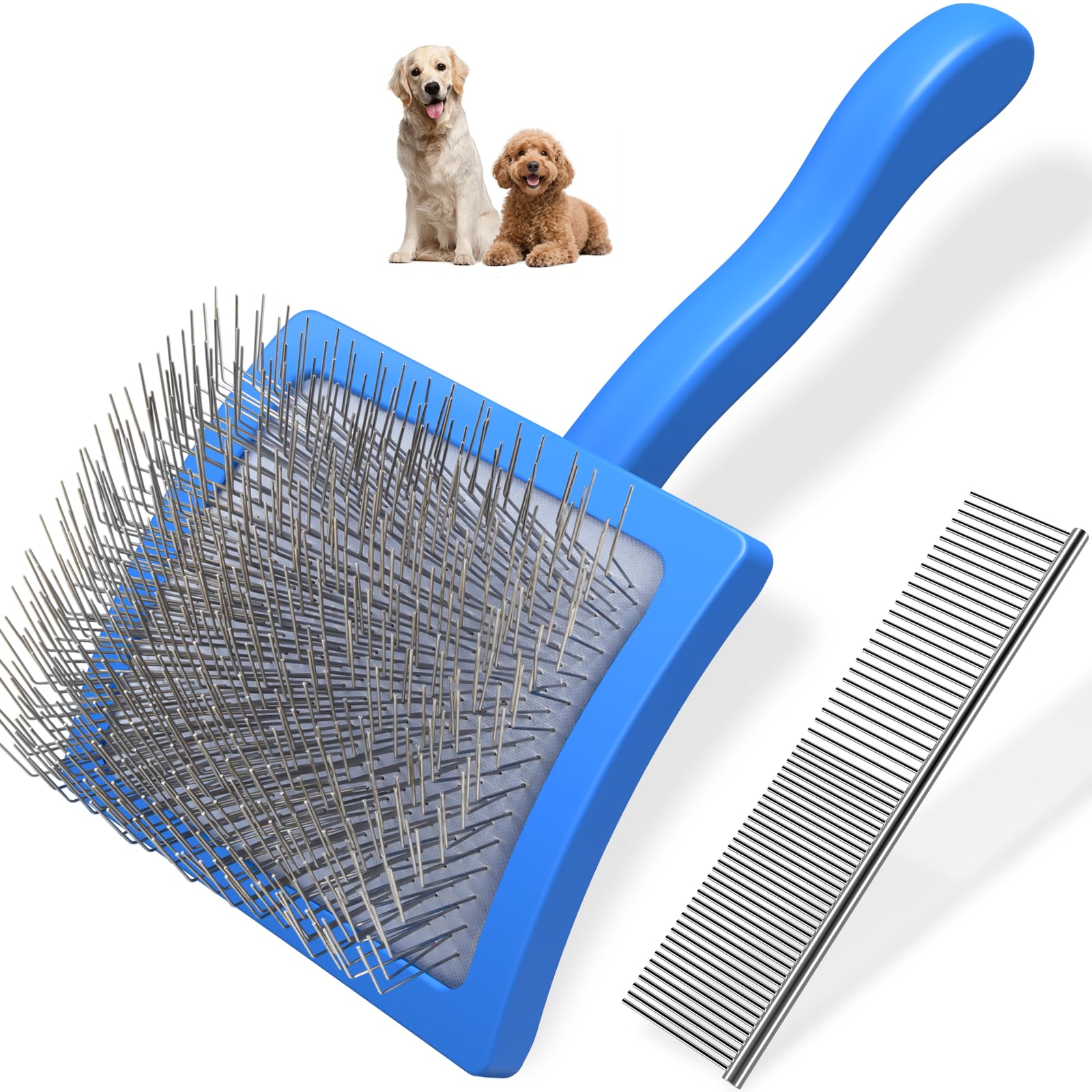
A slicker and a metal comb for a budget price is the pitch, and for a Goldendoodle the comb is not a throw-in. The slicker has roughly one-inch pins set at an angle, which is the specification that matters for a curly coat; the comb gives you a way to check the work. Saccison backs the set with a two-year warranty, which is unusual at this end of the market.

We used the comb after the slicker to test whether the coat was truly clear, and that combination is more useful than a single brush for a dog that mats at the armpits and behind the ears. The pins are not as densely packed as the Big G, so on a thick adult coat we took smaller sections and made more passes. The handle is light and easy to maneuver, and the comb is a solid, useful piece rather than a flimsy extra.

For a puppy or a home that wants one box to cover the basics, this is the budget kit we recommend. It does not have the cushioned flex or pin density of the premium pick, but it gives you the two tools that actually matter for a doodle: a long-pin slicker and a comb to verify the coat. That makes it a smart starting point.

Bottom line: We like this set for a puppy or a first grooming setup: the long-pin slicker covers the coat and the comb lets you check the work.

4

Poodlie Dematting Rake

Poodlie Dematting Rake

Tight mats

Our Score 9.2/10
Check Price

Worth Noting

  • Handle is a weak point
Handle
Textured rubber
Coat Type
Long hair
Blade Length
2.5 inches
Blade Material
Stainless steel
Read the full review

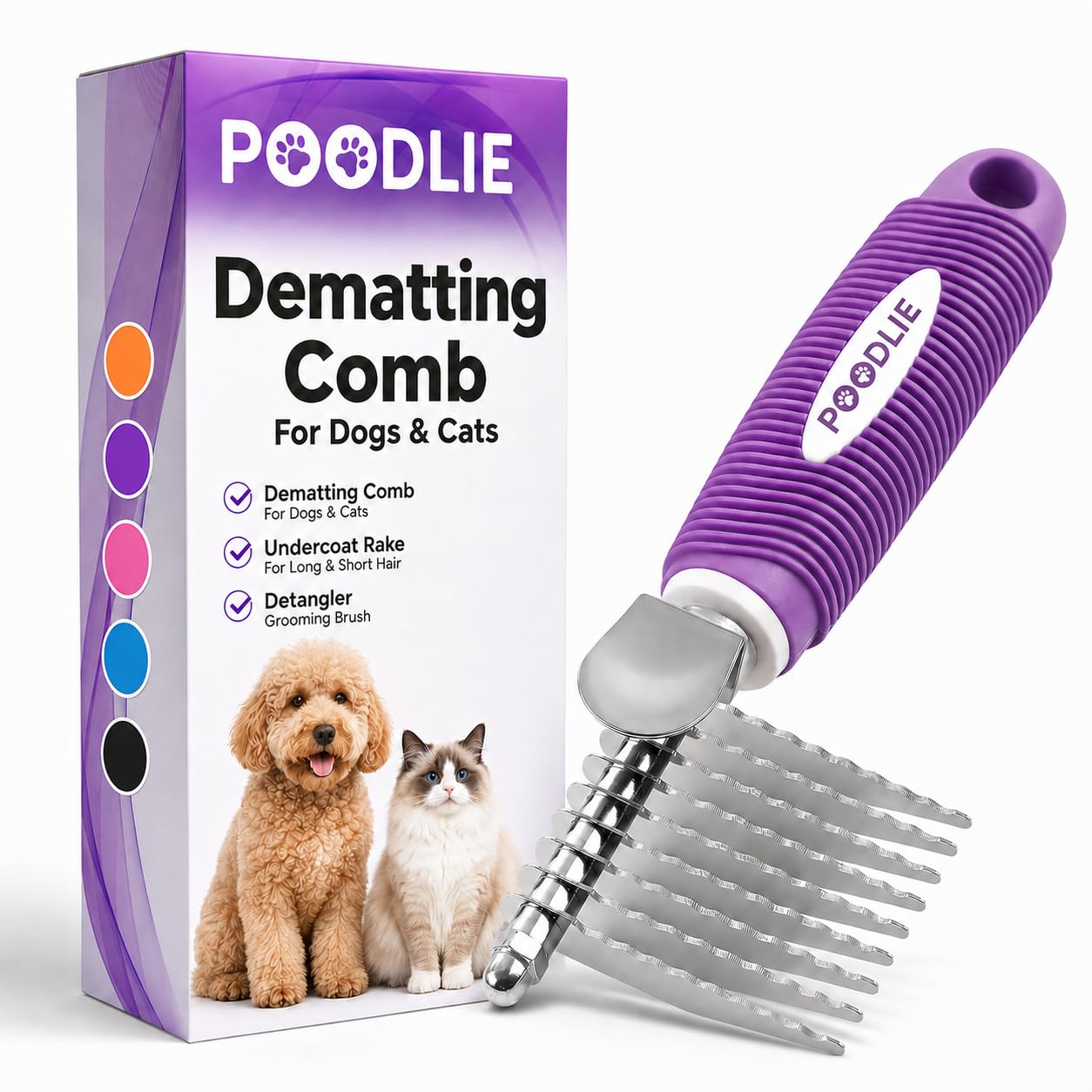
A tight mat is the moment a Goldendoodle household stops browsing and starts looking for a specific tool. The Poodlie rake is built for that moment: two and a half inches of stainless blade, a rubber handle, and a shape that lets you work under the knot instead of pulling straight through it. We found it most useful once a mat had already tightened.

The blades are long enough to slide under a mat and break it into smaller pieces. We worked from the edge rather than pushing through the middle, and we kept the tool away from ears, face, and sensitive skin. It is a sharp tool, so a steady hand matters more than speed. The rubber grip is comfortable, the guard around the blade is a useful reminder, and the hanging hole makes it easy to keep within reach.

This is not a daily brush. It is the rescue tool for the bad spots, and it can save a close shave at the groomer if you catch the mat early. The blade can dull with use, so it is not a forever tool. For a doodle that matts easily, it earns a place in the drawer.

Bottom line: When a mat has already tightened, this is the tool we reach for: it breaks the knot apart quickly, provided you work carefully and accept that the blade can dull.

5

SleekEZ Deshedding Tool

SleekEZ Deshedding Tool

Shedding season

Our Score 9.2/10
Check Price

Worth Noting

  • Not a detangling tool
Weight
3.53 oz
Coat Type
Short, medium, long
Blade Width
5 inches
Read the full review

SleekEZ does not look like a brush; it looks like a strip of metal with a handle. That shape is the reason it works as a shedding tool rather than a detangler. The five-inch blade pulls loose undercoat and surface hair in short strokes, and the hair collects in a strip you can peel off.

We found it best on a coat that is already combed out, not on tight mats. On a doodle in a heavy shed, it is a useful second tool after the slicker: it clears the loose stuff fast and leaves the detangling to the long-pin brush. The edge is sharp enough that we keep it flat against the skin and avoid bony spots. The handle is comfortable and the short strokes are easy to control, even on a wiggly dog.

It is also handy on the couch and car seat, which is more than we expected from a grooming tool. The compact size stores easily, and the hair release is satisfyingly simple. Just do not ask it to do a slicker's job; it is a shedding blade, and it is good at that. For a Goldendoodle in coat blow, that makes it a practical companion rather than a replacement.

Bottom line: We use this as a shedding-season sidekick, not as your only doodle brush: it clears loose hair fast and leaves the detangling to a long-pin slicker.

6

Maxpower Planet Rake

Maxpower Planet Rake

Undercoat removal

Our Score 9.2/10
Check Price

Worth Noting

  • Not a finishing brush
Teeth
9 and 17
Handle
Rubber base
Weight
4 oz
Dimensions
6.6 x 3.9 x 2 in
Read the full review

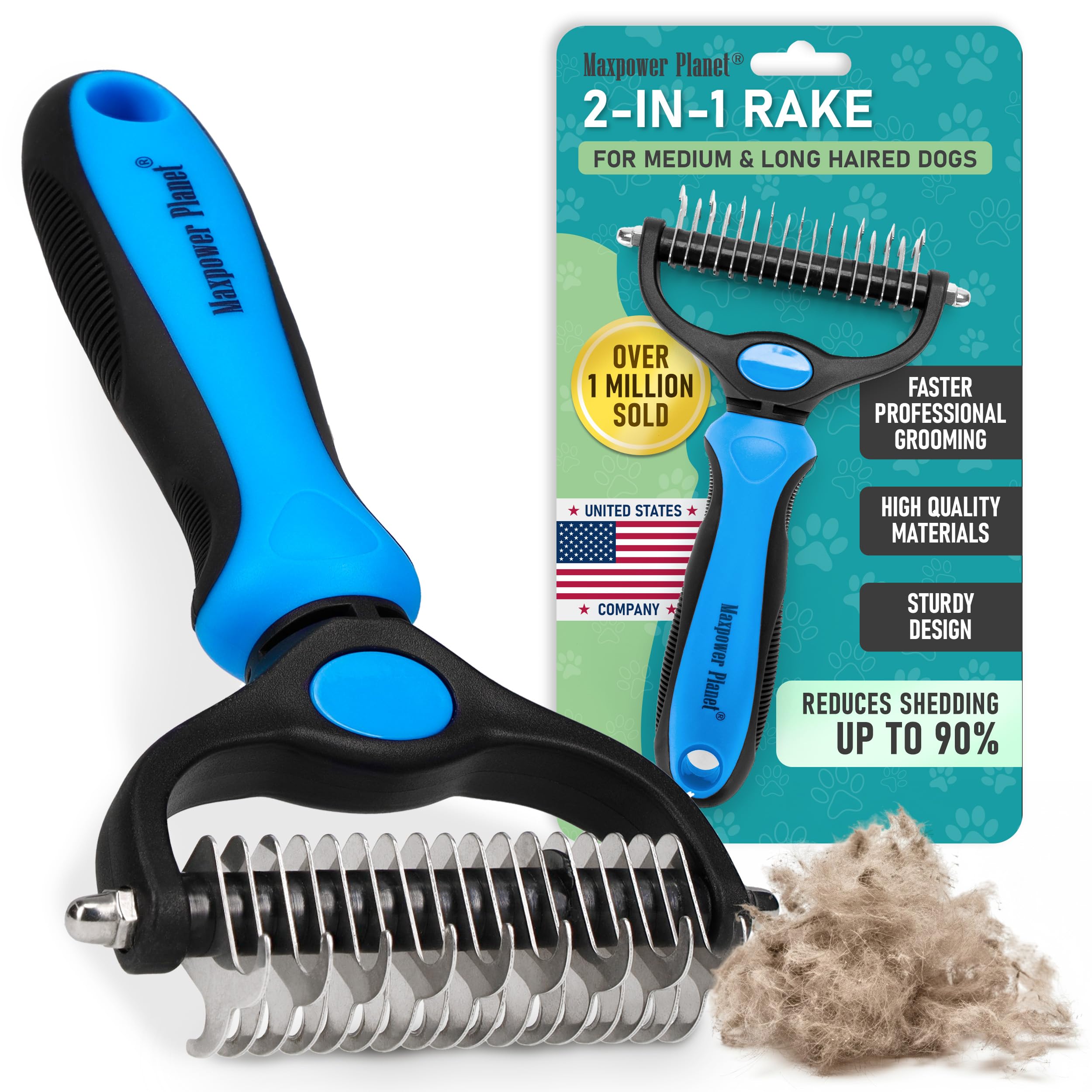
Two tooth counts on one rake is the whole idea here: nine teeth on one side for stubborn knots, seventeen on the other for undercoat. We found the seventeen-tooth side is the one that earns its place on a doodle in coat blow; it pulls loose undercoat without scraping. The nine-tooth side is more aggressive, so we save it for mats and use a light hand. The rounded teeth are gentler than the tooth count suggests.

The rubber base gives the handle some grip, and the four-ounce weight is light enough to use for a few minutes at a time. It is a rake, so it does not fluff or finish the coat the way a slicker does. We reach for it when the slicker loads up with loose hair and we want to get ahead of the shed. The head is compact enough to work around the shoulders and back.

For the money, this is the inexpensive rake we add to a doodle kit for undercoat and mats. It is not the brush we use to finish a fluffy coat, and the aggressive side needs a light hand. But as a second tool, it does a lot of work without asking for much space or care.

Bottom line: Add this inexpensive rake to a doodle kit for undercoat and mats; we do not use it to finish a fluffy coat.

7

Swihauk Self-Cleaning Slicker

Swihauk Self-Cleaning Slicker

Quick cleanup

Our Score 9.2/10
Check Price

Worth Noting

  • Pins are shorter than long-pin slickers
Handle
TPR
Cleaning
Push-button
Coat Type
Long and short hair
Bristle Material
Stainless steel
Read the full review

The push-button is the first thing you notice: press it and the bristles retract, leaving the hair in a neat pad. That cleanup is genuinely convenient, and the rounded pins are gentle enough for a dog that does not love being brushed. We found the brush useful for quick passes on legs, face, and paws, where a big slicker feels clumsy.

For a Goldendoodle, the limitation is pin length: it does not reach as deep as the long-pin slickers here, so it is a finishing tool rather than a mat remover. If your doodle is already combed out, it keeps the surface tidy and the hair off your floor. The handle is light and the button works one-handed, which matters when the other hand is holding a wiggly paw.

We kept it by the door for a quick once-over after a walk. The hair release is the reason: no digging at the bristles, no wet paper towel, just a clean pad of fur to throw away. The bristles are also capped, so it is a good choice for a dog that flinches at sharper slickers.

As a primary brush for a thick, curly Goldendoodle, it falls short; as a quick-finish tool for a coat that is already detangled, it earns its place. That is the role we recommend it for, and it is a useful one.

Bottom line: We keep this one for quick finishing passes and easy cleanup, not as the primary brush for a doodle that mats.

How We Tested 14 Brushes on Real Doodle Coats

We started with research rather than a shopping cart: pin length and spacing, whether the tips were coated, how the handle sat in a wet hand, and whether the brush could be cleaned without pulling hair out by hand. That narrowed the field to 14 brushes, including slickers, undercoat rakes, pin brushes, combs, and a couple of dematting tools, which we used for four months.

Testing happened where the mats actually form: on the living room rug after the evening walk, on the bathroom floor after a bath, and on a towel in the back seat after a swim. Each brush got two five-minute sessions a week. We counted the passes it took to clear the knot behind the ears, then ran a metal comb behind the brush to see whether it had reached the skin or only skimmed the topcoat. We also watched the dog, since leaning in for more or standing up and walking off told us plenty.

Sharpness and durability got their own checks. Before any brush touched the dog, we drew it across the inside of a forearm to feel for a scratch, then washed each one in the sink weekly to see whether pins bent, rusted, or vanished into the coat. Ease of use came down to wet-hand grip and whether a self-cleaning pad released the hair or needed fingers. Set against months of use, the mid-priced brushes held up as well as the expensive ones.

How to Choose Dog Brushes for Goldendoodles

Pin length and density come first

A Goldendoodle coat is dense enough that a short-pin brush can glide over the surface and leave the undercoat untouched. We look for pins around an inch or longer, set at an angle, and mounted on a pad with some give. Density matters too: more pins per square inch means fewer passes and less chance of catching a knot. The Chris Christensen Big G is the clearest example here, and the Paw Brothers slicker is the value route to the same long-pin approach. Whatever you choose, work in thin sections and brush down to the skin rather than scrubbing the surface.

Choose the tool by the job, not the label

A slicker is the daily detangler; a rake is for mats and undercoat; a shedding blade is for loose hair. Most Goldendoodles need a slicker first, and only some need the other two. If mats are already forming, add a dematting rake like the Poodlie and work from the edge of the knot. If the coat is shedding heavily, a blade like the SleekEZ clears the loose undercoat after the slicker. Buying all three at once is usually overkill; build the kit as the coat tells you what it needs.

Gentleness is mostly technique

Rounded pin tips help, but pressure and sectioning matter more. We keep one hand on the skin to feel for lumps and mats, use short strokes, and stop when the dog flinches. A slicker should not scratch; if it does, you are pressing too hard or the pins are too short. For mats, hold the coat at the base and work from the outside in. Never dig a rake into a tight knot or use one on the face, ears, or other sensitive spots.

Cleaning and durability decide how often you use it

A brush that is a hassle to clean ends up in a drawer. Self-cleaning models such as the Swihauk make cleanup quick, but the retractable pins are often shorter than the long-pin slickers that do the deep work on a doodle. We prefer a brush we can clear with a comb or a quick pass of the fingers, then wash and dry. Check the pins for bends and the handle for cracks every few weeks; a worn tip or a loose head is a replacement signal.

Build a small kit, not a drawer of duplicates

Start with one long-pin slicker and a metal comb. The comb is how you check whether the slicker actually reached the skin, especially around the ears, armpits, and tail. Add a rake only if mats are a recurring problem, and a shedding blade only if loose hair is overwhelming. A budget set like the Saccison slicker-and-comb or the Maxpower rake can fill those roles without much outlay. Skip the flea comb and the bath brush unless you have a specific use for them.

Frequently Asked Questions

Final Verdict

For most Goldendoodle households, the Chris Christensen Big G is the brush to start with. Its dense angled pins and flexible pad do the deep work that keeps mats from forming, and that is the difference between a dog that stays comfortable and one that ends up at the groomer for a shave-down.

If you want the same long-pin approach for less, the Paw Brothers Extra Long Slicker is our value pick. Add the Poodlie rake only if mats are already part of your routine; it is a rescue tool, not a daily brush.