Collars & Leashes

Best Dog Harnesses for Walking

The first time my dog backed out of his collar halfway across a crosswalk, I learned that a walking harness is only as good as its fit. A loose one lets a determined dog slip free; a tight one rubs under the front legs. The right harness solves both: it keeps leash pressure off the throat, spreads it across the chest, and stays put whether your dog is a steady stroller or a sudden lunger. It also has to go on without a wrestling match. Over six months, my team and I walked a dozen harnesses on dogs from a 12-pound terrier to an 80-pound puller.

The biggest surprise was how little price predicted performance. A few budget picks held their stitching and hardware better than fancier ones, while some heavily padded styles soaked up water and stayed heavy. What mattered most was adjustability at the neck and chest, buckles that didn't loosen mid-walk, and webbing that didn't chafe after a mile. The picks below are the ones that earned a second walk — and a third.

1

ICEFANG Tactical Harness

Top Pick
ICEFANG Tactical Harness

Strong pullers

Our Score 9.4/10
Check Price

Worth Noting

  • Straps can loosen under hard pulling
Handle
Top control handle
Buckles
Six quick-release: two metal, four plastic
Gear Mounts
MOLLE strips on both sides
Leash Points
Three leash clips
Read the full review

Three leash attachment points and a pair of metal buckles put the ICEFANG in a different class from the budget vests. It is a tactical-looking harness, with MOLLE strips on both sides and enough webbing to look at home on a working dog. The point is not the look, though: it is the control.

This is the pick for a strong, large dog and a walker who wants to change leash position without changing gear. The extra attachment points let you move from a shorter, closer hold to a longer walking line; the padded chest and belly panels spread pressure; and the top handle gives you a handhold when you need it. We also like the two metal buckles mixed into the six-buckle layout, since those are the ones taking the most load.

Six buckles make the ICEFANG slower to put on than a two-buckle vest, especially on a wiggly dog. The plastic buckles are the parts we trust least, and the padded body is bulkier than a simple walking vest. None of that is a dealbreaker for a calm handler who checks the fit, but this is not the harness for someone who wants to clip in and go in three seconds.

For a big dog that hits the end of the leash, the trade is worth it. The metal hardware, multiple leash points, and sturdy build give us more confidence than the cheaper vests, and the MOLLE panels are a bonus on hikes.

Bottom line: We recommend the ICEFANG for strong, large dogs and handlers who want metal hardware and multiple leash points; it offers the most control in this group.
2

Ruffwear Front Range

Ruffwear Front Range

Everyday all-around walks

Our Score 9.2/10
Check Price

Worth Noting

  • Most expensive harness here
Weight
5.92 oz
Padding
Closed-cell foam chest and belly panels
Adjustment
Four points
Leash Points
Back aluminum V-ring; reinforced chest webbing
Read the full review

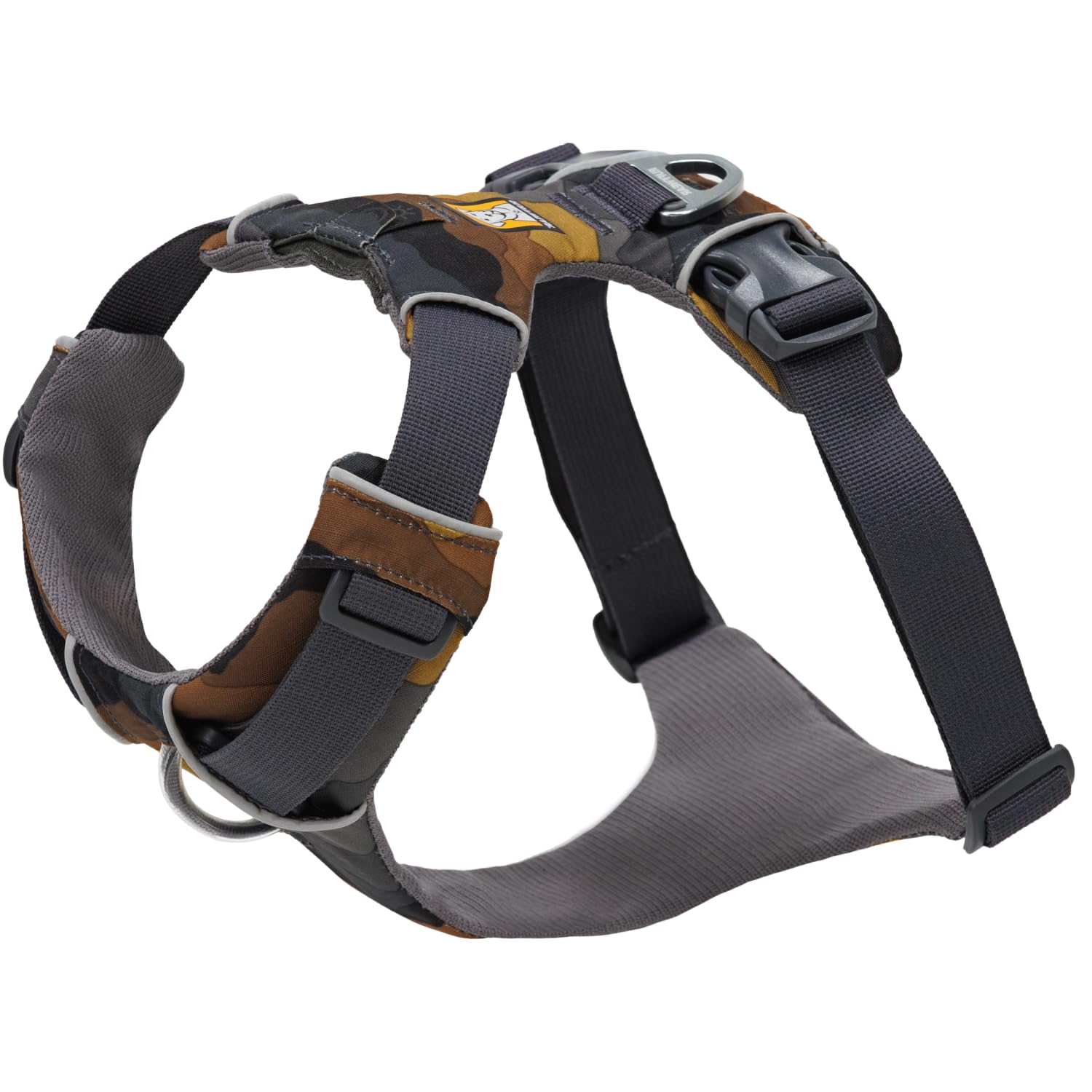
The first thing we check on a walking harness is the chest panel, because that is where a dog leans into the leash. Ruffwear pads the Front Range with closed-cell foam across the chest and belly, and the result is a soft, structured vest rather than a set of straps. That padding is the reason this one stays comfortable on a long walk.

Four adjustment points let you set the neck and chest separately, which matters on dogs with a deep chest and a narrow neck. The back has an aluminum V-ring, and the chest has reinforced webbing for a front attachment. Neither point is a magic cure for pulling; the front clip redirects a lunge, and you still need to teach a loose leash.

At 5.92 ounces, the Front Range is light enough that a medium dog can wear it without a change in stride, and the reflective trim and Beacon loop are useful on early or late walks. We also appreciate the small ID pocket, a detail that keeps tags from jingling against the chest. A loose fit is the one thing to avoid: measure the chest and check the neck gap before you cut the tags.

Yes, this is the most expensive harness in the group. For most everyday walkers, it is still the easiest recommendation to make: comfortable padding, two secure leash points, and enough adjustment for unusual shapes, in a package that does not weigh the dog down. We keep coming back to it because it gets the boring parts right.

Bottom line: Our top pick for everyday walks: the Front Range pairs comfortable padding, four-point adjustment, and two secure leash points in a light package, if you will pay for it.

3

tobeDRI No-Pull Set

tobeDRI No-Pull Set

Leash-included setup

Our Score 9.2/10
Check Price

Worth Noting

  • Sizing runs small for some dogs
Buckles
Locking quick-snap buckles
Included
Harness and 5 ft leash
Material
Nylon oxford with mesh lining
Leash Points
Front and back metal delta rings
Read the full review

A harness that arrives with a matching five-foot leash is a practical kind of value, especially for someone buying their first dog harness. The tobeDRI pairs a padded nylon vest with that leash, and the two look like they were designed together rather than thrown in as an afterthought.

The hardware is the reason to look closer: locking quick-snap buckles on both sides and metal delta rings at the front and back. That front ring gives you a redirect point for a dog that pulls, while the back ring is the one we use for a relaxed walk. The locking buckles add a little security at the neck and chest, which is welcome on a dog that has learned to pop a standard clip. The nylon is machine washable, which helps after a muddy walk.

Sizing is where to slow down. Use the chest measurement rather than the size name, and size up if you are between. The padding is decent rather than plush, and the leash is a basic fixed-length lead, not a training line. For a straightforward daily walk, the combo still makes sense.

The five-foot leash is a sensible length for sidewalk walks: long enough for a dog to sniff, short enough to keep them close at a corner. That practical pairing is what makes the set feel complete.

Bottom line: We recommend the tobeDRI as a leash-included value: front and back metal rings, locking buckles, and a chest measurement that matters more than the size name.

4

AUROTH Tactical Vest

AUROTH Tactical Vest

Trail and work

Our Score 9.2/10
Check Price

Worth Noting

  • Plastic buckles are the weaker hardware
Padding
Air mesh with padded cotton
Size Range
Large: neck 18-29 in, chest 24-37 in, 45-80 lb
Gear Mounts
MOLLE strips on both sides
Leash Points
Two metal leash points
Read the full review

If your walks are really trail sessions, the AUROTH makes more sense than a plain vest. It is a tactical harness with MOLLE strips on both sides, a padded air-mesh body, and a cut that is meant to sit close on a working dog.

The MOLLE panels are the detail that separates it from the rest of the field. You can add a small pouch, a patch, or a backup light without clipping a separate pack to the dog. For a hike or a day of training, that is useful; for a twenty-minute neighborhood loop, it is just extra webbing.

The AUROTH also has two metal leash points, four adjustment points, and a top handle, so the basics are covered. The padded cotton cushion under the mesh is a nice touch on a short-coated dog, and the reflective trim helps at dusk. Machine washable is a practical bonus after a muddy walk.

The trade-off is bulk: the tactical layout is heavier and more involved than a simple walking vest. The size range for the large is specific, too: neck 18-29 inches and chest 24-37 inches, with a 45-80 pound weight range. Measure before ordering, because this is not a harness that forgives a guess.

For a trail dog or a working dog that carries a little gear, it remains our choice over a plain vest. It feels purpose-built, and the MOLLE system is not decorative. Just do not buy it for a simple walk and expect it to disappear on the dog.

Bottom line: We like the AUROTH for trail walks and working dogs: MOLLE gear mounts, padded support, and two metal leash points, though it is more harness than a simple stroll needs.

5

rabbitgoo No Pull Vest

rabbitgoo No Pull Vest

Budget everyday walks

Our Score 9.0/10
Check Price

Worth Noting

  • Webbing can wear at stress points
Weight
10.6 oz
Adjustment
Four adjustable straps
Chest Range
17-33.4 in
Leash Points
Front and back metal hook loops
Read the full review

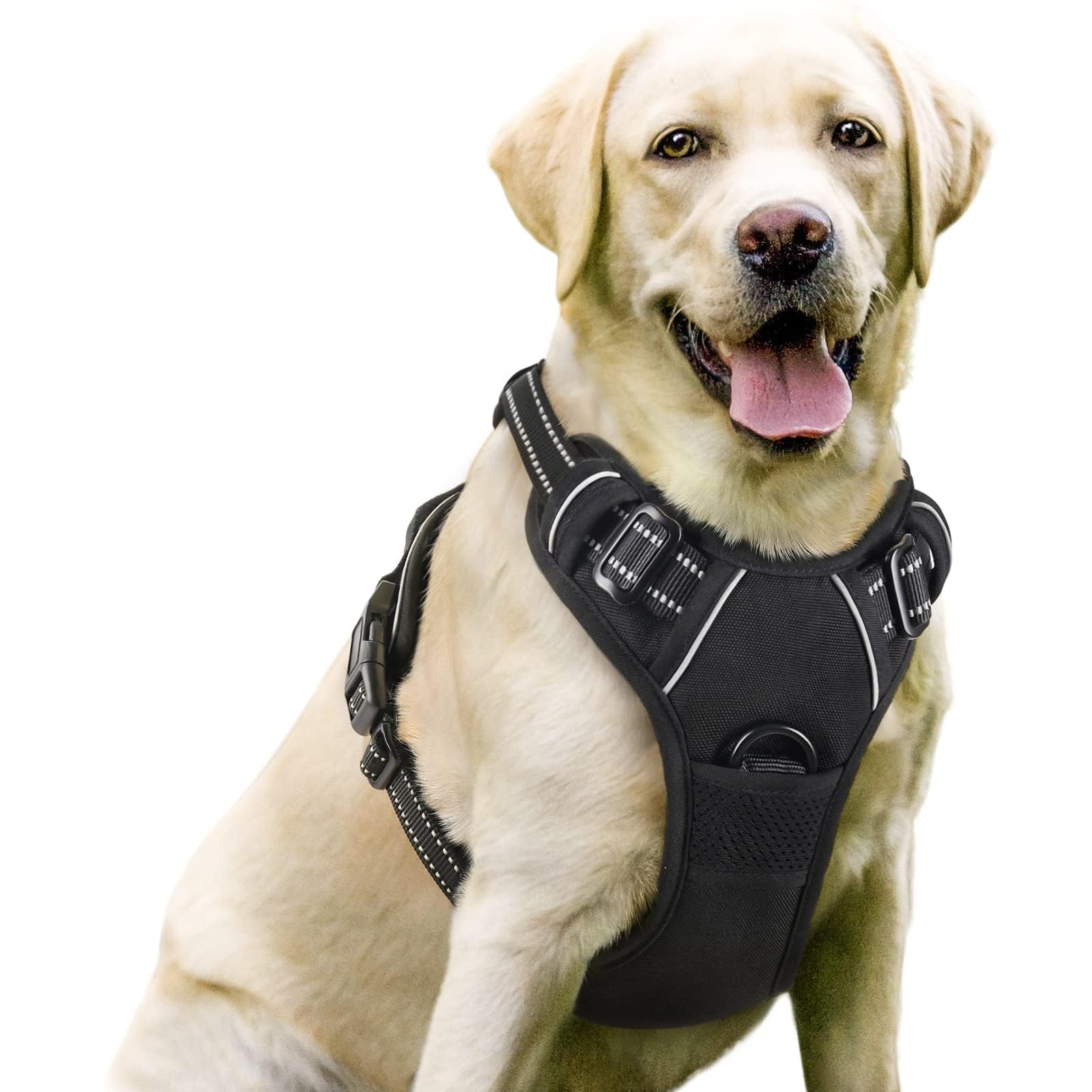
The rabbitgoo is the harness we point to when the budget is the first question. It gives you front and back metal leash loops, four adjustment straps, reflective trim, and a top handle for less than most of the field. That combination is why it remains a default for big dogs and their walkers.

The vest slips over the head and closes with two quick-release buckles, so it is quicker to put on than a three-buckle design. The 17- to 33.4-inch chest range covers a lot of Labs, shepherds, and huskies, and the handle is useful when you need to hold a dog steady at a curb. The padding is thin but adequate for regular walks; it is not the plushest vest here.

What keeps it from the top spot is the fit. The straps are not the easiest to thread, and it takes a few walks to get the chest and neck balanced. That is a minor annoyance once set, but a dog that pulls hard can work the harness loose, so check the adjusters after a lively walk. The four straps do give you enough range to fit a dog that is between sizes.

Bottom line: The budget pick we recommend first: front and back leash points, a handle, and broad sizing, with adjusters that ask for a little patience.

6

PHOEPET No-Pull Vest

PHOEPET No-Pull Vest

Head-shy dogs

Our Score 9.0/10
Check Price

Worth Noting

  • Straps can be fussy to adjust
Weight
7.68 oz
Closure
Three buckles; no over-the-head fit
Material
Oxford cloth, nylon, POM buckles
Leash Points
Front and back metal hook loops
Read the full review

Not every dog will stand still for a harness pulled over their head, which is where the PHOEPET earns its place. It opens at the neck and chest with three buckles, so you can wrap it around the dog instead of threading ears through a loop. For a head-shy rescue or a wiggly puppy, that is a real quality-of-life difference.

The rest is sensible: two metal leash loops, one at the chest and one at the back; a soft handle; reflective material; and a light 7.68-ounce build. We like that it is one of the least expensive harnesses here and does not feel like a disposable one. The front loop gives you a little steering help on a dog that surges, though it will not replace leash training.

The three-buckle design has a cost: there are more pieces to line up before a walk, and the neck buckle has to sit flat to stay comfortable. The cut is less forgiving on a dog with a very deep chest or a narrow neck, so measure rather than guessing. Those are small hurdles for a dog that hates overhead harnesses, and the low price makes it easy to try.

Bottom line: The pick we choose for a dog that fights an over-the-head harness: three buckles let you close it around the neck and chest instead, with front and back leash points.

7

matilor Step-In Harness

matilor Step-In Harness

Small dogs

Our Score 9.0/10
Check Price

Worth Noting

Design
Step-in vest
Closure
Double D-ring and safety-lock buckle
Included
Harness and leash
Size Range
Medium (Chest 13.5''-16.5'', Weight 10-15 lb)
Read the full review

A step-in harness is a small kindness for a dog that dislikes being dressed. The matilor lays flat on the floor, the dog steps in, and the buckles close over the back. For a small dog, that is faster than wrestling a vest over the head, and the air-mesh fabric is light enough for daily walks.

This is the best small-dog pick here, and we like that the matching leash makes it an easy starter set. The medium is sized for a 13.5- to 16.5-inch chest and a 10- to 15-pound dog, with a double D-ring and a safety-lock buckle doing the securing. The reflective trim is a nice touch on a dark evening, and the whole thing is machine washable.

The size range is the catch. It is narrow, and the medium runs small for some dogs, so measure the chest rather than buying by breed or weight. The step-in cut also gives you less to adjust than a vest with four straps; a dog at the edge of the range may end up between sizes. If your dog fits, it is a lot of harness and leash for the money.

Bottom line: The small-dog pick we recommend: a step-in air-mesh harness with a matching leash, provided your dog measures inside its narrow chest range.

8

WINSEE XL Harness

WINSEE XL Harness

Extra-large dogs

Our Score 9.0/10
Check Price

Worth Noting

  • Straps can loosen during walks
Handle
Top handle
Material
1680D nylon
Fit Range
21-33 inch neck, 24-49 inch chest
Leash Points
Front and back metal D-rings
Read the full review

Extra-large dogs are often left with the same five harnesses as everyone else, scaled up badly. The WINSEE's XL range is the reason it is here: a 21- to 33-inch neck and a 24- to 49-inch chest, which covers dogs that fall outside the usual large-size chart. That is a broad, useful window.

The harness itself is a serious piece of nylon: 1680D fabric, two metal D-rings, a top handle, and slide adjusters at both the neck and chest. The front and back leash points give you options on a walk, and we like that the reflective straps are bright enough to matter at dusk. The 1680D nylon is firm rather than plush, but it is sturdy and simple to clean.

The fit has a lot of range to manage, so the first few walks are about dialing in the chest rather than clipping on and going. A broad range is exactly what an XL dog needs, though, and the adjusters have enough travel to make it work. For a big dog that needs room, that is a fair trade.

Bottom line: The extra-large pick we recommend: generous neck and chest adjustment, two metal leash points, and a handle, with straps that need a check on strong pullers.

9

Eagloo No-Pull Vest

Eagloo No-Pull Vest

Between-size dogs

Our Score 9.0/10
Check Price

Worth Noting

  • Webbing and stitching are the wear points
Weight
8.6 oz
Adjustment
Four adjustable sliders
Chest Range
15-35.4 inches
Leash Points
Front and back metal rings
Read the full review

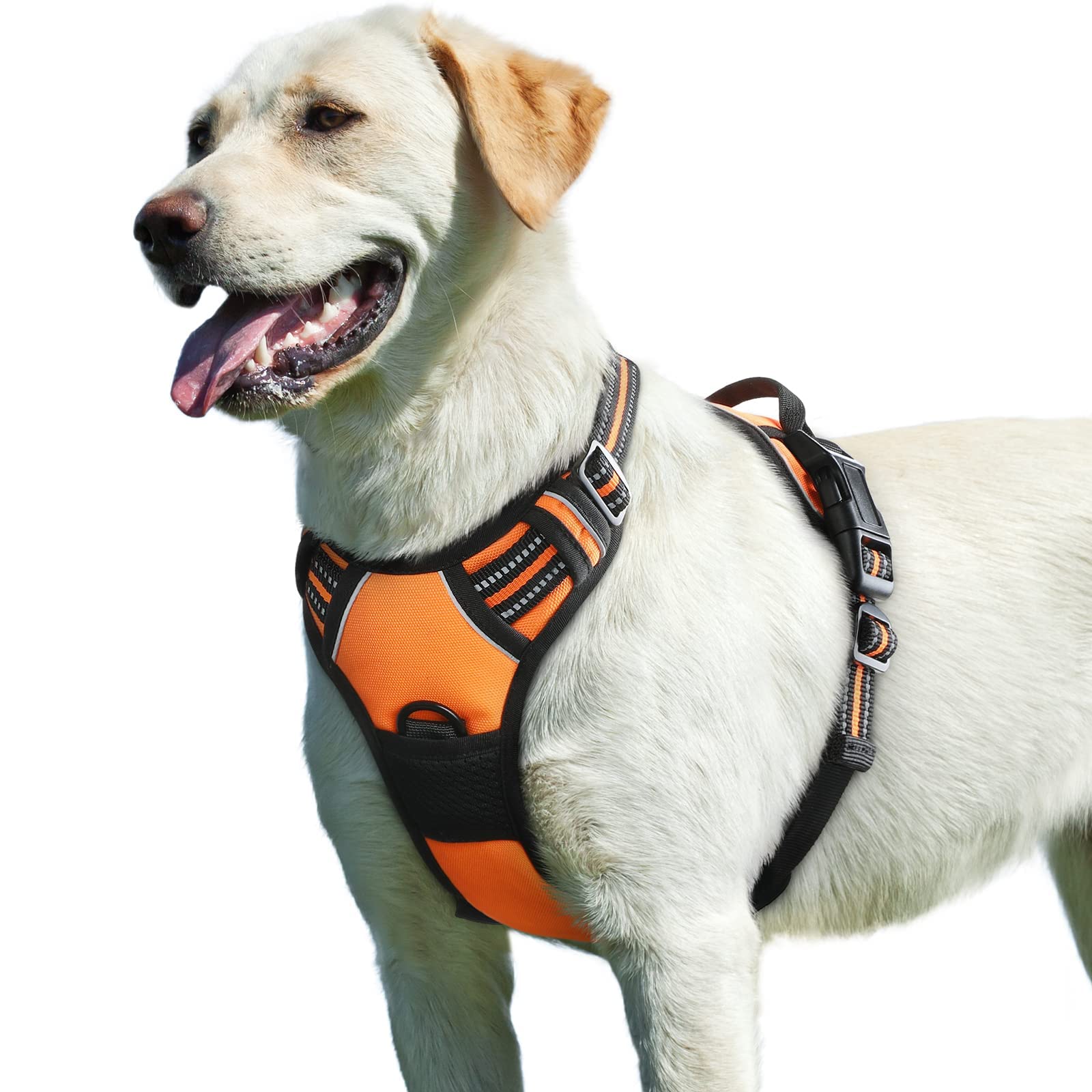
The Eagloo covers a slightly wider chest range than the rabbitgoo, from 15 to 35.4 inches, which makes it the better bet for a large dog that sits between sizes. It is a familiar vest shape: two quick-snap buckles, four adjusters, a padded air-mesh body, and a top handle.

The front and back metal rings give you the same two options as the rest of the budget group, and the reflective trim and orange color are easy to spot on an evening walk. At 8.6 ounces, it is light enough for a big dog to wear without a change in stride, and the handle is firm enough to steady a dog at a crossing.

The price is low, and the broad fit is the main draw. The first fitting takes longer than the rabbitgoo's because there is more range to take up, but once set it stays comfortable on a long walk. The padding is adequate rather than generous, so a dog with sensitive skin under the front legs may prefer the Ruffwear.

Still, for a dog that needs a little more chest room than the budget leader offers, it is a sensible second look. We like it as a spare or a second-dog harness, especially when the color makes it easy to tell two dogs apart at the door.

Bottom line: We recommend the Eagloo when a broad chest range matters more than polish: front and back clips, a handle, and a light build for the money.

How We Tested the Best Dog Harnesses for Walking

I started by pulling together every walking harness I could find from brands I knew and a few I didn't, then narrowed the list by sizing range, adjustability points, hardware type, and price. The goal was a mix of step-in, over-the-head, and strap-style designs, because no single style suits every dog. We ended up with 12 harnesses and six months of daily walks.

Each harness was fitted to as many of our three test dogs as its size range allowed: a 12-pound terrier, a barrel-chested 40-pounder, and an 80-pound puller. They wore them for morning and after-dinner walks through the neighborhood, weekend trail outings, and a few rainy days. I checked whether two fingers could slide under each strap without the dog straining, then watched whether the harness stayed centered after a shake-off. I timed how long it took one person to put each on and take it off, and noted whether a dog could back out while I offered a treat distraction. After every walk, I checked the neck and chest straps for slipping, looked under the front legs for redness or chafing, and felt whether the padding stayed flat or bunched.

To judge durability and value, I inspected stitching, webbing, and buckles before and after the test period, rinsed off mud, and watched for fraying or hardware that loosened. I also compared what each harness cost against how it held up; a cheap harness that lasts is a better value than a costly one that rubs or fails. The final picks are the ones that stayed secure, comfortable, and easy to use across all those walks.

How to Choose Dog Harnesses for Walking

Measure the chest, then the neck

Start with the widest part of the chest, just behind the front legs, and then measure the neck. A harness sold by weight or breed is only making an educated guess; the chest range is the number that keeps the straps off the throat and the front legs. The matilor's medium is built for a 13.5- to 16.5-inch chest, while the WINSEE XL spans 24 to 49 inches. Both are useful numbers because they tell you when a harness is out of range. Leave room for two fingers under the chest strap and check that the neck opening does not slide forward.

Pick the closure you can manage

Over-the-head, three-buckle, and step-in harnesses all walk the same dog; the difference is at the door. A three-buckle design like the PHOEPET is the kindest choice for a dog that backs away from a loop, while the matilor's step-in cut suits a small dog that will stand on the fabric. More buckles mean more security and more time, so do not choose a six-buckle harness unless you want that trade. The test is simple: can you put it on a wiggling dog without pinching skin or guessing which strap goes where?

Use the right leash point for the walk

The back ring is for a relaxed walk and everyday steering; the front ring is for a dog that surges, because it turns the chest slightly toward you when the leash tightens. That is a management aid, not a training cure. A front clip can make a strong dog easier to handle while you teach a loose leash, but it will not stop a determined puller on its own. A top handle helps at crossings and in tight spaces, and the ICEFANG's three clips let you change points without changing harnesses.

Choose the build you will maintain

Padding matters most where the harness crosses the chest and sits behind the front legs. Closed-cell foam, as on the Ruffwear, resists soaking and stays comfortable on a long walk; thinner mesh vests are cooler but offer less cushion. Metal leash rings and metal buckles are worth paying for on a strong dog, while plastic hardware is lighter and usually adequate for a small, calm walker. Reflective trim is a practical extra for early or late walks. Whatever you choose, check the webbing and stitching for fraying after muddy walks, and store it dry.

Frequently Asked Questions

Final Verdict

If you want one harness for most everyday walks, choose the Ruffwear Front Range. The closed-cell padding, four-point fit, and two metal leash points make it the most comfortable all-rounder here, and it stays light on the dog. The premium is real, but it is the one we reach for first.

If the budget decides, the rabbitgoo is the clear alternative: front and back clips, a handle, and a broad chest range for a fraction of the cost. Just take the time to fit it and check the webbing for wear.