Collars & Leashes

Best Medium Dog Harnesses of 2026

The worst part of walking a medium dog isn't the pulling—it's the moment the harness shifts, the dog backs up, and you're both tangled in nylon. A good medium dog harness spreads pressure across the chest instead of the throat, stays put when a squirrel appears, and makes the daily walk feel less like a negotiation. Medium is a tricky size, though: a 25-pound dog and a 55-pound dog can both wear that label, so girth measurement and adjustment range matter more than the tag.

Over the past eight months, my team and I have fitted, adjusted, and walked 14 medium dog harnesses. We paid attention to padding and chafing, buckles and stitching, how easy it was to get a wiggly dog in and out, and how the webbing and colors held up after muddy walks and a few rinses. The ones that earned a spot all shared one thing: they stayed snug without pinching and didn't need constant readjusting mid-walk. Below are the harnesses that made the cut, sorted by what they do best.

1

ICEFANG Tactical Dog Harness

Top Pick
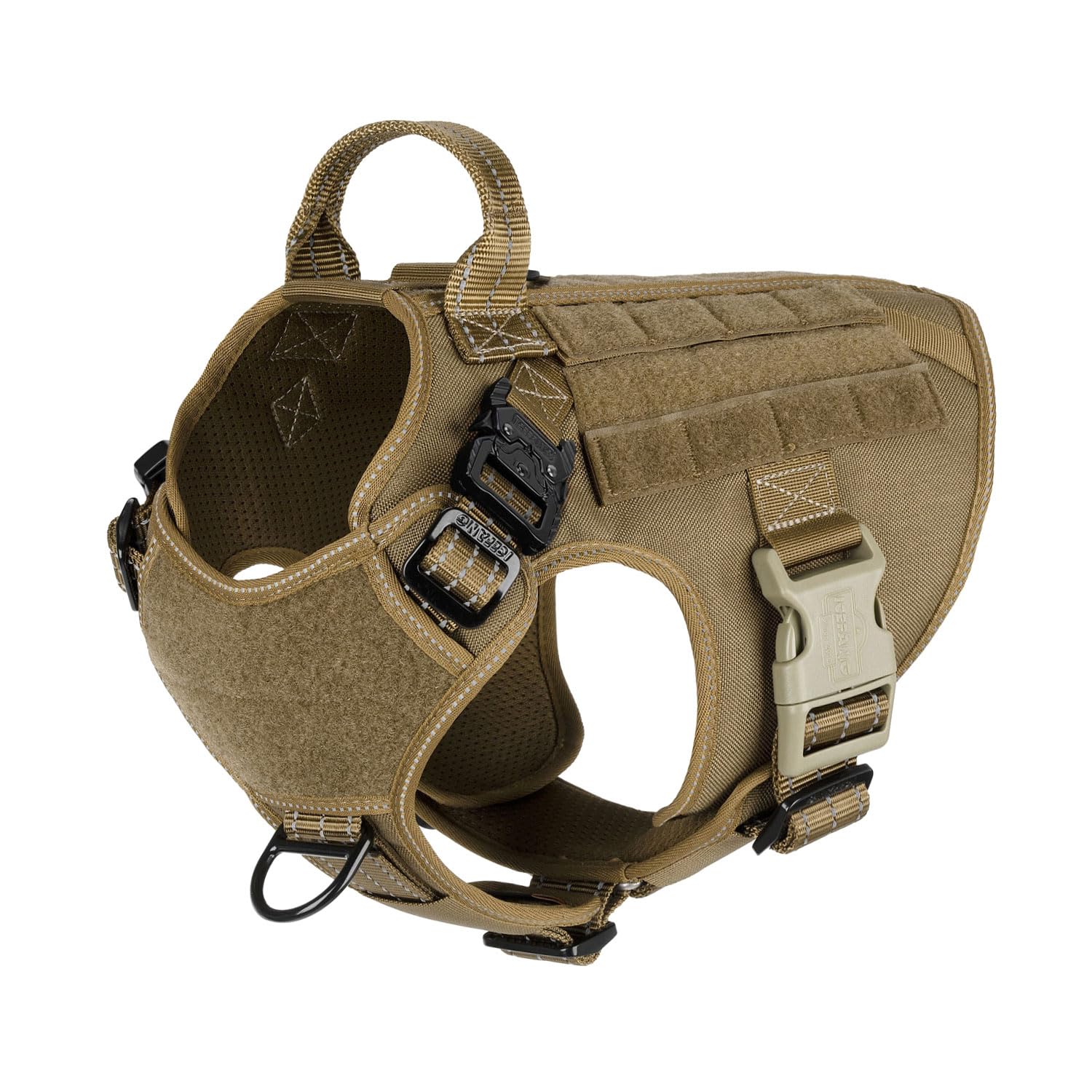
ICEFANG Tactical Dog Harness

Strong pullers

Our Score 9.4/10
Check Price

Worth Noting

  • Can be backed out of when chest straps are loose
  • Hand wash only
Size
Medium
MOLLE
Both sides
Neck Buckles
2 aluminum, 2800N
Chest Buckles
2 plastic, 1500N
Read the full review

Two aluminum buckles at the neck are why this one costs more than the other tactical harnesses here. They're rated to 2800 Newtons, and metal at the neck changes how the harness behaves when a dog lunges: the load goes into the buckle instead of flexing it, which is exactly where we want the strength on a dog that hits the end of the leash.

The rest of the build follows. Seams are reinforced and double-stitched, the back carries a heavy V-ring, and the chest has its own anti-pull D-ring so you can walk from either point. There are hook-and-loop panels on both sides for patches — on the Medium they run about 3 by 4.5 inches, enough for a name tape and not a lot else.

Fit leans snug, which is what you want on a puller, and the padding sits where the straps cross the chest rather than on the parts nobody touches. It's a more substantial harness than the vest-style picks, and a dog that isn't used to wearing anything will take a walk or two to stop noticing it.

Bottom line: The pick for a strong medium dog that leans into the leash, with metal neck buckles that take the load.

2

AUROTH Tactical No Pull Dog Harness

AUROTH Tactical No Pull Dog Harness

Everyday walks

Our Score 9.2/10
Check Price

Worth Noting

  • Over-the-head entry is slow with a wiggly dog
  • Plastic chest buckles are the first part to wear
Care
Machine wash
Size
M: neck 16-22 in, chest 22-33 in, 35-50 lb
Padding
Breathable padded panels
Leash Clips
Front and back metal
Read the full review

The size band is what earns this one the top spot. AUROTH lists the Medium for necks of 16 to 22 inches, chests of 22 to 33 inches and dogs of 35 to 50 pounds, which puts it in the middle of medium rather than at the top of small — and that middle is exactly where harness shopping goes wrong. Four adjustment points let us take up slack at the chest without dragging the straps into the armpits, and the fit stayed where we set it.

Both leash attachment points are metal, which we care about more than a long feature list: the front ring redirects a dog that leans into the leash, and the back ring is the one for a relaxed walk. The harness is machine washable, rarer in this group than it should be — most of these are hand wash only and stay muddy until you get around to it. The padded handle at the back is there when you need to hold a dog close at a curb.

One thing the photos oversell: the MOLLE strips. They'll hold a flat patch or a small pouch, but the panel is narrow, so the fully loaded packs in the marketing shots are a stretch. We ended up ignoring them, and the harness didn't feel like less for it.

Bottom line: Buy this one if your dog measures between 22 and 33 inches around the chest and you want metal at both leash points.

3

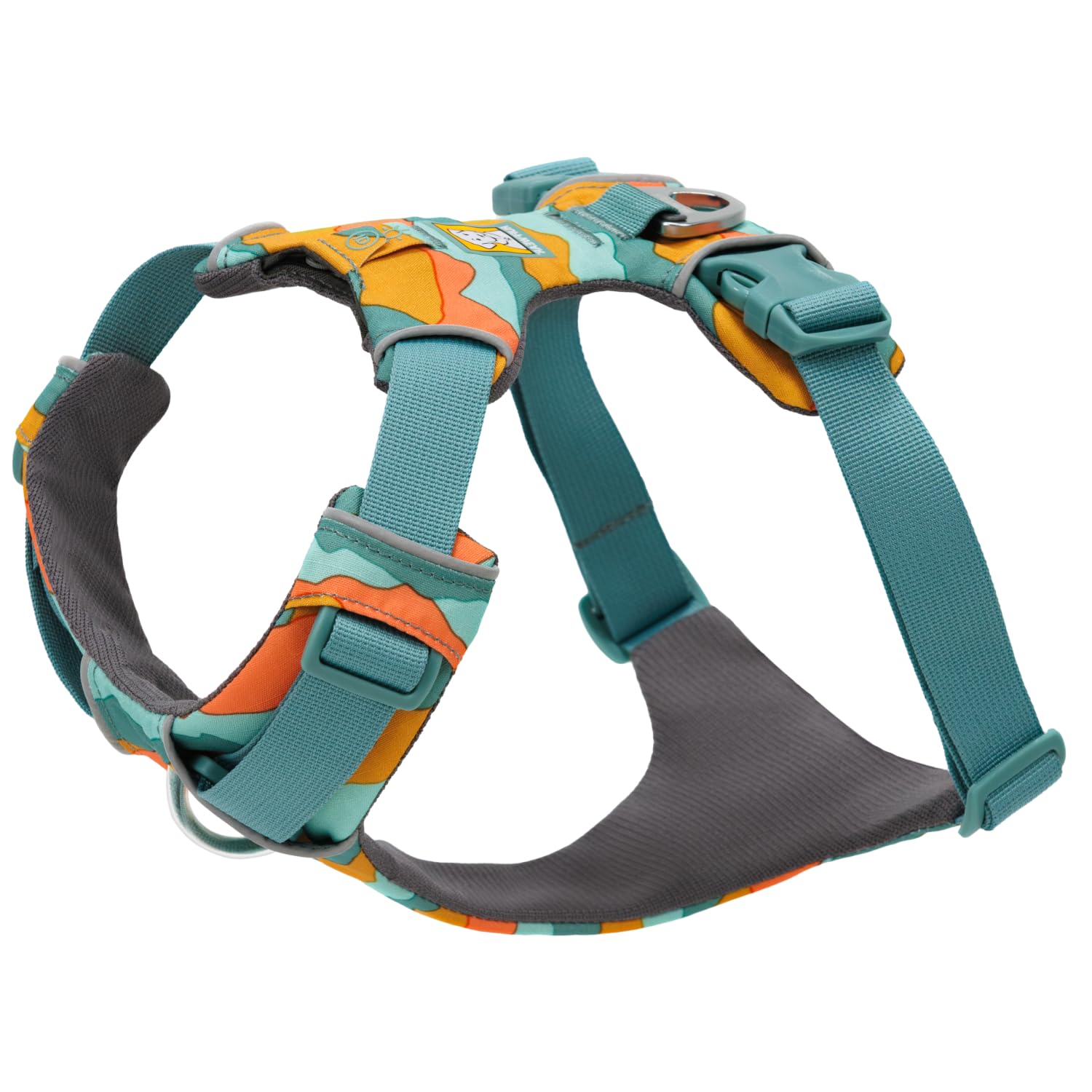
Ruffwear Front Range Dog Harness

Ruffwear Front Range Dog Harness

All-day hikes

Our Score 9.2/10
Check Price

Worth Noting

  • Highest price in this group
  • Hand wash only after muddy trails
Size
Medium
Weight
5.92 oz
Padding
Closed-cell foam
Adjustment
Four points
Read the full review

This is the most expensive harness we're recommending, and the money goes somewhere you can feel: closed-cell foam padding through the chest and belly panels, and a listed weight of 5.92 ounces. That weight is the number that matters for a medium dog on a long hike — nothing else here is close — and the padding is why a strap doesn't end up rubbing a bald patch behind the front legs by the end of the day.

The chest attachment is reinforced webbing rather than a metal front ring, and it's honest about what that does: it redirects a dog rather than overriding one. On a hard puller the leash still comes taut. We like it for steering past another dog or around a corner, and we wouldn't rely on it as a shortcut past loose-leash training.

The small touches are where Ruffwear earns the price. There's an ID pocket, so the tags stop swinging against the leash ring, and a dedicated loop for a clip-on light, which beats threading a carabiner through the D-ring on a dark walk. Four points of adjustment let you set the neck and the chest separately rather than compromising between them.

Bottom line: Worth the premium if your dog wears a harness for hours and you want the lightest, best-padded option here.

4

Beebiepet Tactical Dog Harness

Beebiepet Tactical Dog Harness

Starter kit

Our Score 9.2/10
Check Price

Worth Noting

  • Plastic clips on a heavy-duty build
  • Sizing runs large against the chart
MOLLE
Both sides
Included
5 ft leash, ID tag
Adjustment
Four points
Weight Range
20-50 lb
Read the full review

The box is the pitch: a harness, a five-foot rope leash with a padded handle, a writable ID tag and two hook-and-loop patches. For a first harness on a rescue, or a dog that has just outgrown its puppy gear, that's one order instead of three, and the leash is a real one rather than a token.

The harness is a four-point-adjustment vest with MOLLE strips on both sides, sized for 20 to 50 pounds, with two leash clips and a padded handle at the back. The webbing is nylon, the chest panel is soft, and it's plain enough for a dog that isn't interested in looking tactical.

The ID plate is the detail we keep coming back to. You write your number on it and fix it to the harness, so a dog that slips its collar still carries your details — a small thing that matters the one time you need it. It's the sort of extra that costs the maker almost nothing and saves an owner a very bad week.

Bottom line: A tidy starter kit for a new medium dog — harness, leash and a writable ID tag — as long as you size carefully.

5

rabbitgoo No Pull Dog Harness

rabbitgoo No Pull Dog Harness

Tight budgets

Our Score 9.0/10
Check Price

Worth Noting

  • Webbing and stitching wear on daily pullers
Care
Hand wash
Chest Range
15-27.8 in
Leash Clips
Front and back metal
Weight Range
10-25 kg
Read the full review

The straps are the sticking point. They arrive stiff, the sliders want two hands, and the whole harness takes a couple of outings to settle into a shape. Once it does, it holds where you set it, which is more than we can say for a few harnesses here. If you're buying for a dog that's still filling out, budget an extra minute at the door for the first week.

What the money buys is genuinely useful: two metal leash loops, so a pulling dog can be walked from the front, and a padded handle on the back for holding a dog at a curb or lifting it into the car. The chest range starts at 15 inches and runs to 27.8, which catches the dogs that fall between a small harness and a proper medium one.

The front ring sits high on the chest, and on a determined puller it can ride toward the windpipe if the neck strap is slack. Set the neck strap snug so the ring lands at the breastbone and that stops being a problem — it's the first thing we check on any front-clip harness now.

Bottom line: Buy this if the budget is tight and you want a front clip anyway; plan on spending a few walks getting the straps set.

6

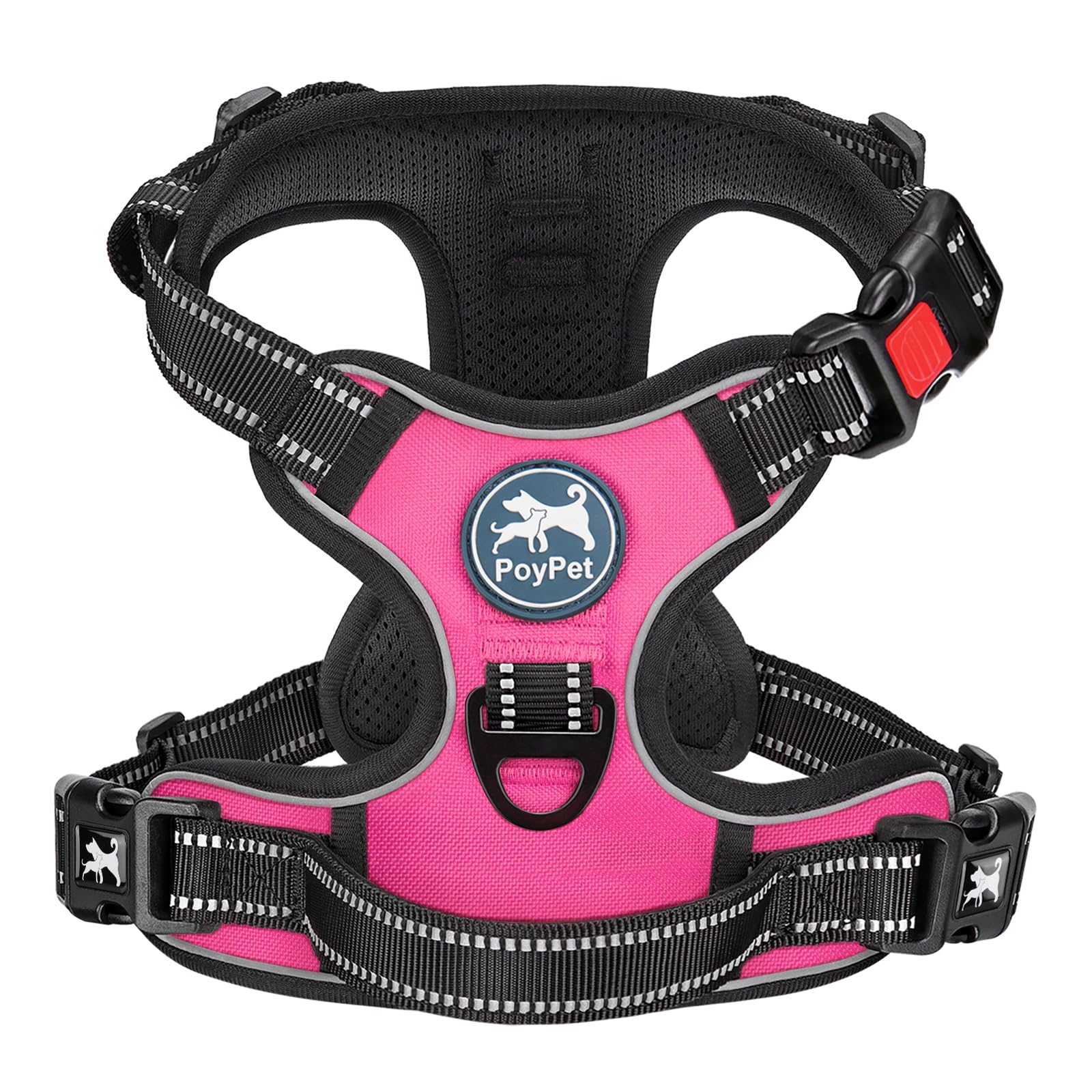
PoyPet No Pull Dog Harness

PoyPet No Pull Dog Harness

Head-shy dogs

Our Score 9.0/10
Check Price

Worth Noting

  • Lockable neck buckle is the first part to fail
  • Hand wash only
Size
Medium
Buckles
3 quick-release, 1 lockable
Leash Clips
Front and back metal
Belly Straps
Dual elastic
Read the full review

Nothing goes over the dog's head. The neck strap opens completely on a quick-snap buckle — one of three on the harness — so you lay it flat, buckle it around the dog and you're done. For a dog that backs away from anything pulled over its ears, that's the difference between a two-second job and a wrestling match at the front door.

We like that the neck buckle is a different color from the two chest buckles, which sounds trivial until you're clipping in before sunrise and can't see which strap is which. Both leash rings are metal, one at the chest and one at the back, and the padded handle gives you something to hold while you work the buckles one-handed.

There's elastic woven into the belly straps, so a sudden lunge stretches a little instead of yanking the whole harness sideways — a small design choice that makes a big dog feel less like a freight train. At 7.68 ounces it sits lightly on a thirty-pound dog, and the whole thing is compact enough to fold into a jacket pocket.

Bottom line: Choose this if your dog ducks away from anything going over its head; the neck opens flat and locks.

7

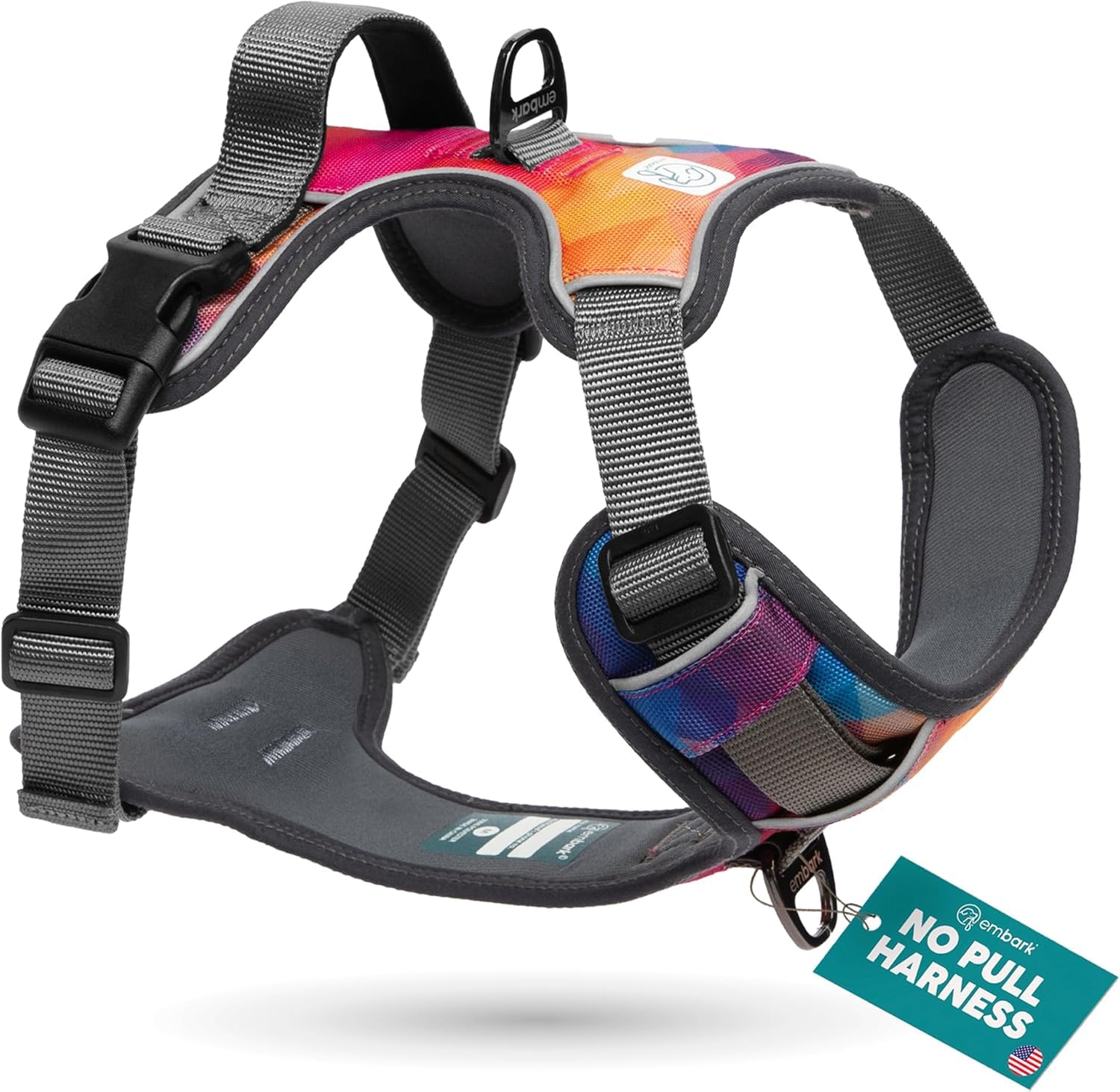
Embark No Pull Dog Harness

Embark No Pull Dog Harness

Night walks

Our Score 9.0/10
Check Price

Worth Noting

  • Sliders can slip while the harness is soaked
Care
Machine wash
Size
M, medium breeds
Adjustment
Four points
Reflective
360° trim
Read the full review

Reflective trim on most harnesses is two short bands stitched to the sides. Embark runs it around the whole thing — chest, flanks, shoulders — so a headlight catches your dog from almost any angle. If your walks happen before sunrise or after dinner in winter, that single difference is worth more than a longer feature list.

The rest of the design is quiet and sensible: four points of adjustment, a padded handle, and a shape cut for medium breeds rather than scaled up from a small pattern. It's also machine washable, which only a couple of harnesses here are, and the metal loops are solid rather than wire-thin.

At 10.56 ounces it's one of the heavier picks, and you notice that in the hand more than on the dog — once it's buckled and the straps are set, the weight spreads across the chest and stops registering. The longer straps give you more adjustment room than most, which helps on a dog that's broad through the ribs but narrow behind the shoulders.

The lining is the detail we didn't expect to care about: it doesn't trap loose hair the way mesh vests do, so it comes out of the wash looking like a harness instead of a felted brush. That combination — a full reflective wrap, four-point adjustment and a machine wash — is why this is the one we reach for on a winter evening.

Bottom line: If most of your walks happen in the dark, the wrap-around reflectivity here is the reason to choose it over cheaper vests.

How We Tested Medium Dog Harnesses

We started by pulling together a shortlist from harnesses our testers already owned, the ones veterinarians and trainers mention most often, and models with clearly published sizing charts for dogs in the roughly 25-to-55-pound range. We filtered out anything with vague sizing, flimsy-looking buckles, or a return policy that made fitting risky, then bought 14 harnesses to test over eight months.

Each harness went on real walks—morning loops around the neighborhood, weekend hikes, car rides, and muddy park visits—with dogs from roughly 25 to 55 pounds. We practiced putting each one on and taking it off a wiggly dog, noted whether the straps adjusted smoothly while the dog stood still, and checked for rubbing under the front legs and across the chest after longer walks. To test secure fit, we clipped a leash and used a treat distraction to see whether a dog could back out of the harness.

Quality and sturdiness got checked the unglamorous way: we looked at stitching, webbing thickness, buckle teeth, and D-ring attachment points before and after months of use, and we rinsed the muddy ones to see whether the padding dried flat or stayed clammy. We also watched for fading, frayed edges, and stretched straps, since a harness that looks sharp on day one but slumps after a season isn't one we'd recommend. Appearance mattered too—we kept notes on colorfastness and whether the design stayed clean-looking, not just cute in the package.

How to Choose Medium Dog Harnesses

Measure the chest, not the label

Medium isn't a standard. One brand's Medium is built for a 16-inch chest and another's runs to 33 inches, and both are sold on the same shelf. Measure the girth around the widest part of your dog's ribcage, just behind the front legs, with the dog standing square. Add about two fingers of room, then look for a harness where your number sits in the middle of the stated range rather than at the last inch.

Our picks show the spread: the rabbitgoo's Medium starts at 15 inches, while the AUROTH Medium runs 22 to 33. A harness whose Medium tops out at 18 inches is a small-dog harness with a medium label, however it's photographed.

Decide what you want the leash clip to do

Every harness here has a back ring, and that's the one for a relaxed, sniff-everything walk. The front ring is the training aid: it pulls the chest sideways when the dog surges, so the dog turns instead of dragging you. It steers, it doesn't brake. A committed puller will still lean into it, which is why the Ruffwear's reinforced chest webbing is described honestly as redirection rather than control.

One trap: a front ring on a slack neck strap rides up toward the throat. Set the neck strap snug so the ring sits at the breastbone, then test it on a short walk before you trust it.

Pick an entry style your dog will tolerate

Over-the-head designs like the AUROTH and rabbitgoo have the fewest buckles and are fastest once a dog is used to them, but a head-shy dog will fight every one of them. A three-buckle harness such as the PoyPet lays flat, buckles around the dog and never passes over the ears. Step-in vests are quickest of all for a calm dog and the least adjustable across the chest.

Choose by what your dog does when the harness appears, not by the spec sheet. If it already backs away, buy the one that opens flat.

Check that your dog can't back out

You want two fingers sliding under the chest strap and no more. Then run the escape test somewhere enclosed rather than on the street: hold the leash, take a step back, and see whether the dog can reverse out of the harness. If the chest panel slides forward as the dog backs up, take in the chest straps and try again. Dogs that slip harnesses do it the same way every time, so a hallway rehearsal is worth more than a size chart.

Weigh hardware, padding and the wash

Metal leash rings outlast plastic, and aluminum neck buckles like the ICEFANG's matter most on a dog that lunges. Padding earns its keep where straps cross the armpits and the breastbone, not on the back where nothing rubs. Care instructions are the spec people skip: the AUROTH and the Embark go in the washing machine, most of the rest are hand wash only, and a dog that finds every puddle will make you care about that within a week.

Frequently Asked Questions

Final Verdict

Our default for a medium dog is the AUROTH. Its stated 22-to-33-inch chest range covers the dogs that sit between small and large, the leash rings at both ends are metal, and it goes in the washing machine instead of the sink.

If your dog wears a harness for hours on end, the Ruffwear Front Range is lighter, better padded and worth the step up in price. If the budget decides it, the rabbitgoo does the same two-clip job for less, provided you're willing to spend a few walks getting the straps set.