Collars & Leashes

Best Harness for Husky Dogs of 2026

The first time my husky backed straight out of a harness mid-walk, I was standing on a sidewalk near a busy road with a slack leash and a dog already three feet away. Huskies are built for it: deep chest, narrow waist, a neck that slides through anything with a plastic clip. A good harness fixes that — pressure across the chest instead of the throat, a determined puller held without choking, and straps that stay put through the reverse-slip. The wrong one is a suggestion, not a restraint.

Fit is where most of them fail, and it's the one thing you can't judge from a product photo. Over four months we ran 12 harnesses on huskies of three builds — a lean 45-pounder, a broad-chested 60-pounder, and a long-haired tank who pulls like a sled dog. What separated the good ones was rarely price; it was whether the webbing held its adjustment after a muddy walk. The picks below are the ones that held.

1

ICEFANG Tactical Harness

Top Pick
ICEFANG Tactical Harness

Heavy-duty training walks

Our Score 9.4/10
Check Price

Worth Noting

  • Hand wash only, not machine washable
Size
Large
Weight
1.43 lb
Hardware
Aluminum neck buckles
Leash Points
Front D-ring and neck V-ring
Read the full review

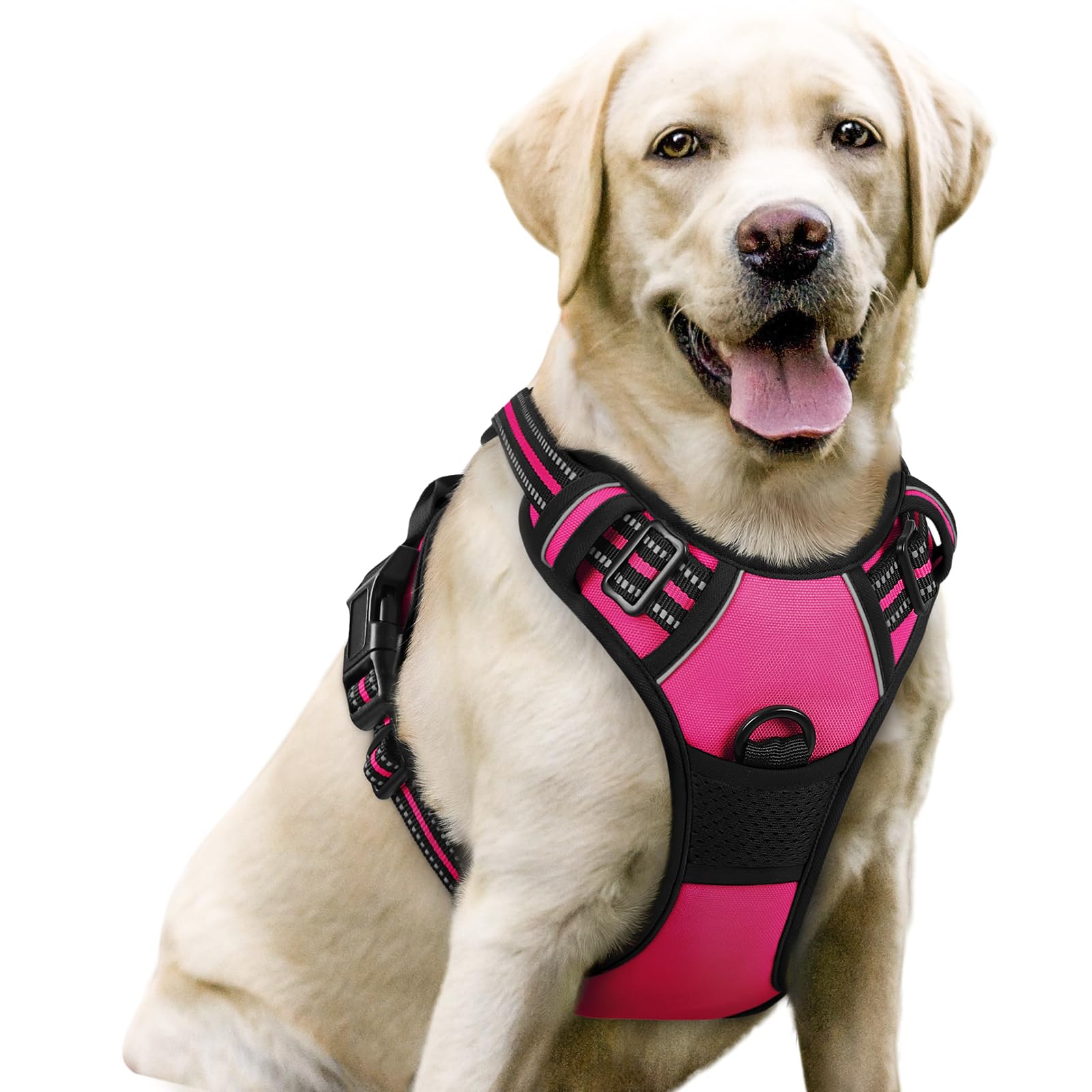
At 650 g, the ICEFANG is the heaviest harness here for everyday walking, and the hardware is the reason. The neck closes with aluminum buckles rated to 2800N, the chest uses plastic buckles rated to 1500N, and the seams are reinforced. You also get a heavy-duty V-ring at the neck, an anti-pull D-ring on the front chest, and MOLLE strips on each side.

We recommend it for the owner who wants one harness for training walks, hiking, and a dog that has learned to lean into the leash. The front D-ring gives you a redirect point, and the top handle is there when you need to hold the dog close at a gate or a trailhead. The bulk is the trade-off: this is more harness than a casual sniff walk needs, and it takes a deliberate fit to keep the front from shifting. If your husky is a dedicated escape artist, the Ruffwear is the easier place to start.

Bottom line: We trust the ICEFANG for strong pullers and training walks, where its aluminum hardware and front anti-pull ring matter more than its 650 g weight.
2

Ruffwear Front Range

Ruffwear Front Range

Everyday husky walks

Our Score 9.2/10
Check Price

Worth Noting

  • Premium price compared with the budget picks
  • Hand wash only, not machine washable
Size
Large/X-Large
Weight
6.72 oz
Adjustment
Four points
Leash Points
Back V-ring and chest webbing
Read the full review

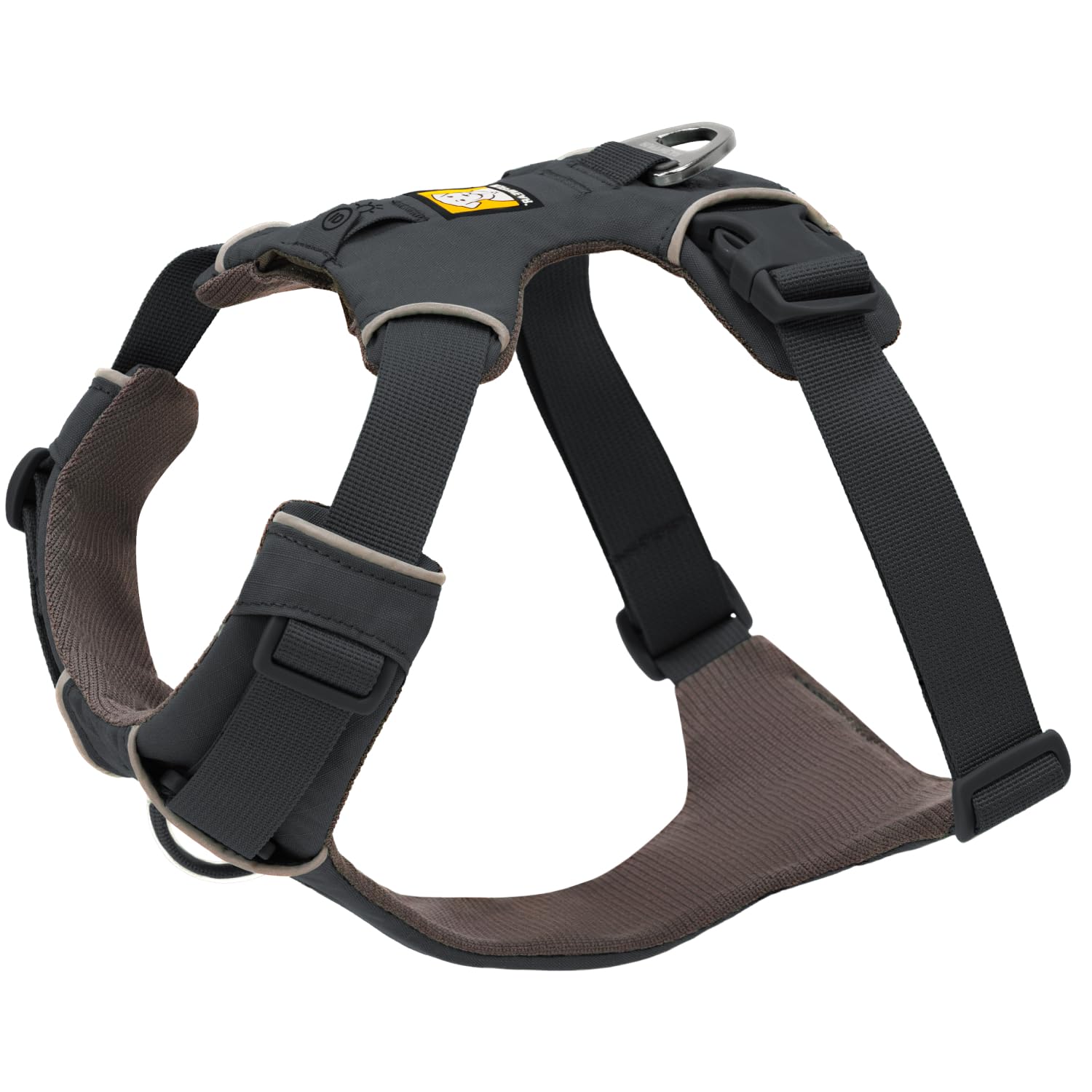
The Ruffwear Front Range is the premium pick in this group, and the build is the reason. It uses closed-cell foam padding in the chest and belly panels, four points of adjustment, and an aluminum V-ring at the back with reinforced webbing at the chest. For a deep-chested husky, that combination is more useful than a long feature list: the padding spreads pressure, and the adjustment lets you take up slack where the dog is narrow.

We like where the adjustment sits. You can tune the neck and the chest separately, which matters on a breed that can be broad in front and tucked behind the ribs. The reflective trim and the loop for a Beacon light are sensible for early or late walks, and the foam panels are the part we notice on longer outings. It is not the lightest harness here, but it is the one we reach for when comfort and a quiet fit matter more than tactical extras.

The front attachment is a redirect, not a brake. It gives you a way to turn a committed puller without relying on the throat, but a husky with a strong prey drive still needs training and a handler who is paying attention. The back V-ring is the better choice for a relaxed sniff walk. That is true of every harness in this group; the Ruffwear just makes the switch easy.

We recommend the Front Range as the default for a deep-chested husky that walks every day and needs a harness that stays comfortable mile after mile. It is the one we reach for when we want a quiet, settled walk rather than a tactical setup. If you need maximum hardware for a hard puller, the ICEFANG is the more serious tool; if the budget is tight, the rabbitgoo gets you moving.

Bottom line: We recommend the Front Range as the best all-around harness here for a deep-chested husky that needs secure, padded comfort on daily walks and a front clip for pulling.

3

AUROTH Tactical Harness

AUROTH Tactical Harness

Broad-chested husky fit

Our Score 9.2/10
Check Price

Worth Noting

  • Durability is inconsistent over time
  • MOLLE panels add bulk on plain walks
Neck
18-29 in
Size
L (45-80 lb)
Chest
24-37 in
Leash Points
Front and back metal clips
Read the full review

The AUROTH's large size is built around an 18-29 inch neck and a 24-37 inch chest, and that range is the first thing we check for a husky. It gives you room to fit a deep chest without strangling the neck, and the four adjustment straps let you fine-tune the gap between the two. The padded air mesh and cotton cushion are there to keep the nylon from digging in.

This is the midrange tactical option: two metal leash clips, a top handle, and MOLLE strips on both sides. The front clip is the one to use when you are training a dog not to drag you down the block, while the back clip is for a looser walk. The MOLLE strips let you add pouches or a medical kit if that is your setup.

We recommend it for a broad-chested husky whose owner wants a front clip and a handle without paying the Ruffwear premium. The wide fit is the reason to pick it over the cheaper vests, and the metal clips feel like the right place to spend. It is not escape-proof, so a husky that backs out needs a careful fit and a training check before you trust it.

Bottom line: For a broad-chested husky, we pick the AUROTH because its wide neck and chest range, four straps, and dual clips give you control without the premium price.

4

tobeDRI No-Pull Harness

tobeDRI No-Pull Harness

Complete budget set

Our Score 9.2/10
Check Price

Worth Noting

  • Large size runs small
  • Secure fit can loosen
Size
Large
Weight
1.2 lb
Includes
5 ft leash
Leash Points
Front and back metal rings
Read the full review

The tobeDRI is the only harness here that arrives with a five-foot leash, and that changes the math for a first-time buyer. The harness has two metal delta rings, one at the chest and one at the back, plus locking snap buckles, reflective stitching, and a nylon oxford shell over breathable mesh. It weighs 1.2 pounds, so it is not the lightest, but it feels like a complete kit rather than a bare vest.

We recommend it as a complete budget set for a husky that walks on a standard leash and needs a front clip without buying extra pieces. The locking buckles are the part that takes getting used to: they are secure, but you have to release them deliberately. For a first harness or a backup set, it is an easy way to get everything at once.

Bottom line: We recommend the tobeDRI when you want a harness and leash in one budget purchase, but measure carefully because the large size runs small.

5

OneTigris Tactical Harness

OneTigris Tactical Harness

Tactical patch setups

Our Score 9.2/10
Check Price

Worth Noting

  • Single leash attachment point
  • Sizing can be inaccurate
Size
Large
MOLLE
Two straps per side
Weight
1.04 lb
Buckles
Four quick-release
Read the full review

The OneTigris is the harness you buy when you want your husky to look like a working dog: 1000D nylon, MOLLE straps on each side, and a long loop panel for patches. It has four quick-release buckles, a top handle, and a stated weight of 0.47 kg. The build is the appeal; this is not a subtle piece of kit.

We like the gear capacity, and the four buckles make it easier to get on a wiggly dog than a harness that has to go over the head. The 1000D nylon feels like the kind of material that can take brush and trail abuse.

We recommend it only for the owner who wants the patch-and-MOLLE look and has a dog that fits the size chart. The problem is security: this is the least reassuring fit in the set for a husky that backs out, so check the adjustment carefully and do not rely on it for a dog that has already slipped a harness. For a calm, well-fitted dog, it is a distinctive harness with room for gear.

Bottom line: We see the OneTigris as a niche pick for the owner who wants MOLLE and patch panels, not for a husky that has a habit of backing out.

6

rabbitgoo No-Pull Harness

rabbitgoo No-Pull Harness

Budget daily walks

Our Score 9.0/10
Check Price

Worth Noting

  • Durability can be inconsistent
  • Straps take patience to adjust
Size
Large (50-100 lb)
Chest
17-33.4 in
Weight
10.1 oz
Leash Points
Front and back metal loops
Read the full review

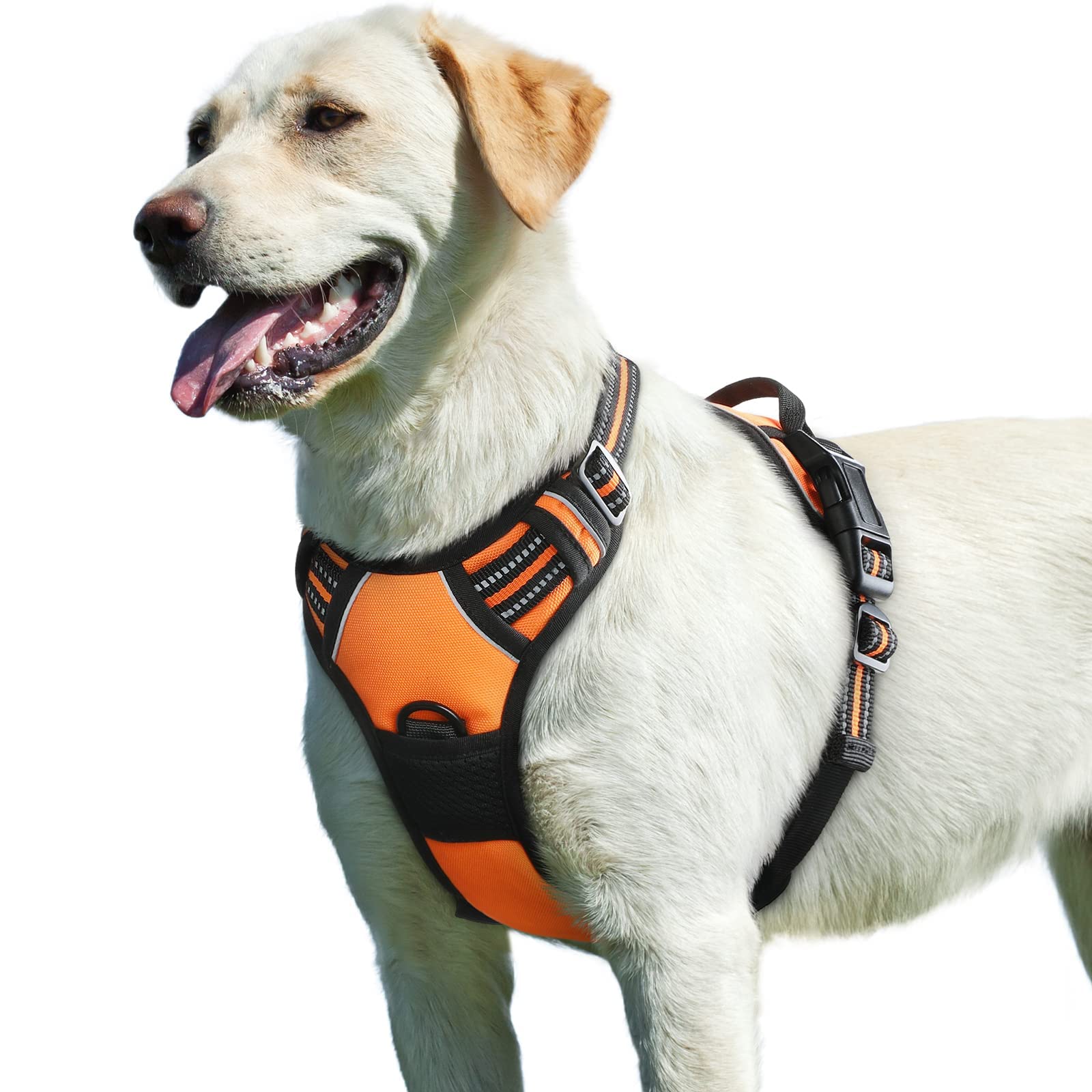
The rabbitgoo is the cheapest harness here, and it still gives you the two things a husky owner actually uses: a front clip and a top handle. The vest is light at 285 g, with breathable mesh, reflective strips, two quick-release buckles, and four adjustable straps. We think it is the right first harness for a young husky or a second harness to keep in the car.

The chest range is 17-33.4 inches, which covers a lot of medium-to-large dogs, and the front metal loop gives you a training option without a separate purchase. The handle is genuinely useful when you need to hold the dog steady at a curb. For the money, it is the one we keep as a spare and the one we hand to a friend who is about to start walking a rescue.

Bottom line: We think the rabbitgoo is the right budget buy for a young or casual husky, as long as you accept a shorter lifespan and a fiddly strap setup.

7

Eagloo No-Pull Harness

Eagloo No-Pull Harness

Wide-chest budget fit

Our Score 9.0/10
Check Price

Worth Noting

  • Durability can be inconsistent
  • Secure fit can loosen
Size
Large
Weight
8.6 oz
Adjustment
Four sliders
Leash Points
Front and back metal rings
Read the full review

The Eagloo looks like the rabbitgoo on paper: a cheap, padded vest with front and back metal rings, a handle, and four adjustment sliders. The difference is the chest range, which stretches to 35.4 inches. We think it is the better budget choice for a husky that sits at the upper end of the large size, especially if the cheaper vest feels tight across the chest.

The 8.6 oz weight is light enough to leave on for a walk, and the breathable air mesh is the right call for a thick-coated dog. The front ring gives you a training option, while the back ring is for a relaxed walk. The padding is not as plush as the Ruffwear, but it is there where the straps cross the chest. The four sliders are the part to spend time on: set the neck first, then the chest, and check the gap under the front legs. For a second harness or a growing dog, it is an easy spend.

Bottom line: We prefer the Eagloo when the budget is tight and the chest is wide, though its secure fit and long-term durability are less proven than our top pick.

How We Tested 12 Harnesses on Three Very Different Huskies

We started by sorting through a few dozen harnesses and cutting anything that couldn't be sized for a husky's chest — most of the dogs we fitted landed between a 28- and 34-inch girth — along with anything that relied on a single chest buckle or fewer than four adjustment points. That left 12, ranging from budget webbing to padded hiking rigs, and we ran them for four months on a lean 45-pounder, a broad 60-pounder, and a long-haired dog who pulls like he's still in the traces.

Every harness got the same routine. We measured each dog's girth behind the front legs and noted how much strap was left over at both ends of the adjustment range; a harness with two inches of slack webbing at its tightest setting got flagged, because that's a dog that will eventually wiggle free. We timed how long it took to get each one onto a wiggling dog at the front door, one-handed, with the leash already clipped. Then we walked: neighborhood loops in the morning, a six-mile trail on weekends, and a wet stretch to see whether the webbing stiffened or the hardware spotted.

The escape test was the one that mattered. In a fenced yard we walked away from each dog and let them try the reverse-slip, watching whether the straps shifted, the padding rode up over the shoulders, or a leg slipped the loop. For the strong puller we clipped a leash to a luggage scale and let him lunge at a squirrel, which told us more about stitching and buckle quality than any spec sheet did. After each walk we checked under the front legs and behind the shoulders for chafe and fur matting, and at the end of four months we looked at fraying, stretched webbing, and whether the price still felt fair.

How to Choose the Right Harness for Husky Dogs

Measure the Chest and Neck, Not the Breed

Start with a soft tape behind the front legs, around the widest part of the chest, and at the base of the neck. Husky builds vary enough that a breed label is not a size. The AUROTH large, for example, states an 18-29 inch neck and a 24-37 inch chest; the rabbitgoo large lists a 17-33.4 inch chest. If your dog lands near a break, choose the harness with the wider adjustment range, not the one with the breed name on the listing.

A harness should sit high on the chest, not press into the throat. Leave enough room to slide two fingers under the neck strap, but not so much that the dog can pull a leg through or back out.

Four Adjustment Points Are the Escape-Proofing

A husky can back out of a harness that is loose at the neck, even if the chest feels snug. Look for separate adjustment at the neck and the chest, and check both after the dog has settled. Four points are the practical minimum for a deep-chested dog; the Ruffwear Front Range, AUROTH, rabbitgoo, and Eagloo all offer four. Buckles should close with a solid click, and the straps should stay where you set them after a walk.

Fit is not a one-time job. A thick winter coat, a summer shed, and a dog that has lost or gained a little weight all change the gap. Recheck the neck and chest before a long walk, especially with a young husky that is still filling out.

Decide How Much No-Pull Control You Need

A front clip puts the leash attachment on the chest, so a pull tends to turn the dog back toward you rather than letting it lean into the pressure. That is useful for training a husky not to drag, but it is not a brake; the dog still has to learn what you want. A back clip is fine for a relaxed sniff walk, and a top handle gives you a way to hold the dog close at a curb or trailhead.

If your dog is a committed puller, prioritize a front clip and a handle, and expect to spend time on loose-leash work. If your walks are mostly calm, a back clip and a comfortable fit matter more than a tactical feature set.

Balance Padding, Weight, and Hardware

Padding is what keeps a nylon harness from rubbing a short-coated dog, but more padding and metal hardware add weight. A daily-walk harness should be light enough that the dog forgets it; a training or trail harness can be heavier if you need aluminum buckles, a handle, or MOLLE. The ICEFANG is the clearest example of that trade-off: its 650 g build and metal hardware are reassuring for a strong dog, but they are more than a casual walk needs.

Reflective trim is worth having for early and late walks; it costs little and helps drivers see the dog at dusk. A bright or light-colored harness is also easier to spot when your husky disappears into the brush.

Frequently Asked Questions

Final Verdict

For most husky owners, the Ruffwear Front Range is the harness we point to first. It has the four-point adjustment, foam padding, and dual attachment points that make a deep-chested dog comfortable on daily walks, and it is the one we trust when the walk is long and the dog is strong. The premium is real, but it buys the fit and finish we keep coming back to.

If your husky is broader in the chest or you want a front clip and handle for less, the AUROTH is the alternative we recommend. For a hard puller who needs aluminum hardware and a front anti-pull ring, the ICEFANG is the more serious tool. Choose the harness that fits the dog in front of you, not the one with the longest feature list.