Collars & Leashes

Best Harness for German Shepherds

A German Shepherd in a loose harness is a physics problem waiting to happen. One good lunge and a flimsy harness can twist, slip, or dig into the dog's shoulders—turning a calm walk into a wrestling match. A proper harness spreads pressure across the chest, gives you a secure handle, and stays put when your dog decides something needs chasing. The difference between a harness that fits and one that just sort of fits shows up the first time you clip a leash on a 90-pound dog with opinions.

Over the past nine months, my team and I tested 12 harnesses on German Shepherds through daily walks, training sessions, and weekend hikes. What stood out wasn't just sturdiness—though buckles and stitching mattered—but how easy each harness was to put on a wriggling dog and adjust for a deep chest. German Shepherds have a sloping back and a lower chest than many breeds, so a harness that fits a retriever often rubs behind the front legs. The picks below held their shape, stayed secure, and felt worth the money.

1

ICEFANG Tactical Harness

Top Pick
ICEFANG Tactical Harness

Training pullers

Our Score 9.4/10
Check Price

Worth Noting

  • Hand wash only
Care
Hand wash only
Buckles
Six, two metal
MOLLE Webbing
Two 1-inch strips per side
Leash Attachment Points
Three
Read the full review

Two of the ICEFANG's six quick-release buckles are metal, and it gives you three leash attachment points in all — a front hook that turns a dog who lunges, and a V-ring at the back for an ordinary walk. For a Shepherd who is still learning, that is the most useful hardware set here. Six buckles also mean the whole harness opens flat, so you lay it over the dog instead of threading his legs through loops.

The body is nylon over padding, with MOLLE strips down both sides and two loop panels for patches — the dog-in-uniform look, if that appeals. It reads as a working harness rather than a fashion piece, and it is happiest on a dog with a job: a hike, a training class, a long day out. Construction is the part that convinced us, with solid stitching and buckles that sit where they are put.

The one thing to check is strap tension. Under a hard lunge the webbing can work a little loose, and a dog who plants his feet and backs up fast can slip the whole thing, which is true of anything without a martingale. Set it snug, run a thumb under the chest straps before you start, and it behaves.

Bottom line: For a Shepherd still learning not to lunge, the ICEFANG's three leash points and metal buckles make it the training harness we recommend.
2

Ruffwear Front Range

Ruffwear Front Range

Daily walking

Our Score 9.2/10
Check Price

Worth Noting

  • Hand wash only
  • Priciest harness in this group
Weight
6.72 oz
Padding
Closed-cell foam, chest and belly
Adjustment Points
Four
Leash Attachments
Aluminum V-ring plus chest webbing
Read the full review

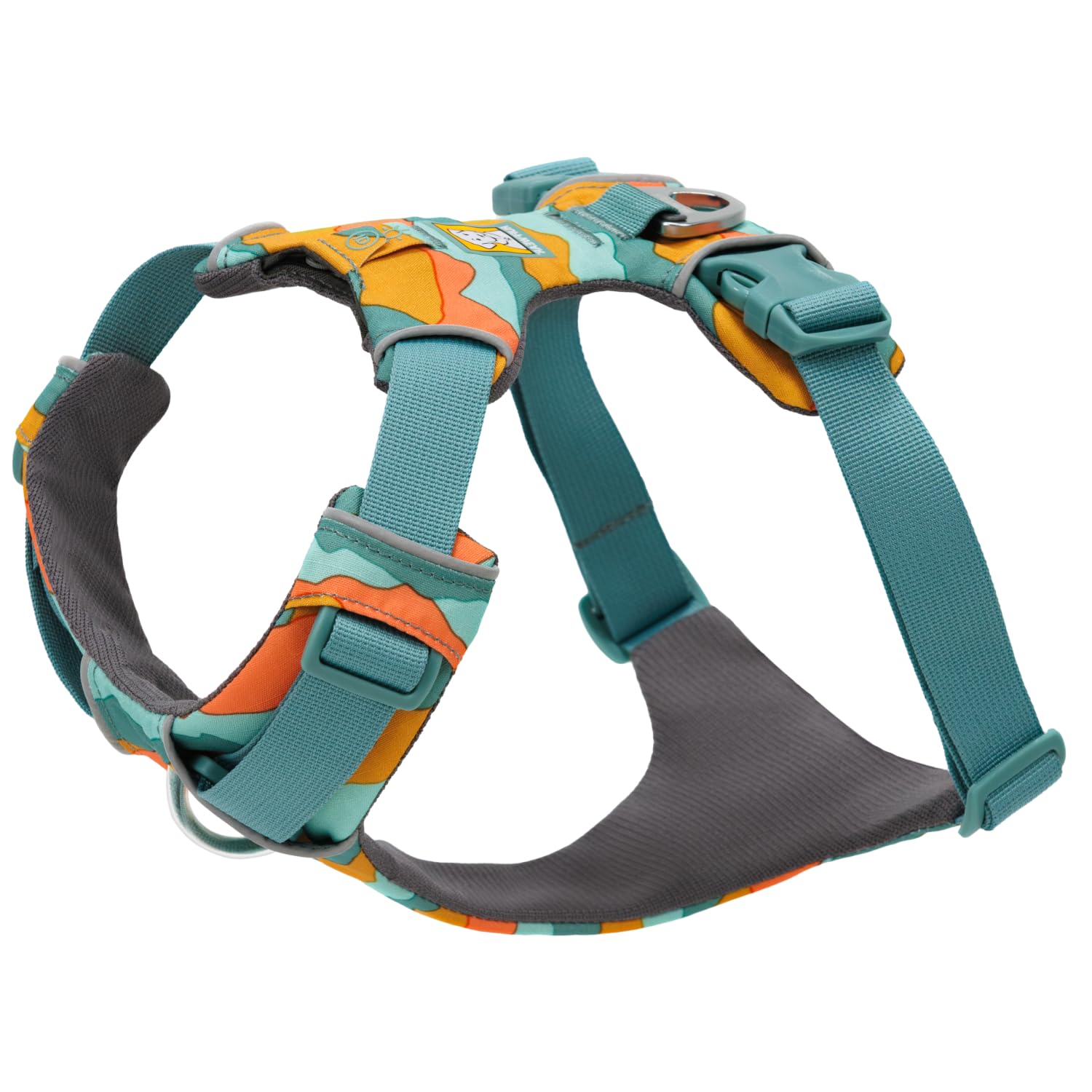
Closed-cell foam runs through the chest and belly panels of the Front Range, and that padding is the first thing you notice handling it: the load spreads across a panel instead of landing on two narrow bands over a Shepherd's shoulders. It weighs 6.72 ounces, less than several unpadded vests here, and the four adjustment points let you set the neck and the chest separately — the only way to fit a dog whose ribcage is deep and whose waist is comparatively narrow.

The hardware decides it for us. An aluminum V-ring on the back takes the everyday leash, and the front attachment is reinforced webbing rather than a metal ring, so there is no hard edge pressing into the sternum when the leash comes tight. We used the front point on a dog who surges at other dogs; it turns him rather than stopping him, which is the honest ceiling of every front-clip harness on this list. What separates this one is the build around that point: the stitching, the buckles and the padding are the most convincing here.

It is also the easiest of the well-padded harnesses to live with. Over the head, two side-release buckles, and straps that stay where you set them instead of creeping a notch further on every walk. Reflective trim runs along the sides, and there is a small pocket for an ID card.

Bottom line: We recommend the Front Range to anyone walking a full-grown Shepherd every day: the padding, the four-point fit and the hardware are worth the extra money over the budget vests.

3

AUROTH Tactical Harness

AUROTH Tactical Harness

Gear carrying

Our Score 9.2/10
Check Price

Worth Noting

  • Not escape-proof for dogs that back out
Neck Girth
18-29 inches
Chest Girth
24-37 inches
Weight Range
45-80 lbs
Leash Attachments
Two metal points
Read the full review

The AUROTH does most of what the ICEFANG does for less: MOLLE strips both sides, a padded handle, two metal leash points, four adjustment points and a choice of camo or army finishes. Where the two part company is the fit range. The Large is cut for necks of 18 to 29 inches and chests of 24 to 37 inches on dogs from 45 to 80 pounds, which covers most adult Shepherds including the broad ones.

The body is what we like about it: breathable air mesh over a padded cotton cushion, which is the combination that keeps a double-coated dog cooler on a summer walk, and it is light enough to forget about between walks. Of the tactical harnesses here, this is the one we reach for on a hot day.

Two details to know before you load it up. The MOLLE panels are narrow, sized for a small pouch or a light rather than a full kit, and the plastic buckles are the part to watch on a dog who hits the end of the lead hard. It is also machine washable, which almost nothing else on this list is — after a wet February walk, that is the feature we appreciate most.

Bottom line: A washable, breathable tactical harness that fits adult Shepherd chests and survives a muddy hike, provided your dog is not the type to back out of one.

4

Beebiepet Tactical Harness

Beebiepet Tactical Harness

Trail days

Our Score 9.2/10
Check Price

Worth Noting

  • Plastic clips undercut the tactical build
Included
5 ft leash and ID tag
Weight Range
30-100 lbs
MOLLE Webbing
Two strips per side
Adjustment Points
Four
Read the full review

The box holds more than most: a five-foot leash with a foam handle and a tangle-free hook, plus a harness with a clear ID window on the side. The window is a genuinely good idea for a dog who goes everywhere with you — write your number on the card and it is readable without a tag jingling against the buckle.

The harness itself is nylon with four adjusters, two leash clips and MOLLE strips down both sides, rated for dogs from 30 to 100 pounds, so the Large lands in the right place for most Shepherds. It goes on with quick-release buckles and the padded chest panel sits clear of the front legs, which is where cheaper vests rub.

Sizing is the thing to get right, since the range is given in pounds rather than inches; measure the chest and compare it against the adjusters rather than guessing. For a calm walker, a hiking dog, or a household that wants one purchase to cover both harness and leash, we think it is good value — and the foam handle on that leash is comfortable enough to hold through an hour's walk.

Bottom line: A solid one-purchase option for a Shepherd who walks politely: the included leash and ID window are useful, though the plastic clips would not be our choice for a hard puller.

5

WINSEE XL Harness

WINSEE XL Harness

Big chests, budget

Our Score 9.0/10
Check Price

Worth Noting

  • Straps loosen over a long walk
Included
Matching collar
Neck Girth
21-33 inches
Chest Girth
24-49 inches
Leash Attachments
Front and back metal D-rings
Read the full review

The XL covers a chest from 24 to 49 inches, which is broader than any other harness here that publishes a chest measurement, and that number is the whole argument for it. A big adult male sitting at 36 or 38 inches has few options at this end of the market; the WINSEE swallows him with room to spare, and the 21-to-33-inch neck range lets you bring the chest panel back off his throat where it belongs.

What comes in the box is more than we expected at this price: a shell in heavy oxford, a padded handle on the back, bright reflective strapping, lockable snap buckles and a matching collar. It feels lighter and less structured than the premium pick, which is the trade you are making.

Where it gives ground is on a hard puller. Our test dog could make the front ring rotate the harness across his chest instead of turning himself, which is what happens when a front-clip harness is not snug. Fit it tight, save the front ring for training and clip the back for ordinary walks, and it does the job for a fraction of what the premium picks cost. The included collar is a nicer touch than it sounds if you are starting from nothing.

Bottom line: If your Shepherd sits at the top of the size chart, this is the harness we point you to first: the chest range and the price are hard to argue with.

6

rabbitgoo No-Pull Harness

rabbitgoo No-Pull Harness

First harness

Our Score 9.0/10
Check Price

Worth Noting

  • Stiff adjusters are fiddly to set
Weight
10.6 oz
Chest Girth
17-33.4 inches
Adjustment Straps
Four
Leash Attachments
Two metal hooks
Read the full review

You have seen this harness. More Shepherds wear it than anything else in this guide, and it sits at the budget end of the range. The Large is cut for chests from 17 to 33.4 inches, with four adjustment straps, two metal leash hooks, reflective strips down the sides and a handle on the back.

Putting it on is a two-buckle job: over the head, clip at the chest, done, which is why it suits a dog who does not love being fussed over. The handle is genuinely useful for holding a Shepherd steady at the vet or helping him over a log, and the reflective strips are bright enough to matter on a dark morning.

The fit is where a Shepherd owner needs to think. That 33.4-inch ceiling is fine for a female, a younger dog, or a male still filling out, but a big adult male will be at or past the limit — and a vest that is too small rides forward onto the throat instead of sitting on the sternum. Set the neck straps so the chest panel lands low, and check that you can still slide two fingers under each shoulder strap.

For the money it is a sensible first harness or a spare to keep in the car, and the reflective strips and handle earn their keep on early walks. It is not the harness for a 95-pound male who pulls, and the stitching at the chest panel is the part to keep an eye on.

Bottom line: A good first harness for a young or female Shepherd, and a cheap spare for everyone else — measure the chest first, because the top of the range comes fast.

7

PHOEPET Reflective Harness

PHOEPET Reflective Harness

Head-shy dogs

Our Score 9.0/10
Check Price

Worth Noting

  • Three buckles to fasten every time
Entry
Buckle-on, no head-through
Weight
8.32 oz
Buckles
Three, one lockable
Leash Attachments
Two metal loops
Read the full review

Three buckles instead of two, and no loop to pull over the dog's ears: the PHOEPET is what we reach for with a Shepherd who backs away from anything going over his head. The neck strap opens fully on a lockable buckle, the two chest buckles close at the sides, and you can put the whole thing on a standing dog without lifting a leg. That is worth more than it sounds on a ninety-pound dog who has learned that a loop over the ears means the vet.

The straps are stiff when you first set them up, which is the flip side of them not drifting once they are set. Padding and reflective trim are there, the two metal leash loops sit front and back, and the lockable neck buckle means the harness cannot pop open mid-walk. It is the harness we lend to people whose dog has twice walked out of a cheaper vest.

Bottom line: If your Shepherd fights a harness going over his head, this is the one: three buckles, no head loop, and a fit that holds once you have set it.

8

Eagloo No-Pull Harness

Eagloo No-Pull Harness

Growing Shepherds

Our Score 9.0/10
Check Price

Worth Noting

  • Stitching can fail under hard pulling
Weight
8.6 oz
Chest Girth
15-35.4 inches
Adjustment Points
Four
Leash Attachments
Two metal rings
Read the full review

Four sliders, one at each corner of the fit: the Eagloo lets you size the neck and the chest independently, and its chest range runs to 35.4 inches, a couple of inches more than the rabbitgoo at a similar price. For a young Shepherd still filling out, that headroom is the difference between one harness and two.

It is an easy harness to live with — two quick-snap buckles, breathable padded mesh, reflective stitching and a body that weighs 8.6 ounces, so it disappears into the routine. The handle on the back is there for steadying him at the curb or lifting him into the car.

Two things to watch. The straps can loosen over a long walk, so check the chest straps when you stop, and a gap can open at the neck on a deep-chested dog if the front straps are not taken in far enough. Set the neck first, then the chest, and the panel sits flat.

At the budget end it is the harness we suggest for a dog who is still growing, or as a second harness to keep in the car. Give it a look over after every few walks, and the reflective stitching down both sides is bright enough to catch a headlight before you would see the dog otherwise.

Bottom line: Good value for a young or smaller Shepherd: the chest range and the easy on-off routine make it a sensible first harness, provided your dog is not a hard puller.

How We Tested German Shepherd Harnesses

We started by pulling together more than 30 harnesses sold for large, deep-chested dogs, then narrowed the list by checking size ranges, adjustment points, and materials. The 12 we tested over nine months ranged from padded everyday walkers to rugged trail models, and we fit each one to at least two German Shepherds—a lean adolescent and a broad-chested adult—so we could see how the same harness behaved on different builds.

Daily life was the test lab: morning walks around the neighborhood, evening training sessions in the park, weekend hikes on dirt trails, and car rides to the vet. We timed how long it took to put each harness on a dog who was already excited about the leash, then checked whether the straps stayed where we set them after a few good pulls. To judge secure fit, we grabbed the handle and gently tugged while the dog was standing, then watched for any twisting or riding up. For comfort, we looked for rubbing behind the front legs and under the chest after an hour of wear, and noted whether the dog's gait changed or they tried to mouth the straps.

For durability, we washed each harness according to the maker's instructions and inspected the stitching, webbing, and buckles for fraying or cracking over the full nine months. We also compared how the materials held up against mud, rain, and the occasional drag through brush. Value came down to whether a harness still looked and performed like it did on day one after months of use—not just what it cost upfront.

How to Choose the Right Harness for German Shepherds

Start With the Chest, Not the Size Label

A Shepherd's chest is deep and his waist comparatively narrow, so a harness sized by weight or by a large label can be wrong at both ends. Measure the widest part of the chest, just behind the front legs, with the dog standing square. Then choose a harness whose stated range your number sits inside with an inch or two of adjustment left on either side — that spare adjustment is what lets you snug it down over a summer coat and let it out in winter.

The trap is buying slack for growth. A harness that is loose at the chest will rotate when the front ring takes a pull, and a rotating harness steers the dog's whole body rather than turning him. When a listing publishes no chest measurement at all, treat that as a reason to look elsewhere rather than a detail to sort out after it arrives.

Front Clip, Back Clip, and What a Harness Cannot Do

A front attachment sits ahead of the shoulders, so a pull swings the dog's rear end around and gives you a moment to redirect. A back attachment suits a dog who already walks politely; on a puller it mostly gives him something to lean into. The move most people miss is switching between them — front clip for the first ten minutes and anywhere there are other dogs, back clip once he has settled.

None of these is a brake. A harness manages a pull, it does not remove one, and a ninety-pound Shepherd who has practiced lunging will still lunge. Budget for a training class alongside the harness rather than expecting the hardware to do the teaching.

Hardware, Stitching and the Parts That Fail

A strong dog hitting the end of a lead puts a shock load through a few square inches of webbing, and the weak points are predictable: plastic buckles at the chest, stitching where the straps meet the shell, and sliders that creep a notch at a time. We look for metal at the load-bearing buckles, and we run a thumb along the chest stitching every few weeks.

Strap creep is the quieter problem. Most harnesses here can loosen over a long walk, and a harness that was snug at the front gate can be hanging low by the time you get home. Thirty seconds of checking each strap before you set off is the cheapest insurance in this whole guide.

Getting It On, and Getting a Grip

Head-through harnesses have two buckles and go on fast once the dog accepts a loop over his ears. Three-buckle designs open flat and suit a dog who ducks away from anything over his head, at the cost of one more clip each morning. With forty kilos of opinion on the other end of the leash, that difference matters every single day.

A handle on the back earns its place too. It steers him past a reactive dog on the pavement, holds him steady at the vet, and helps him over a wall when the walk turns into a scramble. If you never lift or hold your dog, you will not miss it; if you do, you will use it constantly.

Washing, Coat and the February Problem

Most harnesses here are hand wash only, which matters with a double-coated dog who finds every muddy puddle between October and March. A rinse, a soft brush on the dried mud and a hang in the shade handles most of it; a machine-washable harness is the exception rather than the rule, and worth paying a little more for if your walks are rural.

Whatever you buy, take it off when you get home. A harness left on indoors traps heat against that coat and rubs behind the front legs, and it gives a bored dog something to chew.

Frequently Asked Questions

Final Verdict

The Ruffwear Front Range is the harness we hand to a Shepherd owner who wants to stop thinking about harnesses. The foam panels, the four points of adjustment and the hardware are worth the premium, and it is the one here we trust with a dog who pulls every single day.

If the budget is firm, the WINSEE XL covers the biggest chests for very little. If your dog is in training class twice a week, the ICEFANG's three leash points and metal buckles earn their keep. Everyone else can buy the Ruffwear and get on with the walk.