Collars & Leashes

Best Harness for Pitbulls of 2026

Pitbulls are not just strong dogs; they are shaped differently from the dogs most harnesses are cut for. A broad chest, a thick neck, and a talent for backing out of anything that is not snug can turn a simple walk into a wrestling match. I have watched my own dog contort out of a large harness in a parking lot, and it was not funny. The right harness fixes that: it stays put without pinching, adjusts where the dog actually needs room, and holds up to a serious puller.

Over the past four months, we have walked, hiked, and made vet visits with 14 harnesses on pitbull-type dogs from 45 to 80 pounds. The ones that earned a spot below got the basics right: sturdy webbing and hardware, a fit that does not gap at the chest, and straps that stay adjusted after a dozen walks. A good harness should feel like a seatbelt, not a straitjacket, and it should be easy enough to put on when your dog is already spinning at the door. The picks ahead are sorted by the dog and the walk, not by brand hype.

1

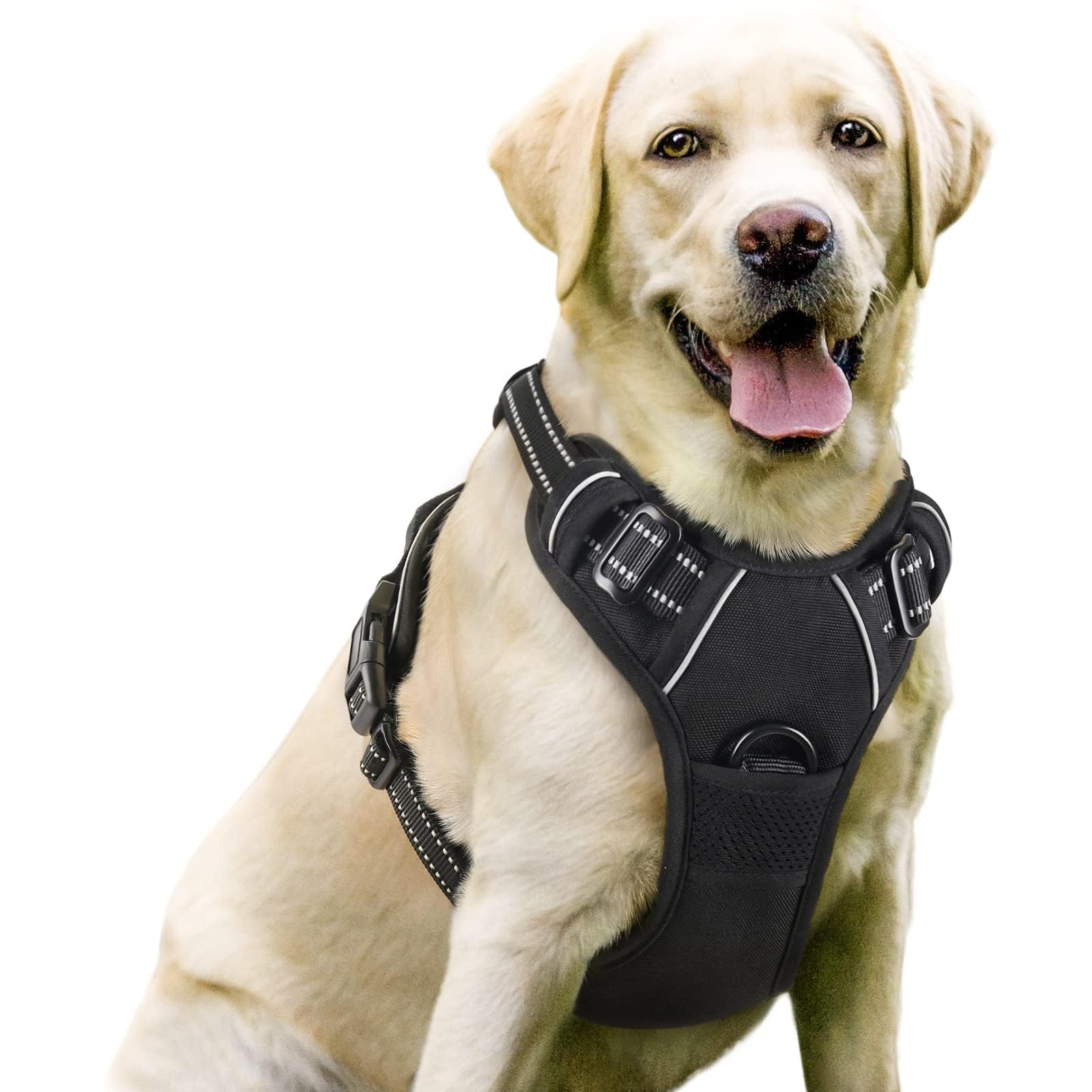
ICEFANG Tactical Harness

Top Pick
ICEFANG Tactical Harness

Strong pullers

Our Score 9.4/10
Check Price

Worth Noting

  • Straps can work loose between walks
  • Overkill for a calm dog on short walks
Care
Hand wash only
Buckles
6 quick-release, 2 metal
Gear Mounting
MOLLE strips, both sides
Leash Attachments
3 clips
Read the full review

Three leash clips on one harness looked like marketing to us until we attached a leash to the front V-ring and watched a hard-pulling dog lose most of his leverage. ICEFANG puts one ring high near the neck for close control, one on the back for an ordinary walk, and one at the chest for redirection, and on a broad, heavy-chested dog that chest ring is the one that changes things: he still leans in, but the harness turns him instead of letting him tow.

Hardware is where it separates from the rest of the set. Six quick-release buckles, two of them metal, metal leash points, and stitching that has held through everything we've put it through. Durability is the recurring weak spot in this category, with split webbing and popped plastic side buckles turning up across the group, and this harness has the strongest durability record of anything here. The adjusters sit between every pair of buckles, too, so the chest panel opens wide for a deep rib cage without the neck ending up baggy.

The MOLLE strips are the part we're least excited about. Two one-inch rows on each side carry a patch or a small pouch, which earns its keep on a hike and does nothing on a neighborhood loop. The handle across the shoulders is the opposite: we grab it on every walk, either to hold a lunging dog steady at the vet's door or to help him into the car without hauling on his neck.

It is a lot of harness, and a calm dog on short sidewalk walks is carrying control features nobody uses. What settles it for a pit is where that front ring sits — high on the chest, so a lunge turns into a sidestep instead of a tow, and you never have to lean back on the leash.

Bottom line: Our default pick for a strong, broad-chested pit: three leash points with a front clip that genuinely redirects, metal where the load lands, and the best durability record here.
2

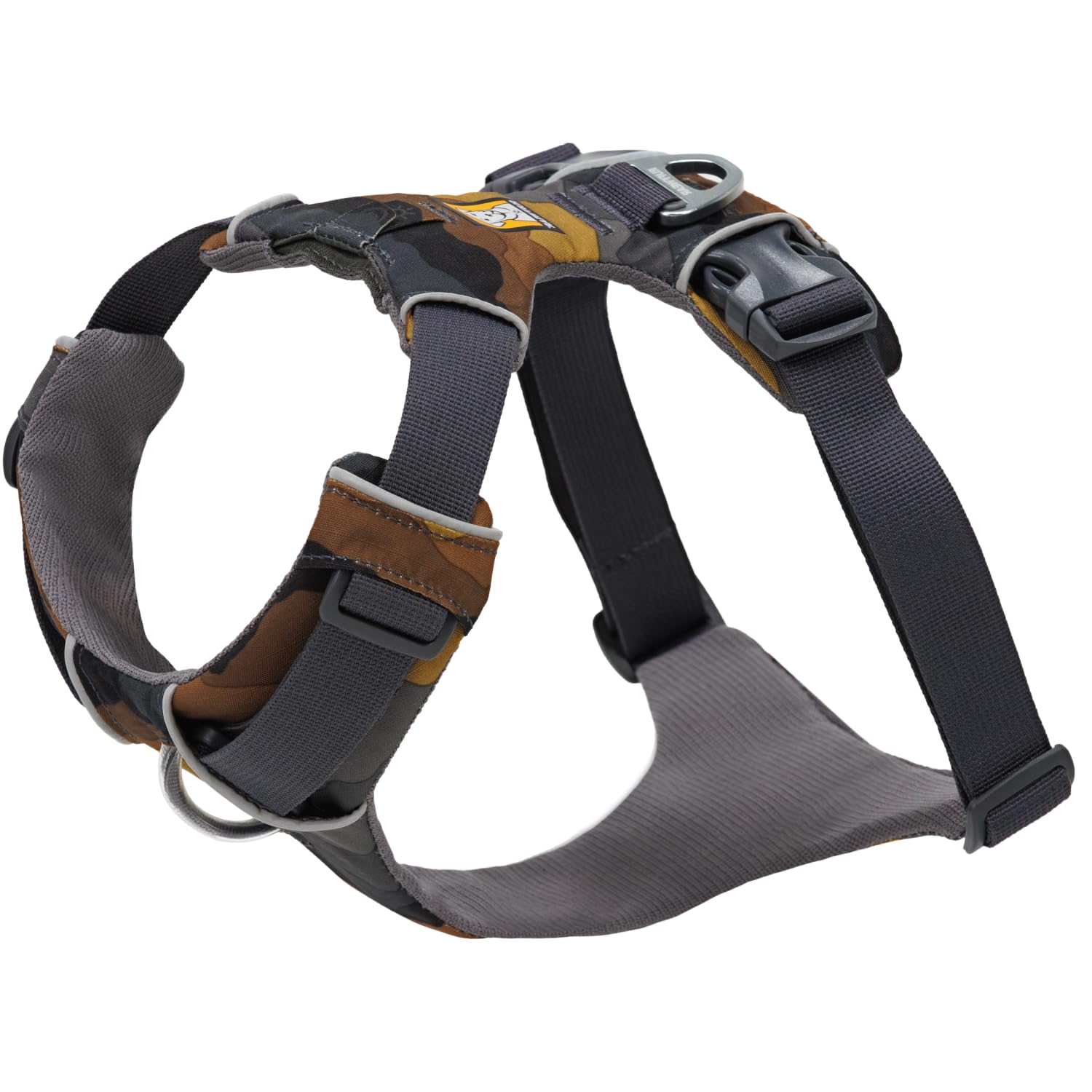
Ruffwear Front Range Harness

Ruffwear Front Range Harness

All-day wear

Our Score 9.2/10
Check Price

Worth Noting

  • Chest attachment barely redirects a hard puller
Padding
Foam chest and belly panels
Item Weight
6.72 oz
Adjustment Points
4
Leash Attachments
Aluminum V-ring plus chest webbing
Read the full review

At 6.72 ounces, the Front Range is the lightest padded harness here, and the closed-cell foam in the chest and belly panels is the difference between a dog who tolerates gear and one who forgets he has it on. We've had it on a dog through a whole afternoon of errands and forgotten it ourselves.

What the premium buys is comfort and construction, not control. The chest attachment is reinforced webbing rather than a swiveling ring, and on a dog who throws his weight forward it redirects him only mildly; the ICEFANG gives you far more to work with. Everything else is beautifully done — four-point adjustment, an aluminum V-ring on the back, an ID pocket, reflective trim, and stitching we haven't had to think about.

Fit is where we paid closest attention, because a wide-chested dog rubs raw in the armpits in most vests. The padding here sits forward of that crease, and after weeks of walks there's no bald patch and no chafing. The four adjustment points do run out of room on a genuinely deep chest, so measure the widest part of the rib cage and size up if you land within an inch of the top of the range.

It's machine washable as well, which after a muddy month is the detail we appreciated most.

Bottom line: We keep this one for dogs who wear a harness for hours: light, foam-padded and beautifully made, though its chest attachment only nudges a hard puller instead of steering him.

3

AUROTH Tactical Harness

AUROTH Tactical Harness

Working gear

Our Score 9.2/10
Check Price

Worth Noting

  • Plastic side buckles carry most of the load
Neck Girth
18-29 in
Chest Girth
24-37 in
Gear Mounting
MOLLE strips both sides
Leash Attachments
2 metal points
Read the full review

The buckles are where our attention went first, which isn't the reaction a harness maker wants. Four plastic side-release buckles carry most of the load on this vest, with metal at the leash points, and on a strong dog that's the part worth watching. The rest of the build is genuinely good: nylon webbing with reinforced stitching, air-mesh padding under a soft cotton cushion, and two metal leash points, front and back.

For the money it's the most harness per dollar here, and the fit range is the reason. The large covers an 18-to-29-inch neck and a 24-to-37-inch chest — a genuine broad-chested cut — and our test dog landed in the middle of it rather than on the last hole of the strap. Four-point adjustment means chest and neck get set independently, which is what you need on a dog shaped like a barrel with legs.

The MOLLE panels sell this harness and they're smaller in person than the photos suggest: the hook-and-loop panel is narrow, so it takes a patch or a small pouch rather than the modular kit the listing implies. Buy it for the cut and the front clip and treat the gear mounting as a bonus. One more job before you trust it near a road: set the chest snug, then check it after the first week, because a dog who backs out of harnesses can back out of this one if the straps have gone slack.

Bottom line: We recommend it as the best value tactical cut in this group — genuine broad-chest sizing and front and back clips — with the caveat that plastic buckles carry most of the load.

4

Beebiepet Tactical Harness

Beebiepet Tactical Harness

One-box setup

Our Score 9.2/10
Check Price

Worth Noting

  • Plastic clips on a heavy-duty build
  • Heavier and bulkier than a vest harness
Included
Harness and 5 ft leash
Item Weight
1.63 lb
Weight Range
30-100 lbs
Adjustment Points
4
Read the full review

A five-foot leash, a padded handle, a writable ID tag and a harness, all in one box — the kit is the pitch, and it's a good one if you're starting from nothing. The harness itself is a padded tactical vest with MOLLE strips, four adjustment points and a control handle, rated for dogs from thirty to a hundred pounds.

We like it most for the shape of the chest panel. The large is cut wide enough that dogs with genuinely huge chests fit without the front straps digging in, and the padding is soft enough that a dog who usually fusses stops bothering about it. The leash isn't an afterthought either: climbing-rope construction, a foam handle, and a swivel snap that hasn't twisted on us once.

It runs big. The size chart and the actual harness sit about a size apart, so measure the chest and think hard about dropping one. At 0.74 kg it's also a substantial thing to hang on a dog in July, and the plastic clips are the trade you make at this end of the range — the hardest-pulling dog in the group belongs in the ICEFANG instead.

Bottom line: Our pick when you need everything at once: a wide-chested harness, a usable rope leash and an ID tag, sized up to a hundred-pound dog but running large.

5

rabbitgoo No-Pull Harness

rabbitgoo No-Pull Harness

Tight budgets

Our Score 9.0/10
Check Price

Worth Noting

  • Webbing and stitching wear before the hardware
Chest Girth
17-33.4 in
Item Weight
10.6 oz
Adjustment Points
4 straps
Leash Attachments
2 metal clips
Read the full review

A 17-to-33.4-inch chest range is why this harness keeps showing up on broad-chested dogs: it's the widest span in this group, and the lowest-priced harness here. Four straps, two buckles, two metal leash hooks, a handle and reflective piping is a lot of harness for the money, and the basic geometry is right — a wide chest panel, straps that sit behind the shoulder, and a fit that stays where you put it on an ordinary walk.

What we don't love is setting it up. The sliders are stiff, and dialing in four straps took us a couple of tries and a fair bit of hand strength; if your grip is weak, this is the harness that will fight you. Once it's set, though, ours stayed set, and the front clip gives you the no-pull option the design doesn't advertise loudly enough.

The front panel is the other thing to watch on a hard puller. On a dog who leans into the leash, the chest piece can ride up toward the throat instead of staying low across the ribs; walking on the front clip keeps it down and takes the pressure off the windpipe. That's how we walk in it, and it's the difference between a harness that helps and one that just moves the problem.

Durability is where the value story gets thinner. This is a light fabric harness, and the wear, when it comes, is in the webbing and the stitching rather than at the buckles — a season of daily walking is a reasonable expectation, a determined chewer is not.

Bottom line: The cheapest harness here that still fits a wide chest, and the basic geometry is right, as long as you set the stiff straps once and walk on the front clip.

6

PHOEPET Reflective Harness

PHOEPET Reflective Harness

Head-shy dogs

Our Score 9.0/10
Check Price

Worth Noting

  • Back D-ring is small and fiddly
  • Stiff sliders slow the first fitting
Care
Hand wash only
Buckles
3, neck buckle lockable
Item Weight
8.32 oz
Leash Attachments
2 metal loops
Read the full review

Getting a harness over a pitbull's head is the part nobody warns you about: the ears fold back, the dog reverses, and by the time the strap clears his skull he has decided he hates the thing. PHOEPET opens flat on a third buckle at the neck and goes on from the side instead. It went on without a single argument, which is more than we can say for the over-the-head harnesses here.

The neck buckle locks, which answers the obvious worry that a third buckle is a third thing to pop open mid-walk. Two metal leash loops, front and back, padded chest panels, a handle and reflective material finish the specification at eight and a bit ounces — the standard kit, done properly.

We rate it as the pick for the dog who fights being dressed. The chest panel is wide enough that the front straps land on the ribs rather than the throat, it stayed put through a walk with a dog who lunges at bicycles, and there were no red marks under the front legs afterward. On a budget harness, that's more than we expected.

Bottom line: We hand this to the dog who fights having a harness pulled over his head — three buckles, a lockable neck, and a wide panel that sits on the ribs.

7

BARKBAY No-Pull Harness

BARKBAY No-Pull Harness

Blocky chests

Our Score 9.0/10
Check Price

Worth Noting

  • Front straps loosen as the dog moves
  • Zinc alloy hardware is a step below the tactical picks
Hardware
Zinc alloy clips, POM buckles
Chest Girth
24.5-32.5 in
Item Weight
10.4 oz
Leash Attachments
2 metal points
Read the full review

BARKBAY names Pitbull in the breed recommendation, next to Boxer and Husky, and the cut backs it up: a 24.5-to-32.5-inch chest, a wide front panel, and a shape that sits on a blocky rib cage rather than sliding around it. Plenty of harnesses claim a large-dog fit; fewer are actually cut for a chest that is wider than the neck by that much.

The rest of the specification reads well — 10.4 ounces, two metal leash points front and back, reflective strips along the sides, a lift handle on top. On a calm dog it's light, comfortable and easy to live with, and the padding sits where a short coat needs it.

The catch is the one that matters most for a strong, wide dog. The front straps loosen as the dog moves, and a chest that goes slack on a walk is a chest a determined dog can back out of. Of the eight harnesses here, this one holds its fit least securely, and that's a real limitation on a dog who already knows how to reverse out of things.

It stays in the roundup because the shape is right and it's light for the coverage it gives; it's the harness we hand to a calm, broad dog rather than to the escape artist. The zinc alloy hardware is the part to inspect after a few months, since that's where this one saves money.

Bottom line: It's cut for a blocky pitbull chest at a light weight, but the front straps loosen as the dog moves, which is the last thing a strong dog needs.

8

Annchwool No-Pull Harness

Annchwool No-Pull Harness

Easy on and off

Our Score 8.8/10
Check Price

Worth Noting

  • Little adjustment across the chest
Care
Hand wash only
Included
2 velcro patches
Strap Width
1.5 in
Leash Attachments
O-ring and D-ring
Read the full review

Two velcro patches come in the box — a flag and one reading MAMA SAY I'M SPECIAL — and they're the reason this harness gets photographed, not the reason to buy it. Underneath them sits a padded nylon vest with 1.5-inch straps, reflective stitching, a front clip, a back ring and a soft padded handle.

What it does better than anything else here is go on. The fastenings take a second, the padding is soft against a short coat, and the usual dance with a dog who backs away from straps didn't happen. For a household where dressing the dog is a fight every morning, that alone is worth a lot.

The chest is where it loses ground for this buyer. There's less adjustment across the front than the other picks offer, and on some sizes the chest strap is fixed, which is exactly the measurement a pitbull needs to be adjustable. On a dog at the top of a size, the panel sits where it sits.

On a dog it fits, the wide webbing and the soft padding make it feel like more harness than it is. On a dog it nearly fits, there's no strap left to give, and that's the whole story with a chest this broad.

Bottom line: The easiest harness here to get on and off, with soft padding and a wide strap, though the fixed chest strap limits how precisely it fits a very broad dog.

How We Tested the Best Harnesses for Pitbulls

We started by shortlisting harnesses that came in sizes for broad-chested dogs or adjusted at both the chest and neck, then ruled out anything with thin webbing or plastic buckles that flexed under thumb pressure. Fourteen harnesses made the cut, and we spent four months using them on pitbull-type dogs from 45 to 80 pounds. We measured each dog's neck and chest, fitted every harness to leave room for two fingers under the straps, and noted where the padding sat—behind the front legs, across the chest, and under the belly. If a harness only came in generic sizes and could not be cinched down without bunching, it did not move forward.

The testing happened on daily neighborhood walks, a few weekend hikes, and vet visits where we had to lift dogs in and out of the car. We timed how long it took to put each harness on a wiggling dog and whether we could do it with one hand; we watched for chafing behind the front legs and under the armpits after an hour of walking and whether the dog kept a normal stride. For secure fit, we had a helper hold a treat just out of reach while the dog backed up—any harness that let a shoulder slip out was eliminated.

Once a harness passed the fit and escape checks, we looked at construction: box stitching at stress points, the D-ring attachment, and whether the webbing stayed flat instead of rolling. We tugged each one against a fixed post to see if buckles creaked or deformed, and we re-checked the straps after every walk to see if they had slipped. Durability got a real-world test over four months of mud, rain, and one dog who likes to drag his chest through the bushes. The harnesses that made the list still looked and worked like they did on day one.

How to Choose the Right Harness for Pitbulls

Measure the chest, then ignore the weight chart

Run a tape around the widest part of the rib cage, just behind the front legs, and write the number down. That's the figure the harness has to match. Weight ranges sit beside it on every listing and they mislead: one large size here is sold for dogs from thirty to a hundred pounds, which tells you nothing about whether it will clear a deep chest.

Chest ranges are the honest comparison — 17 to 33.4 inches on the rabbitgoo, 24 to 37 on the AUROTH, 24.5 to 32.5 on the BARKBAY — and they don't line up across brands. A dog can be a large in one and an XL in another, so shop the number rather than the letter, and size up if you land within an inch of the top of a range.

What a front clip does, and what it doesn't

A front leash attachment pulls the chest sideways when the dog pulls, which turns him toward you and takes the leverage out of a lunge. It isn't a brake. A determined dog can still drag you; he just does it at an angle. The chest panel has to be snug for any of this to work, or the whole harness rolls around his ribs under load.

A back ring is for a dog who already walks politely, and a harness with both lets you switch between training and a relaxed stroll. Buy two attachment points even if your dog is calm today — the front clip costs nothing extra and it's the feature you'll want the first time a cat crosses the road.

Hardware, adjusters and the escape problem

Where the load lands matters more than how many buckles there are. Metal at the leash points, metal or a good alloy at the adjusters, and plastic reserved for side-release buckles that aren't carrying the pull. Then look at adjustment: four points let you set the chest and the neck separately, which is exactly what a wide-chested dog needs.

The trap is that a harness which fits in the shop loosens a notch after a week of pulling, and a slack chest is how dogs back out of them. Set the chest first, then the neck, then check both after each of the first three walks.

Padding, weight and how much harness to buy

Every harness here spreads pressure across the chest; the difference is what sits against the skin. Foam panels under a light shell, like the Ruffwear's, are for dogs who rub under the front legs, and the whole harness weighs 6.72 ounces. Heavier tactical builds add metal, MOLLE panels and a handle, and the weight climbs with them — 0.74 kg on the Beebiepet.

If the harness goes on for a walk and comes off in the hallway, buy the control you want and don't worry about the grams. If it's on for hikes and errands, the lighter harness with real padding is the one your dog stops noticing.

Frequently Asked Questions

Final Verdict

If we were buying one harness for a broad-chested pitbull this week, it would be the ICEFANG. Three leash points with a front clip that steers rather than just snags, metal where the load lands, and the strongest durability record in this group — it's the one built to survive a dog who pulls.

For a dog who wears a harness for hours at a time, the Ruffwear Front Range is lighter and softer, and worth the step up if comfort outranks correction. On a tight budget, the rabbitgoo fits a wide chest for less than anything else here; set the straps carefully and walk on the front clip.