Food & Treats

Best Long-Lasting Dog Treats of 2026

The package said long-lasting; the reality was six minutes and a dog staring at the spot where the chew used to be. That gap is the problem with shopping for long-lasting dog treats: the label tells you nothing about whether your dog will work at it or lose interest after the first bite. A good one buys you real time — a work call, a dinner, a rainy afternoon — while satisfying the chewing urge instead of frustrating it. The bad ones vanish too fast, get gulped down whole, or come back up later.

My 60-pound shepherd mix treats most chews like a personal challenge, and over three months we tested 14 long-lasting options across sizes, textures, and proteins — dense chews, softer sticks, and everything between. We noted which got the instant grab-and-run, which got abandoned under the coffee table, and which got picked back up the next day. Long-lasting is relative, though: ten minutes is a marathon for a Yorkie and a warm-up for a Lab. The picks below are the ones that held repeat interest, not just a first sniff.

1

Good 'n' Fun Kabobs

Top Pick
Good 'n' Fun Kabobs

Most dogs

Our Score 9.4/10
Check Price

Worth Noting

  • Hide core can upset sensitive stomachs
  • Bags vary from pliable to hard and dry
Chew Type
Beef hide and pork hide kabob
Pack Size
48 oz
Breed Size
All breed sizes
Protein Wrap
Chicken, duck, chicken liver
Read the full review

A three-pound bag is the first thing to get straight about this one. You aren't buying a single showpiece chew; you're buying a supply, and that suits the way long-lasting treats actually get used in a house with a dog in it. Each kabob is a beef hide and pork hide core wrapped in chicken, duck and chicken liver, so there are two stages to work through: the meat goes first, then the hide, and the hide is the slow part. That structure is why it's our top pick.

The shape earns its keep as well. A long, knobbly stick doesn't vanish in a single bite the way a small biscuit does, and the meaty outside gives a fussy dog a reason to start. We've seen how much difference the wrap makes — a dog that walks away from a plain pressed chew will usually take one with real chicken on it.

Two things to weigh. The core is hide, and hide is where most of the stomach trouble in this category begins, so if your dog has had a bad reaction to rawhide before, this is not the bag to test the theory on. Texture also varies: kabobs turn up pliable and meaty, and they turn up hard and dry, and hard is a lot to ask of a small dog. Bend one before you hand it over. If it has no give at all, you've got a decision to make about whether your dog should take it on.

One more thing worth knowing before you commit to the big bag: plenty of dogs strip the meat off and lose interest in the bare hide core. If yours is that kind of dog, you're paying for a very short treat and a bag of leftovers, so start small. For everyone else — the Labrador, the terrier, the dog that inhales everything — this is the one that keeps working.

Bottom line: For most dogs this is the bag we hand over first: the two-stage kabob keeps a determined chewer busy well past a biscuit, and there's enough in it to make a habit of it.

2

Purina Busy Bone Tiny

Purina Busy Bone Tiny

Toy breeds

Our Score 9.4/10
Check Price

Worth Noting

  • Firmness varies from bag to bag
Count
60 count
Flavor
Pork
Dog Size
Up to 15 lb
Chew Type
Rawhide-free meat chew
Read the full review

Fifteen pounds is the line worth drawing first, because it decides everything else about this chew. Purina sizes these for tiny adult dogs, and that's the entire reason we included them: most long-lasting chews are built for a Labrador's jaws, and handing one of those to a Yorkie is a bad idea on both safety and enthusiasm grounds. These are small enough to be a genuine chew for a small mouth without being a joke.

The recipe is the other half of the argument. No rawhide, real meat in the center, a firm texture, and no artificial flavors — for a small dog that's a good combination, because a firm chew gives a light chewer something to work at without being so hard it's discouraging. Sixty to a pouch helps too; the trouble with small-dog treats is that they disappear faster than you can reorder them.

Be realistic about duration. A determined chewer, and plenty of small terriers are determined, gets through one of these faster than you might like, while a soft-mouthed lap dog takes a good while over it. The bones are small but they aren't soft, and a twelve-year-old Chihuahua with worn teeth deserves a bend test before you hand one over.

Bottom line: If your dog is under fifteen pounds, this is the one we choose: a firm, rawhide-free chew that fits a small mouth and comes sixty to a pouch.

3

DreamBone Kabobz

DreamBone Kabobz

Rawhide-free chewing

Our Score 9.4/10
Check Price

Worth Noting

  • Softer than hide, so it goes faster
  • Texture and acceptance vary between bags
Count
18 count
Flavors
Chicken, beef, pork
Chew Type
Rawhide-free kabob
Enriched With
Vitamins and minerals
Read the full review

If the top pick's format appeals and the hide core doesn't, this is the same idea in a different wrapper — literally. DreamBone builds these without rawhide, using real chicken and vegetables, and enriches them with vitamins and minerals. The trade is straightforward: you lose some of the resistance that makes hide last, and you get a chew made without the ingredient that causes most of the trouble.

Eighteen to a bag, and the ticket is easier to say yes to than the big hide bag, which is why we suggest starting here if you're new to kabobs. Medium dogs are the sweet spot — enough chew to matter, not so much that it becomes a project — and the chicken-and-beef-and-pork flavor rotation keeps a dog interested across a bag.

What you should not expect is a miracle of endurance. A rawhide-free kabob gives way faster than hide does, and a strong chewer will be done before you've finished your coffee. That's the trade, not a flaw, but if a long chew is the whole point the top pick wins this one and these are the gentler alternative. Dogs that turn their noses up at pressed chews often take these because of the chicken — though a few turn around and refuse them, so buy one bag before you buy three.

Bottom line: We recommend these for medium dogs whose people want kabobs without rawhide — an easy first bag, provided you're not expecting hide-level endurance.

4

Oinkies Hearty Kabobs

Oinkies Hearty Kabobs

Small dogs

Our Score 9.4/10
Check Price

Worth Noting

  • Smaller than the photos suggest
  • Short sessions by the maker's own description
Count
18 count
Chew Type
Rawhide-free kabob
Breed Size
Small and medium breeds
Real Ingredients
Chicken breast, duck breast, carrot, sweet potato
Read the full review

Hartz calls these short-session chews, and we appreciate a maker that doesn't oversell. That phrase is the review in miniature: this is a good chew, it isn't a long one, and it's sized accordingly. Eighteen kabobs in an 8.8-ounce bag, built for dogs that want a focused chew rather than a project.

What's inside is better than the price suggests. Real chicken breast, duck breast, carrot and sweet potato, slow-baked, with no beef rawhide anywhere in it. If you've been avoiding hide but still want something with visible meat rather than a uniform pressed stick, that combination is hard to argue with. The savory outside is what gets a dog's attention; the rest goes down easily, which is both the appeal and the limit.

The catch is size and staying power. These run small — smaller than the product photos suggest — so a medium or large dog is done quickly, and even a small dog tends to finish one in a sitting rather than over a stretch. Treat them as a step up from a biscuit rather than a replacement for a hide chew and they make sense: a satisfying chew for a little dog, a between-chews snack for a bigger one.

Bottom line: These earn their place for small dogs that want real meat in a chew — just don't buy them expecting an afternoon of quiet.

5

Country Kitchen Beef Rings

Country Kitchen Beef Rings

Trying the format

Our Score 9.4/10
Check Price

Worth Noting

  • Soft, airy texture won't slow a hard chewer
Count
7 count
Texture
Chewy and airy
Chew Type
Rawhide-free beef ring
Ingredient Claims
No gluten, wheat, or soy
Read the full review

A collagen ring with a meaty coating, made without rawhide, gluten, wheat or soy, and sold seven to a bag. The shape is the appealing part: a ring gives a chewer a continuous edge to work around rather than a single end to gnaw, and for a dog that loses interest in straight sticks that alone is worth something.

Airy is the word on the bag, and it's accurate. These give way more readily than a hide chew or a pressed braid, which makes them a reasonable fit for older dogs and light chewers and a poor fit for a dog that destroys everything in sight. The meaty coating is what gets the initial interest; the ring underneath is the softer part.

Seven rings is a trial size, and that's their real value: you learn whether your dog likes the format without committing to a bulk bag, and being wrong costs you very little. Just don't count on one to fill an afternoon, and don't buy the ring if your dog is the sort that eats the coating and walks away.

Bottom line: We treat these as a test drive: rawhide-free, real beef, and a small enough bag to learn whether your dog takes to rings at all.

6

Starmark Everlasting Treats

Starmark Everlasting Treats

Dispenser owners

Our Score 9.2/10
Check Price

Worth Noting

  • Needs a Starmark dispenser, sold separately
  • Can upset sensitive stomachs
Fits
Starmark Everlasting dispensers
Size
Large
Count
2 count
Chew Type
Dental chew disc
Read the full review

Two discs in a bag only makes sense if you already own the holder. Starmark builds these to wedge into its Everlasting Treat dispensers, and the design is the point: a firm disc with raised dental ridges, wheat- and soy-free, made in the USA, that a dog works at from the edges inward instead of simply picking up.

Wedged in a dispenser, it's the closest thing in this roundup to a chew that genuinely occupies a dog for a long stretch. The ridges give teeth something to do, the disc stays put while the dog works, and the chicken flavor is clearly doing its job — the dogs we've given them to stay with it rather than wandering off.

Outside a holder it's a different product. The disc is easy to pick up and, once a dog has pried it loose, easy to finish, and it comes free of some holders more readily than it should. If you're not going to use the dispenser, don't buy these — a kabob gives you more chew for less ceremony.

The other flag is digestion. These don't sit well with every dog, and stomach upset after a dental chew is the thing to watch, so start with a single disc rather than both and stop if your dog reacts. For a household that already has the holder and a dog with a cast-iron stomach, they're the most useful thing in this roundup that isn't a stick.

Bottom line: Ours is a conditional yes: with a Starmark dispenser this is the longest-working chew we tested, and without one it's a soft biscuit.

7

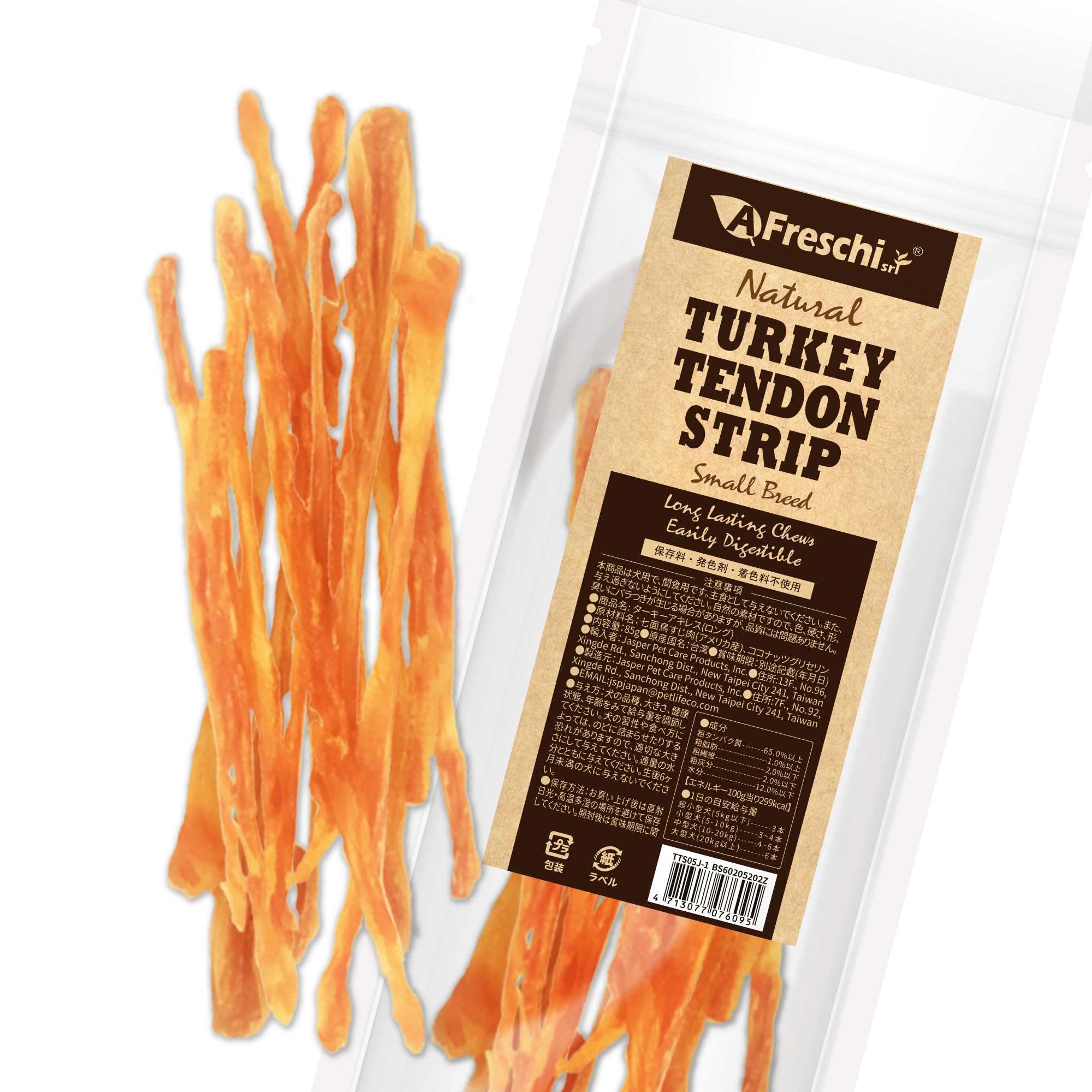
A Freschi Turkey Tendon

A Freschi Turkey Tendon

Short ingredient lists

Our Score 9.0/10
Check Price

Worth Noting

  • Most expensive per ounce here
  • Not a long chew for determined dogs
Sourcing
USA-sourced turkey tendons
Chew Type
Turkey tendon strip
Pack Size
3 oz
Ingredient Claims
Grain-free, low fat
Read the full review

Three ounces does not sound like much, and it isn't. This is the smallest package in the roundup and the most expensive per ounce by a wide margin, so the first question is whether the ingredient list justifies it. It's about as short as a dog treat gets: turkey tendon sourced in the USA, no grains, no rawhide, no artificial colors or flavors.

For a dog with a sensitive stomach, or for someone who reads labels for a living, this is where we point. Tendon is lean and it's a natural structure rather than a pressed one, and it's the single most popular chew with dogs here — the fussy ones and the greedy ones both go after it. If you've been through a run of chews your dog sniffed and abandoned, that counts for something.

The honest limit is duration. A tendon strip is chewy, but it is not hide, and a determined dog will be finished with one well before you've settled into your chair. It suits light and medium chewers, older dogs whose teeth can't handle dense chews, and households where the treat is part of a routine rather than a way of buying an hour of quiet. Supervise a gulper the way you would with any chew.

Bottom line: We buy these for the label, not the stopwatch: one clean ingredient, lean and grain-free, and gone well before a hide chew would be.

How We Picked and Tested Long-Lasting Dog Treats

We started with a list of about 50 treats marketed as long-lasting — bully-style chews, dental sticks, baked bars, pressed sticks — and cut it down by reading ingredient panels, checking protein content, and comparing cost per ounce. We also looked at what was actually in stock and easy to reorder, since a treat you can't buy again isn't much use. The final 14 went to a panel of dogs ranging from a 12-pound terrier to an 80-pound retriever, including one power chewer who has destroyed toys rated for tough.

Over three months, each treat was handed over at the same kinds of moments — after dinner while we ate, during a 3 p.m. work call, and in the yard when the mail carrier came up the steps — with a stopwatch running. We recorded whether the dog took it immediately or sniffed and walked away, whether they carried it off to a favorite spot, and how long they stayed with it before losing interest. We also noted the chewing style: a dog that gulps versus one that gnaws steadily tells you a lot about whether a treat is too hard, too soft, or just right for their size.

After each session, we checked in over the next 24 hours for loose stools, gas, or vomiting — digestibility is the part most reviews skip, and it's the one that matters at 2 a.m. We also calculated cost per minute of chew time, because an expensive chew that lasts 20 minutes and a cheap one that lasts 15 are not the same purchase. Finally, we tracked which treats the dogs came back to voluntarily on day two, since enthusiasm on the first offering is easy and repeat interest is not.

How to Choose Long-Lasting Dog Treats

Match the chew to the chewer

The biggest variable isn't the treat, it's the dog. A chew that occupies a nine-year-old spaniel is a two-minute snack for a young staffie, and the same kabob can be too much for a toy breed and not enough for a Labrador. We look at three things before anything else: how hard the dog chews, how big the treat is relative to the muzzle, and whether the dog gulps. If you don't know yet, buy the smallest pack of the chew you're considering. A four-count bag is cheap information; a three-pound one isn't.

Rawhide, or something else

Hide has been the default long-lasting chew for decades because it resists, and that resistance is also its weakness: a hide chew that comes away in chunks is harder on a dog than a softer one. Rawhide-free chews — pressed starch, collagen, tendon — trade some of that endurance for easier digestion, and the trade is real. Expect a shorter chew.

If your dog has vomited or had loose stool after a hide chew, that's your answer; don't keep testing the theory. If your dog has a cast-iron stomach and you want maximum minutes out of one treat, hide still wins, and it wins by a wider margin than the marketing suggests.

Size, shape and choking risk

Chew size is about the mouth more than the body, and a chew small enough to swallow whole is a hazard whatever it's made of. Choose one noticeably larger than the dog's open mouth, take it away once it wears down to a swallowable stub, and don't leave a dog alone with an unfamiliar type of chew the first time. Shape matters too: a long kabob, braid or stick is harder to gulp than a round disc, and that difference is worth more than any claim printed on the front of the bag.

Texture changes between bags

Two bags of the same product don't always behave the same way. Chews turn up pliable and meaty, and they turn up hard and dry, and a chew that's fine for a Labrador can be a discouraging brick for a Chihuahua. Bend one before you hand it over. If it has no give at all, it's either a hard batch or past its best, and a small dog shouldn't have it. That's the argument for buying a small pack first and a bulk bag only once you know the batch suits your dog.

Frequently Asked Questions

Final Verdict

The bag we buy is Good 'n' Fun's kabobs. Three pounds of two-stage chew is the best answer we found to 'something that lasts,' and it suits the widest range of dogs — provided your dog tolerates hide.

If it doesn't, or your dog is under fifteen pounds, the Purina Busy Bone Tiny is the alternative: no rawhide, firm enough to work at, sized for a small mouth. And when the ingredient list matters more than the minutes, the turkey tendons are the ones worth the premium.