Food & Treats

Best Puppy Food for Cane Corsos of 2026

A Cane Corso puppy is not a small dog in a bigger body—it's a giant breed built to grow slowly, and the wrong puppy food can push growth too fast or leave them hungry an hour later. The right formula does three things at once: it supports steady bone and joint development, keeps digestion calm, and gives a big muzzle enough resistance that dinner doesn't disappear in four seconds. I learned that the messy way with my own Corso puppy, who treated tiny kibble like popcorn and had the gas to prove it.

Over the past five months, my team and I fed 12 large-breed puppy formulas to a pair of growing Cane Corsos, watching for the things that actually matter day to day: whether they cleaned the bowl, how firm their stools stayed, whether their coats kept a shine, and whether the bag survived a week in the pantry without going stale. We also tracked how much food it took to keep weight on, because value with a giant breed comes down to cost per day, not the number on the tag. The picks below are the ones that held up.

1

Purina Pro Plan Large Breed Puppy

Top Pick
Purina Pro Plan Large Breed Puppy

Cane Corso puppies

Our Score 9.4/10
Check Price

Worth Noting

Bag Size
34 lb
DHA Source
Fish oil
Joint Support
Glucosamine
Large-breed Growth
Appropriate growth rate
Read the full review

The first thing we check on a large-breed puppy formula is whether it addresses growth rate and joints together, not just protein. Purina Pro Plan does: the formula is positioned for an appropriate growth rate for large-breed puppies, and it adds glucosamine for developing joints and cartilage. That combination is why it is our top pick for a Cane Corso puppy, a breed that will add a lot of weight before it finishes growing.

The rest of the package is practical for a giant-breed household. DHA from fish oil supports brain and vision development, vitamin A and omega-6 fatty acids are there for skin and coat, and real chicken is the first ingredient in a high-protein formula. We also appreciate the 34-pound bag: it is large enough to be worth storing and not so large that it takes over the pantry. For a puppy that will eat through kibble quickly, that size makes sense.

Digestion is where we pause. Some puppies do well on this formula, others get loose stools, and a slow switch matters. We don't ignore that, but we also don't rule out a formula this well specified because of it. Start with the old food and blend the new kibble in gradually, keep the bag sealed, and judge the result over a couple of weeks rather than one bowl. If loose stools continue, stop and talk to your vet.

Bottom line: For most Cane Corso puppies, this is the large-breed formula we recommend first: it pairs large-breed growth support with glucosamine and DHA in a bag that suits a giant appetite.
2

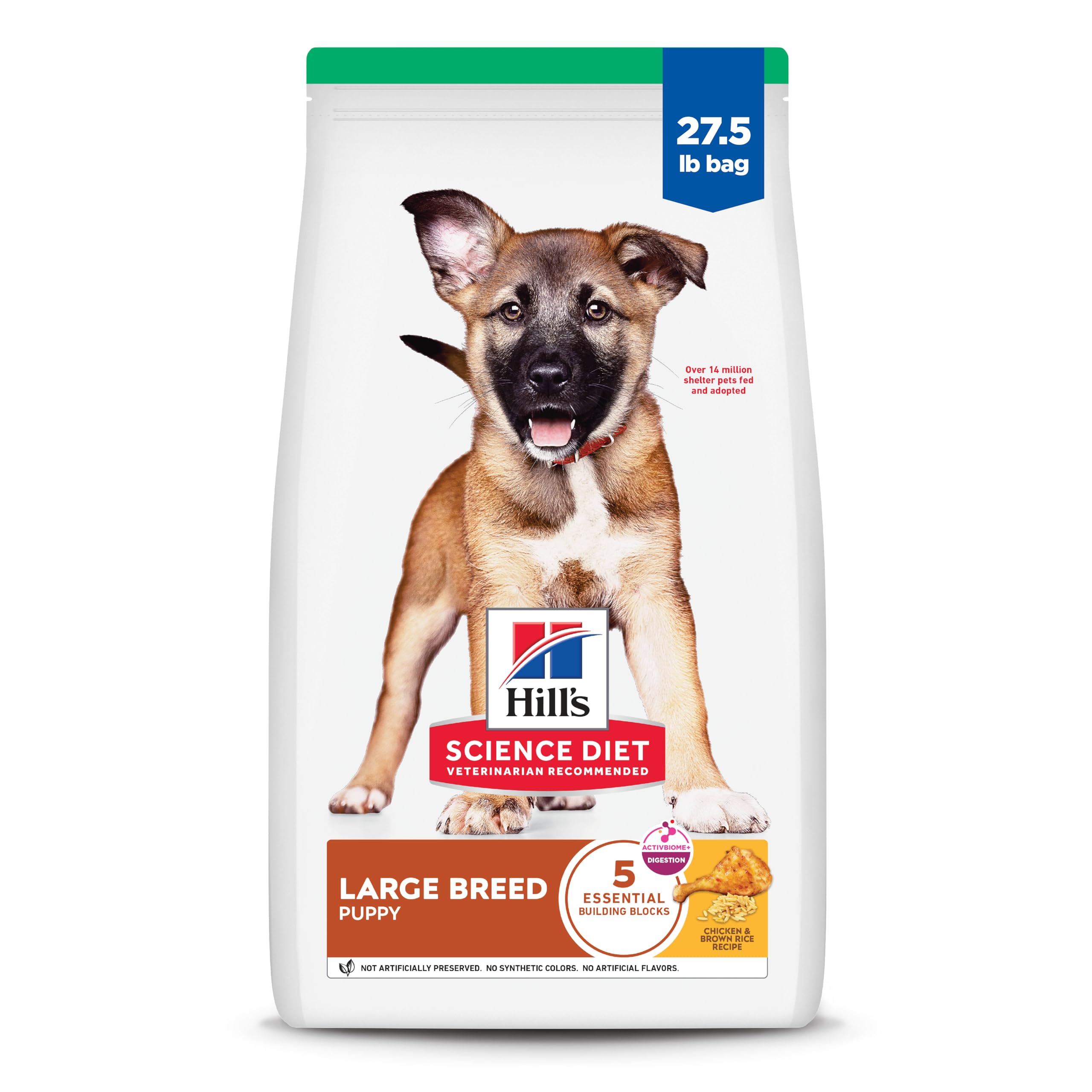
Hill's Science Diet Large Breed Puppy

Hill's Science Diet Large Breed Puppy

Premium large-breed feeding

Our Score 9.4/10
Check Price

Worth Noting

  • Premium price per pound
Bag Size
27.5 lb
DHA Source
Fish oil
Large-breed Growth
Large-breed puppy formula
Bone & Joint Support
Balanced minerals
Read the full review

The kibble on Hill's Science Diet Large Breed Puppy is noticeably large. The pieces are big enough that a fast-eating Cane Corso puppy has to slow down and chew, which is exactly what you want from a food built for a giant breed. The formula also uses balanced minerals for growing bones and teeth, plus DHA and fish oil for brain and eye development.

Where it earns its place is as the premium alternative here. It is a mineral-focused formula with a kibble that discourages gulping, and we prefer it for a household that has already decided to feed a premium large-breed puppy food. The high-quality protein is there for muscle growth, and the formula is built around the bone-and-teeth needs of a growing giant.

Digestion is the other caveat. Some puppies do well on it, others get loose stools, so a slow transition is essential. The large kibble is a sensible match for a Cane Corso's mouth, but it is not enough to promise a calm stomach.

Bottom line: We recommend this premium large-breed formula for Cane Corso puppies that need balanced minerals and a larger kibble that slows fast eaters.

How We Tested Cane Corso Puppy Food

We started with a long list of 30 puppy foods marketed for large breeds, then narrowed it by reading guaranteed analyses and ingredient panels—moderate calcium and phosphorus, a named meat source near the top, and no vague fat or grain fragments. We also filtered out bags that felt flimsy or had seals that looked like they'd fail by Tuesday, and formulas with kibble too small for a Cane Corso's mouth. That left 12 formulas to feed over five months.

For five months, two Cane Corso puppies in different homes ate each formula for at least two weeks, with a three-day transition between bags to avoid upset. We fed twice a day from the same measuring cup, timed how fast they ate, and noted whether they walked away satisfied or scrounged for more. Each morning we checked stool firmness and gas odor; once a week we ran a hand over the coat to judge shine and softness. Open bags lived in the pantry for a week so we could see whether the resealable closure held and whether the food stayed fresh-smelling.

The formulas that rose to the top kept growth steady without loose stools, produced less gas, and kept coats glossy. We weighed each meal and counted how many days a bag lasted, since a Corso puppy can eat through a 30-pound bag faster than you'd expect; value came down to cost per day, not the number on the shelf tag. Kibble size got its own test: we watched whether puppies chewed or inhaled, and whether small pieces ended up on the floor.

How to Choose the Right Puppy Food for Cane Corsos

Start With Giant-Breed Growth

A Cane Corso puppy is not a small dog scaled up. Giant breeds put on weight quickly, and the goal is steady growth rather than the fastest possible gain. That is why the large-breed label matters: these formulas are built around appropriate growth rate, with mineral balance for developing bones and joints. Purina Pro Plan leans on glucosamine for joint support, while Hill's Science Diet uses balanced minerals for bones and teeth. Either approach is more relevant here than a generic all-breed puppy formula.

We prioritize a formula that names large-breed growth on the bag and backs it with joint or bone support. Protein still matters for muscle, but it is not the only number to chase. If a formula is marketed only as high-protein puppy food without a large-breed growth claim, it is not the right default for a Cane Corso.

Treat Digestion as a Real Criterion

The most useful thing you can watch in the first month is stool quality, not how quickly your puppy empties the bowl. Large-breed puppy foods can be nutritionally sound and still disagree with an individual puppy; some puppies thrive on a formula, others get loose stools. That is not a reason to switch foods every week. It is a reason to pick a formula with a track record you can live with and judge it over a couple of weeks.

We put digestive tolerance ahead of a slightly higher protein number. A puppy that is growing steadily and producing firm stools is doing better than one on a fancier formula with loose stools. If your puppy has a sensitive stomach, choose one large-breed puppy formula, transition carefully, and give it a couple of weeks rather than switching every week.

Look at the Kibble, Not Just the Bag

A giant-breed puppy tends to eat fast, and a very small kibble makes that easier to do. Larger pieces give a puppy something to chew and can slow a gulper down. Hill's Science Diet is the clearest example in this set: its kibble is sized for large-breed puppies, and that is a practical advantage if your Cane Corso inhales dinner.

Palatability is the other side of the bowl. A food can be well formulated and still be refused, so buy the smallest bag that makes sense when you are trying a new formula. Once your puppy is eating reliably, a larger bag is easier to justify.

Do the Bag Math

A 34-pound bag and a 27.5-pound bag are not directly comparable until you look at cost per pound and how fast your puppy eats. A giant-breed puppy can go through a bag quickly, so the larger bag can be the better value even when the sticker price is close. The catch is storage: a big bag that sits open for months can go stale.

We keep food in its original bag inside a sealed container, and we buy the size we can finish while it still smells fresh. If you have a small kitchen or a puppy that is still switching foods, the smaller bag is the safer buy.

Frequently Asked Questions

Final Verdict

For most Cane Corso puppies, we recommend Purina Pro Plan Large Breed Puppy. It has the clearest large-breed growth and joint-support combination here, plus a bag size that suits a giant appetite. Choose Hill's Science Diet if you want balanced minerals and a larger kibble and are willing to pay more per pound. If your puppy has a sensitive stomach, introduce either one slowly and let stool quality, not marketing, make the final call.