Food & Treats

Best Puppy Food for Miniature Schnauzers of 2026

Miniature schnauzer puppies are tiny, bearded chewing machines with a talent for making a bag of puppy food disappear — or for turning up their noses at it. The right kibble has to do more than vanish; it has to fit a mouth the size of a bottle cap and agree with a digestive system that can be surprisingly delicate. My own two schnauzer puppies taught me that, especially the one who would rather skip breakfast than crunch an oversized piece. Over the past four months, we've fed 12 formulas to a rotating group of miniature schnauzer puppies, and the gap between tolerated and thriving is wide.

Schnauzer puppies are skilled at holding out for something better, so taste and preference matter — but so does what happens after dinner. A formula has to be palatable enough to eat eagerly, small enough to chew comfortably, and gentle enough to keep digestion steady, without charging boutique prices. The picks below are the ones that balanced those demands; some lean toward sensitive stomachs, others toward enthusiastic eaters, but each earned its place.

1

Royal Canin Small Puppy

Top Pick
Royal Canin Small Puppy

Miniature schnauzer puppies

Our Score 9.6/10
Check Price

Worth Noting

  • Four-pound bag empties quickly
Bag Size
4 lb
Age Range
2 to 10 months
Adult Weight
9 to 22 lb
First Ingredient
Chicken
Read the full review

Nine to twenty-two pounds is the number that put this bag at the top of our list. That's the adult weight Royal Canin builds this formula for, and it's where a miniature schnauzer lands once it's grown; the two-to-ten-month window covers the stage that gets it there. It's rare to see both figures spelled out on a bag, and it makes the match something you can check rather than assume.

What kept us coming back was how little we had to think about it. The kibble is small enough that a ten-week-old eats it without gulping air, and firm enough to survive a pocket, which matters more than it sounds when half a puppy's calories are going into training. We were also struck by the DHA sources: fish oil and marine microalgae oil, rather than a bag that announces itself across the kitchen every time you open it.

Cost is the honest catch. Per pound this is the most expensive bag we recommend, and the four-pound size means you're reordering through the fastest part of the growth curve. For one puppy that premium buys a formula matched to its adult size; for a breeder or a two-puppy household, the bigger bags further down this page make more sense.

One thing we didn't expect to care about: the pieces are uniform enough to count out as rewards, so the food doubles as the treat pouch through the first weeks of house training. Fewer bags in the cupboard, and no argument about whether the treats count against the day's ration.

Bottom line: For a miniature schnauzer puppy this is the bag we hand over without a caveat: the weight band, the age window and the kibble all line up.

2

Hill's Science Diet Small & Mini

Hill's Science Diet Small & Mini

Value-minded small breeds

Our Score 9.6/10
Check Price

Worth Noting

Kibble
Nibble size
Bag Size
4.5 lb
Breed Size
Small and mini
Key Nutrients
DHA and fish oil
Read the full review

Per pound, this is the better-value half of the two small-breed-specific bags we recommend, and it gives up very little to get there. Hill's calls the kibble a nibble size, and it is: small, uniform and easy for a puppy with a mouth the size of a thimble to pick up. That alone makes it the bag we point to first for anyone who wants a small-breed formula without the Royal Canin premium.

The nutrition is the standard puppy checklist done properly — DHA and fish oil for brain and eye development, balanced minerals for growing bones and teeth, an antioxidant blend for the immune system, and chicken and brown rice as the base. It's also one of the plainer bags to open. There's no fishy hit when you unseal it, which is not something every formula here can say.

The one thing to settle before ordering is protein. This is chicken from the first ingredient down, and a puppy that has already told you it does better on fish has no version of this formula to move to — that's the gap the Pro Plan salmon bag fills. If chicken has been fine so far, there's nothing here to argue with, and the 4.5-pound bag is a sensible size for one dog.

Bottom line: Buy this if you want small-breed puppy nutrition for less per pound than our top pick and your puppy is already doing well on chicken.

3

Royal Canin Small Indoor Puppy

Royal Canin Small Indoor Puppy

Apartment puppies

Our Score 9.6/10
Check Price

Worth Noting

  • Smallest bag in the group at 2.5 lb
Kibble
For miniature jaws
Bag Size
2.5 lb
Age Range
2 to 10 months
Adult Weight
9 to 22 lb
Read the full review

The claim on the front of this bag is about what comes out the other end: prebiotics, highly digestible proteins and a specific fiber blend are there to reduce stool volume and odor. In a fifth-floor flat with a puppy that isn't house-trained yet, that stops being a marketing line and becomes the difference between noticing an accident and smelling it from the hallway.

Everything else matches our top pick's fit — two to ten months, an expected adult weight of nine to twenty-two pounds, and a kibble built for miniature jaws and, in Royal Canin's own words, picky appetites. The pieces are among the smallest in this group, which suits a puppy that walks away from anything it has to work at.

Indoor is the part worth thinking about. This formula doesn't assume a garden or a long off-lead run; it's built for a puppy whose exercise happens on pavements and in a small yard. If you have a big garden and a puppy that tears around it, the standard Small Puppy formula is the better match.

Our take: this is a formula for a specific kind of life. When a puppy's exercise happens on pavements and its accidents happen on a rug two metres from the sofa, stool quality stops being a footnote and becomes the reason to buy. That's a narrow brief, and this bag answers it better than anything else here.

Bottom line: Choose it if the puppy lives in an apartment and you care as much about what comes out as what goes in.

4

Purina Pro Plan Small Breed

Purina Pro Plan Small Breed

Active small puppies

Our Score 9.4/10
Check Price

Worth Noting

  • Chicken-based only, no fish version
Protein
High protein
Bag Size
6 lb
Breed Size
Small breeds
Probiotics
Guaranteed live
Read the full review

High protein plus guaranteed live probiotics is a combination aimed at exactly the puppy a miniature schnauzer tends to be: busy, quick-growing and occasionally convinced there are better things to do than eat. Real chicken is the first ingredient, and the protein level is pitched at small dogs with a lot of energy to spend.

DHA from fish oil covers brain and vision development, and the kibble is genuinely small — the pieces sit at the tiny end of what we fed during testing, which suits a breed that can bolt its food. The six-pound bag is also the most sensible size in the Pro Plan range for a single puppy: enough to last, not so much that the bottom of the bag has been open for months.

We reach for this one when a puppy is doing a lot — long walks, training, a household with children — and we want protein and digestion handled in one bag rather than propped up with extras. It sits in the middle of the group on price per pound, and it's the formula here that most closely matches a working small dog's appetite.

Bottom line: The pick for a busy, high-energy small-breed puppy that needs protein first and a kibble it can clear from the bowl quickly.

5

Purina Pro Plan Sensitive Skin & Stomach

Purina Pro Plan Sensitive Skin & Stomach

Sensitive stomachs

Our Score 9.4/10
Check Price

Worth Noting

  • Four-pound bag only
  • Costs more per pound than the chicken version
Formula
Salmon and rice
Bag Size
4 lb
Key Nutrients
Omega-6 and vitamin A
First Ingredient
Salmon
Read the full review

When chicken hasn't agreed with a puppy, this is the swap we make first, because it changes the protein and keeps everything else familiar: salmon as the number one ingredient, rice as the grain, and prebiotic fiber working on stool quality. That's a cleaner experiment than switching brand, protein and bag size in the same week.

The rest of the formula is built for skin and coat as much as for the bowl — omega-6 fatty acids and vitamin A — and the rice is there because it's easy to digest. The bag is the giveaway: salmon smells like salmon, and this is the strongest-smelling food in the group. Decant it into a sealed container and the kitchen stops noticing within a day.

This is a formula you choose for a reason rather than by default. If your puppy's coat has been dull, or its stools have never quite settled on a chicken food, making the swap now is more useful than waiting out another bag. Buy the small size first and give it a fortnight before you judge it.

Bottom line: Worth the extra per pound if chicken formulas have not agreed with your puppy's stomach or coat, and you want one variable changed.

6

IAMS Proactive Health Puppy

IAMS Proactive Health Puppy

Tight budgets

Our Score 9.4/10
Check Price

Worth Noting

  • All-breed formula, not small-breed specific
Bag Size
5 lb
Breed Size
All breed sizes
Key Nutrients
Omega-3 DHA
First Ingredient
Chicken
Read the full review

This is the least expensive bag in the group, and it's a real puppy formula rather than a maintenance food in a puppy-colored bag: chicken first, dried egg for muscle, omega-3 DHA for brain and vision, and the usual antioxidant support for a developing immune system.

We treat it as the low-risk first bag. If you're bringing home an eight-week-old and you don't yet know what it will eat, spending the least on the first bag leaves room to change direction later, and nothing in the formula is a compromise a healthy puppy will notice. Where it lands is simple: the money you save is money toward the bag you buy once you know what your puppy likes.

Bottom line: A sensible first bag when the budget is tight and you don't yet know what your puppy will actually eat.

7

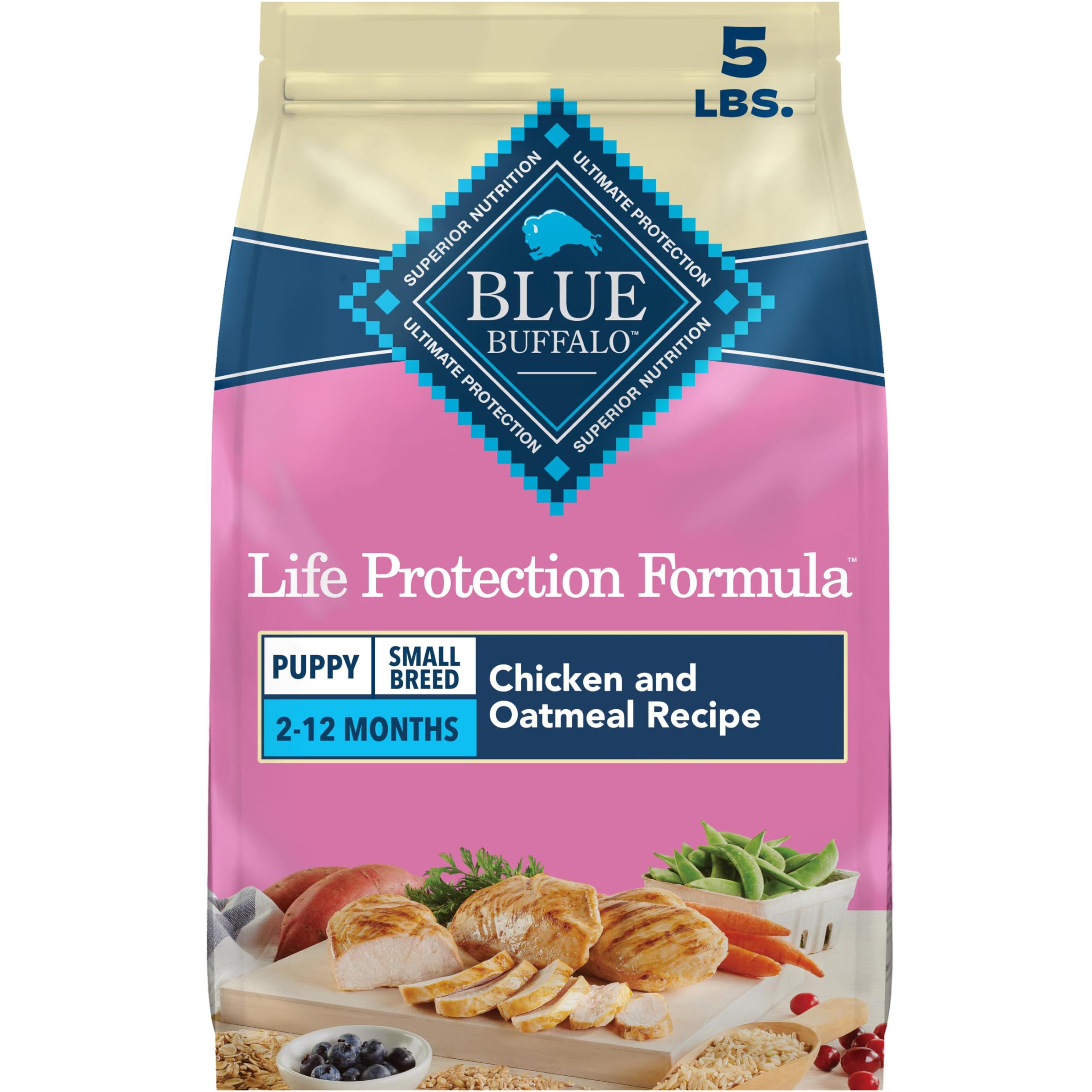
Blue Buffalo Small Breed Puppy

Blue Buffalo Small Breed Puppy

Grain-inclusive feeding

Our Score 9.4/10
Check Price

Worth Noting

  • Kibble runs large for a small breed
  • Bag is not resealable once opened
Bag Size
5 lb
Age Range
2 to 12 months
Breed Size
Small breeds
First Ingredient
Real chicken
Read the full review

The first thing to know about this small-breed bag is that the kibble inside runs bigger than the label suggests. The pieces were noticeably chunkier than the ones in the Royal Canin and Hill's bags we fed, which is fine for a confident chewer and less fine for a ten-week-old miniature schnauzer still working out how its mouth works.

The recipe itself is sound. Real chicken is the first ingredient, brown rice, barley and oatmeal carry the grain, and there's no corn, wheat or soy. The LifeSource Bits scattered through the bag add a blend of antioxidants, vitamins and minerals, and the stated puppy window runs to twelve months rather than ten.

So: a good formula with an awkward piece size for the breed you're feeding. If your puppy is already chewing well and you want a grain-inclusive food at a low price, it's a reasonable buy. For a young miniature schnauzer we start with one of the smaller kibbles and keep this one for later, when the mouth has caught up with the appetite.

Bottom line: Good ingredients at a fair price, but the chunky kibble makes it a second choice for a very young miniature schnauzer.

8

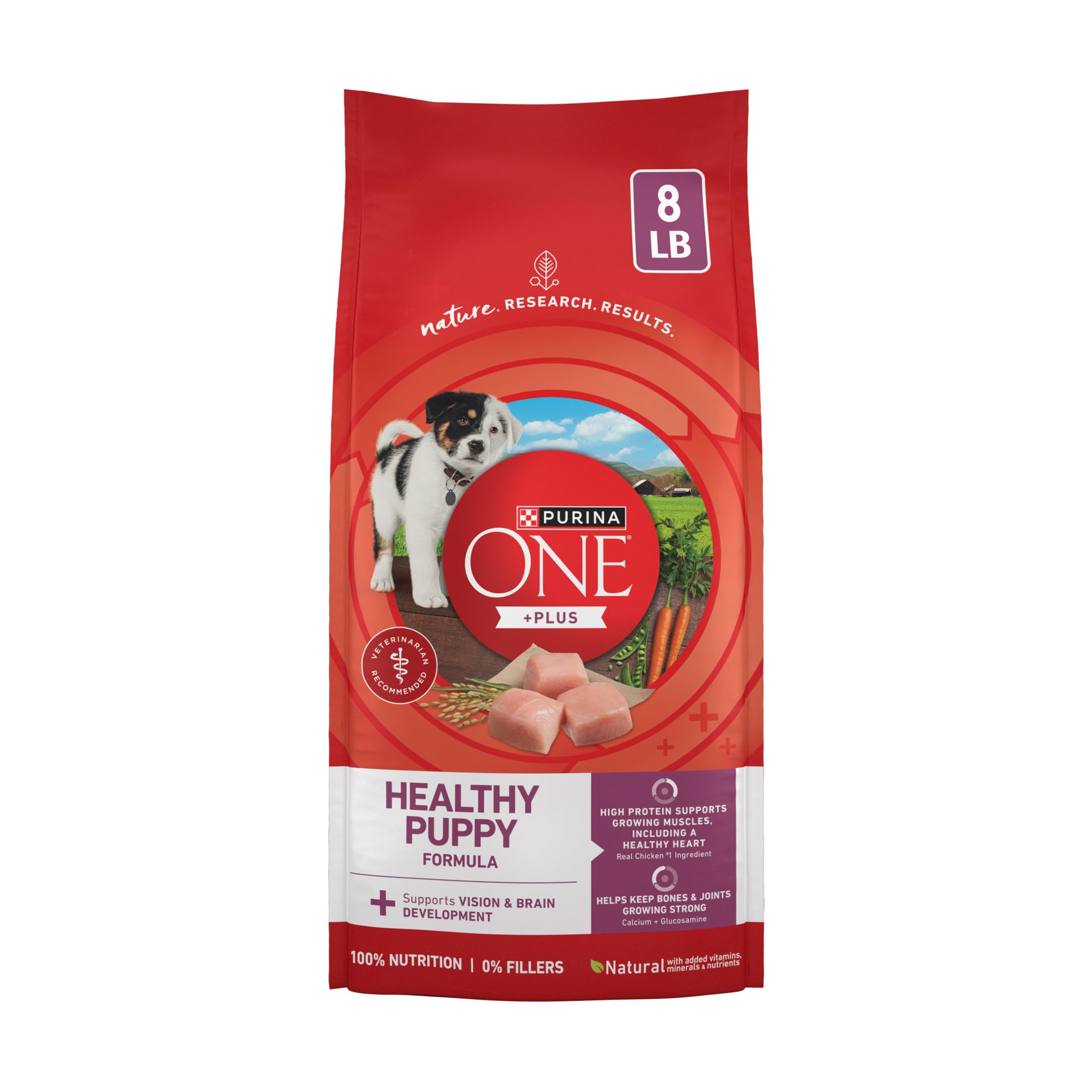
Purina ONE Healthy Puppy

Purina ONE Healthy Puppy

Multi-dog homes

Our Score 9.4/10
Check Price

Worth Noting

Kibble
Crunchy plus meaty morsels
Bag Size
8 lb
Breed Size
All breed sizes
Key Nutrients
DHA and antioxidants
Read the full review

Eight pounds is the biggest bag on this page, and that changes the arithmetic of feeding a puppy that will eat more every few weeks for the next year. One bag, one order, fewer trips to the shop — and if there's a second dog in the house, it's the obvious size to buy.

The formula is a two-texture mix: crunchy kibble plus tender meaty morsels, which is the detail that keeps a fussy puppy eating when plain kibble starts getting inspected and pushed aside. Real chicken is first, DHA supports vision and brain development, there are four antioxidant sources for the immune system, and the bag carries no artificial flavors or preservatives.

Stool quality is the thing we watched most closely here. Give the switch a full week, keep the treats the same, and hold off on adding toppers until you know where your puppy's digestion lands. That's good practice with any food, and it's especially worth doing with a formula that mixes two textures in one bowl.

Our take: this is the value pick for a household rather than a single puppy. The big bag, the two textures and a plain ingredient list add up to a food that's easy to keep buying — though if you're feeding one small dog in a small kitchen, split it into a sealed container so it stays fresh to the bottom.

Bottom line: The one to pick when you want a big bag, a bit of texture, and a formula that suits a household with more than one dog.

How We Tested Puppy Food for Miniature Schnauzers

We started by rounding up puppy formulas from pet specialty stores and big retailers, then filtered by guaranteed analysis, protein and fat levels for growth, and kibble size. Anything with pieces that looked too large for a miniature schnauzer's mouth — or a price that only made sense for a show kennel — came off the list. That left 12 formulas for the four-month test.

We fed those 12 formulas to eight miniature schnauzer puppies — my own two plus six from a breeder friend — in ordinary kitchens and laundry rooms, not a lab. Each puppy worked through three formulas, four weeks per formula including a slow transition. We set bowls down at 7 a.m. and 6 p.m., timed how quickly each puppy started eating, and noted whether they finished, nibbled, or walked away. We also measured kibble pieces with a ruler and watched the puppies pick them up, since some crunched easily while others dropped pieces or coughed.

After every meal, we logged stool quality the next morning, along with gas and any loose stools or upset. We weighed each puppy every two weeks and tracked energy and coat condition across the four months. To judge value, we calculated cost per day from each bag's feeding chart rather than just the shelf price. The formulas that made the cut were the ones the puppies ate without coaxing, digested without surprises, and kept growing steadily — without making us wince at the cost per bowl.

How to Choose the Right Puppy Food for Miniature Schnauzers

Start with the weight band, not the word small

Small covers a lot of ground across brands, and the number that matters is the expected adult weight the formula is built for. Royal Canin's small puppy food states nine to twenty-two pounds and a two-to-ten-month window; Hill's uses a Small & Mini label with no weight figure. Both suit a miniature schnauzer. A bag aimed at dogs that finish much heavier is not tuned for the dog you have, however puppy-friendly the front of it looks.

Check the age window too. Small breeds finish growing earlier than large ones, and a formula with a twelve-month puppy window is not wrong for a miniature schnauzer — it just means you'll be buying puppy food a little longer than you expect.

Kibble size decides the first month

A ten-week-old miniature schnauzer has a small mouth and a beard that collects crumbs, and a piece it can't pick up is a piece it swallows whole or walks away from. Our Blue Buffalo pick is the cautionary example: a small-breed label on a bag with pieces that run chunkier than the label implies. If you can't see the kibble before ordering, plan to soak it in warm water for five minutes for the first couple of weeks.

Digestion and stool quality separate these formulas

Prebiotics, guaranteed live probiotics and easy grains like rice show up across the picks, and the difference they make is usually visible inside a fortnight. Change one thing at a time. A new food, a new house and a new treat all at once gives you nothing to read.

Give a switch a full week, keep the old treats going, and judge on firmness and regularity over several days rather than on one bad morning. A loose stool in week one is common and not automatically the food's fault — which is why we'd rather you slow the transition than start shopping again.

Protein is the lever you pull

Chicken is the default in every budget bag here and it's fine for most puppies. Salmon is the alternative when you want to change one variable and hold everything else steady, which is exactly how you find out whether chicken was the problem. Two-texture formulas, crunchy kibble with soft morsels, are worth knowing about for a fussy eater because the mix gives a puppy something to pick at.

Work out price per pound, not price per bag

The bags here run from two and a half pounds to eight, and per pound the gap between the cheapest and the most expensive is wide enough to matter across a year of feeding a dog that ends up around fifteen pounds. Buy the small bag first even when the big one looks like better value. A sack of food a puppy refuses is the most expensive option there is, and once you know a formula suits, order the size that keeps up with the growth curve.

Frequently Asked Questions

Final Verdict

If you want one bag and no second-guessing, buy Royal Canin Small Puppy. It's built for puppies that will finish between nine and twenty-two pounds, the kibble is small enough for a young miniature schnauzer to pick up unassisted, and nothing else here matches the label to the dog as precisely.

Hill's Small & Mini is the value alternative at a lower price per pound, and if chicken has already disagreed with your puppy, make the switch to Pro Plan's salmon formula before you buy anything else.