Food & Treats

Best Puppy Food for Pomeranians of 2026

A Pomeranian puppy can make a bowl of food look enormous. The kibble that suits a Labrador is a choking hazard for a mouth that small, and a picky toy breed will walk away from dinner if the smell doesn’t sell them. The right puppy food fixes both problems at once: a piece small enough to chew without gulping, a formula gentle enough for a tiny digestive system, and a flavor that keeps them coming back. Over the past six months, we fed 12 small-breed puppy foods to a panel of Pomeranian puppies—mine included—and watched which bowls emptied, which caused gas or loose stools, and which kibble got batted across the kitchen floor.

Puppy food for a toy breed isn’t just adult food in a smaller bag. It has to support steady growth and energy without overloading a tiny stomach, and the kibble has to fit a mouth the size of a thumbnail. We also kept an eye on value, because a food that gets refused is expensive no matter what the bag costs. The picks below are the ones that earned their place after months of real meals, not just a pretty label.

1

Royal Canin X-Small Puppy

Top Pick
Royal Canin X-Small Puppy

Tiny toy puppies

Our Score 9.6/10
Check Price

Worth Noting

  • Premium price per pound, small bag
Bag Size
3 lb
Age Range
2 to 10 months
Key Nutrients
DHA, prebiotics, antioxidants
Adult Weight Target
Up to 8 lb
Read the full review

Eight pounds is the number this bag is built around. Royal Canin makes X-Small Puppy for puppies expected to mature at eight pounds or less, and covers them from two months to ten. An adult Pomeranian is a three-to-seven-pound dog, so that ceiling lands right where your puppy is headed — and it means the kibble, the calorie density and the portion chart were drawn for a dog this size rather than a retriever's little cousin.

We keep coming back to the kibble itself. A young Pom has a muzzle you can cover with a thumb, and the pieces here are small enough to be picked up, chewed and swallowed without the puppy losing half of each bite to the floor. That is the first thing we check on any toy-breed bag. Behind it sits a serious formula: DHA for brain and eye development, antioxidants for the immune system, and prebiotics and protein aimed at gut health.

What we didn't expect was how little there was to manage. Stools stayed firm through the switch and the bowl came back empty at almost every meal. A puppy that age is meant to be an eating machine, but not every food keeps up with one.

The cost is real: three pounds in the bag, and a price per pound near the top of this group. For one puppy that stings less than it looks, because a bag this size gets finished while the kibble is still fresh. One piece of planning — the formula ends at ten months, so put a reminder in your phone to move onto an adult X-Small formula rather than stretching the puppy bag.

Bottom line: If your Pomeranian will finish under eight pounds, this is the bag we point you to: the smallest kibble here and a formula built for exactly that size.

2

Hill's Science Diet Small & Mini Puppy

Hill's Science Diet Small & Mini Puppy

Gentle digestion

Our Score 9.6/10
Check Price

Worth Noting

  • Not drawn for toy-breed adults
Recipe
Chicken and brown rice
Bag Size
4.5 lb
Breed Size
Small and mini
Key Nutrients
DHA and fish oil
Read the full review

The first week on this food was uneventful, which is the highest compliment we can pay a puppy kibble. No loose stools, no gassy nights, no bowl left half-full — just a puppy who ate, slept and grew. That steadiness is most of why it sits near the top of this list.

The kibble is a true nibble, small enough for a puppy with almost no jaw to work through a mouthful, and the formula behind it is built for growth rather than maintenance: DHA and fish oil for brain and eye development, balanced minerals for bones and teeth, an antioxidant blend for the immune system, and chicken and brown rice as the base.

Where it differs from our top pick is precision. Hill's labels this one for small and mini breeds generally, so it isn't drawn around an eight-pound ceiling the way the Royal Canin is, and for most Pomeranians that distinction never shows up in the bowl. What you get in exchange is four and a half pounds of food for about the money our top pick charges for three — several extra weeks of meals for a puppy eating tablespoons.

Bottom line: The bag we hand most Pomeranian owners who want steady digestion and more food for the money, without giving up a small kibble.

3

Eukanuba Puppy Small Breed

Eukanuba Puppy Small Breed

Full first year

Our Score 9.6/10
Check Price

Worth Noting

  • Adult weight band wider than a Pom needs
Bag Size
4.5 lb
Age Range
Up to 12 months
Key Nutrients
DHA, calcium and phosphorus
Adult Weight Target
Under 23 lb
Read the full review

Twelve months on the label is the fact that organizes this one. Eukanuba's small breed puppy formula runs from weaning to the first birthday, so there is one food, one transition at the start, and no decision to make partway through. If you like the idea of buying the same bag for a year, that is a real convenience.

The kibble is genuinely tiny — small enough that a very young puppy can work through a bowl without help, and small enough that we didn't need to soak it for a pup just off soft food.

Underneath, it is a growth formula with the pieces spelled out: chicken first, clinically proven levels of DHA for brain development, calcium and phosphorus for growing bones, and concentrated energy from fat and carbohydrate for a puppy that never sits still. It is also one of the better-value bags in this group.

Digestion is the place to go slowly. A puppy's gut is the unsettled part of any switch, and this is a formula where a careful ramp is worth the extra days — a quarter of the bowl at first, then more across a week. Given the tiny kibble, the full-year coverage and the price per pound, it remains one of the easiest recommendations here for a first-time Pom owner.

Bottom line: One bag for the whole first year, with genuinely tiny kibble and stated DHA — the simplest plan if you would rather not rethink food at ten months.

4

Royal Canin Small Indoor Puppy

Royal Canin Small Indoor Puppy

Larger small breeds

Our Score 9.6/10
Check Price

Worth Noting

  • Adult weight band starts at nine pounds
  • Smallest bag at a premium price
Bag Size
2.5 lb
Age Range
2 to 10 months
Key Nutrients
DHA, prebiotics, vitamins C and E
Adult Weight Target
9 to 22 lb
Read the full review

Nine pounds is where this formula starts, and for a Pomeranian that is the wrong end of the range. Royal Canin builds Small Indoor Puppy for puppies expected to reach nine to twenty-two pounds as adults — miniature schnauzers, small spaniels, bigger terriers — while most Pomeranians finish well below that line.

Which is a shame, because the formula is a good one. It is designed around smaller, less frequent stools through a fiber and prebiotic blend, the sort of thing that matters in an apartment. There are clinically proven antioxidants including vitamins C and E, DHA for brain development, and kibble cut for miniature jaws and picky appetites. The two-and-a-half-pound bag is the smallest here.

So our recommendation is narrow. This makes sense for an oversized Pomeranian, a Pom mix you expect to mature past nine pounds, or a household where stool odor is the daily complaint rather than the occasional one. For a typical Pomeranian puppy, the eight-pound ceiling of our top pick is the closer match, and it costs less per pound while giving you more food.

Bottom line: A good formula aimed at a different dog: it is built for puppies expected to mature between nine and twenty-two pounds, so most Pomeranians sit below its target.

5

Purina Pro Plan Toy Breed Puppy

Purina Pro Plan Toy Breed Puppy

Picky eaters

Our Score 9.4/10
Check Price

Worth Noting

  • Costs more per pound than budget picks
Recipe
Chicken and rice
Bag Size
5 lb
Breed Size
Toy breeds
Key Nutrients
DHA and guaranteed live probiotics
Read the full review

Guaranteed live probiotics are the detail that sets this bag apart from everything else on our list. Purina adds them to the kibble and stands behind the count on the label, which is a more specific promise than most puppy formulas make. For a puppy moving off mother's milk and onto dry food, that is the window where a little gut support earns its keep.

The rest of the recipe is aimed squarely at toy breeds: real chicken first, protein levels set for highly active small dogs, and DHA from fish oil for brain and vision. The kibble is small enough for a young Pom to chew without a fight, and it holds up as a training treat — which matters more than it sounds when you are rewarding a four-pound puppy twenty times an hour.

We reach for this one when a puppy has been leaving dinner in the bowl, because a food a picky dog finishes beats a better-formulated one that goes stale in the dish. It costs more per pound than our budget picks, and that is the trade for the probiotics and the toy-breed label. Purina also builds it for busy puppies, so a true couch-cushion Pom gets less from the extra protein than an active one does.

Bottom line: For a Pomeranian who turns up their nose at dinner, this is our first call: chicken first, guaranteed live probiotics and a toy-breed kibble that gets eaten.

6

Blue Buffalo Baby BLUE Puppy

Blue Buffalo Baby BLUE Puppy

Budget first bag

Our Score 9.4/10
Check Price

Worth Noting

  • Some puppies refuse it outright
Recipe
Chicken and oatmeal
Bag Size
4 lb
Free From
Corn, wheat and soy
Key Nutrients
DHA and LifeSource Bits
Read the full review

This is the bag we suggest to someone bringing home an eight-week-old who doesn't want to sink much money into a food the puppy might reject. It is the least expensive of our picks, and it isn't a stripped-down formula: chicken is the first ingredient, DHA is in there for cognitive development, and the LifeSource Bits add an antioxidant blend. That combination of a low entry price and a real formula is why it holds a place here.

The kibble is the other reason. Baby BLUE's pieces are small enough for a puppy with a tiny mouth to chew rather than gulp, which is the failure point we check for first on any budget bag aimed at small breeds.

The one thing to plan around is the switch. Moving onto it can be loose for a few days, as with most puppy foods, so mix it into the old kibble over about a week rather than swapping overnight. There is no corn, wheat or soy and no by-product meal in the recipe, which is more than the price suggests.

Bottom line: The least expensive way into a real-chicken, small-kibble puppy food, and a sensible first bag for a puppy whose tastes you don't know yet.

7

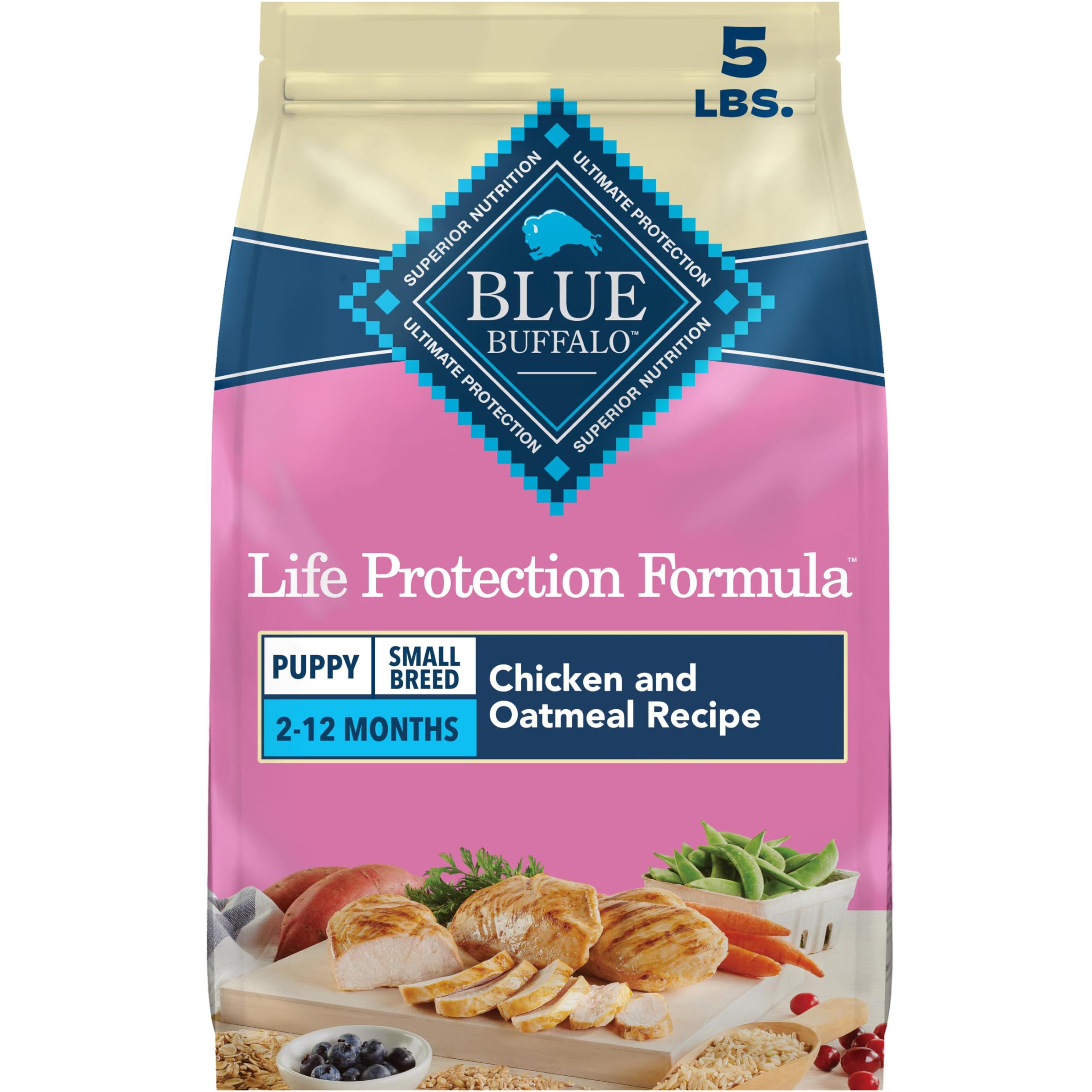
Blue Buffalo Life Protection Puppy

Blue Buffalo Life Protection Puppy

Bigger litters

Our Score 9.4/10
Check Price

Worth Noting

  • Kibble too big for toy-breed mouths
  • Loose stools for some puppies during the switch
Recipe
Chicken and oatmeal
Bag Size
5 lb
Age Range
2 to 12 months
Key Nutrients
LifeSource Bits antioxidants
Read the full review

Think of this as Baby BLUE's bigger sibling: the same chicken-and-oatmeal thinking, five pounds instead of four, and a two-to-twelve-month age range that covers the whole first year. Chicken is first, there is no corn, wheat or soy, and the LifeSource Bits carry the antioxidant blend while brown rice, barley and oatmeal do the carbohydrate work.

Where it falls down for a Pomeranian is the size of the pieces. This is a small-breed formula, not a toy-breed one, and the kibble runs bigger than a puppy with a tiny muzzle wants — for a very young Pom you would be soaking or crushing it for the first few weeks, which is the chore the extra-small formulas exist to remove. In a house with two or three dogs the arithmetic changes: the price per pound is the lowest here and the bag goes a long way. One practical note, the bag doesn't reseal, so buy a storage tub at the same time.

Bottom line: A solid chicken-first formula at the lowest price per pound here, held back for Pomeranians by kibble that is bigger than a toy breed wants.

How We Tested Pomeranian Puppy Food

We began with a shortlist of small-breed puppy formulas that carried a complete-and-balanced statement for growth, then filtered by kibble size, protein and fat levels, and cost per day. Over six months, we tested 12 of them with a panel of Pomeranian puppies, including my own two. Each formula got at least three weeks, with a slow transition, so we weren’t blaming a new food for an old stomach upset.

Most of the testing happened in ordinary kitchens and puppy pens, during the morning rush and the slower evening feed. At every meal we noted how quickly each puppy approached the bowl, whether they finished or walked away, and whether we had to coax them back. For digestion, we kept a simple log of stool consistency, gas, and any change after switching; a formula that produced loose stools or a gassy puppy got marked down no matter how eagerly it was eaten.

We measured kibble against a ruler and watched how each puppy chewed—whether they crunched, gulped, or carried pieces away. We also noted whether the kibble stayed in the bowl during enthusiastic eating or scattered across the floor, which mattered with mouths this small. To judge value, we calculated cost per day from the bag’s feeding guide and recorded how much food was actually eaten versus wasted. Over the six months, we tracked body condition, energy between meals, and coat condition at regular weigh-ins.

How to Choose the Right Puppy Food for Pomeranians

Size the kibble to the muzzle, not the label

A Pomeranian puppy's mouth is small enough that a piece of kibble the size of a pea is a two-bite project. Bags labeled small breed cover everything from a Yorkie to a cocker spaniel, and the pieces inside are often sized for the bigger end of that range. Our Blue Buffalo Life Protection pick is a good food that a very young Pom would need soaked first.

Pour a handful out before you commit. If a piece looks wide next to your puppy's muzzle, plan on warm water for the first few weeks. The extra-small formulas in this group exist precisely to skip that step, and for a breed this small that is worth paying something for.

Match the formula to the adult weight it names

The most useful line on any puppy bag is the expected adult weight. Royal Canin's X-Small formula is built for dogs that finish at eight pounds or less; the same brand's Small Indoor formula starts at nine and runs to twenty-two. A Pomeranian adult is a three-to-seven-pound dog, which puts the extra-small band squarely in range and the indoor band above it.

Buy for the dog your puppy will be. If your pup is the biggest in the litter or a Pom mix, read that line twice before assuming the toy-breed bag is the right one.

What toy-breed growth nutrition should say

Toy puppies grow fast in the first months and finish small, so the formula has to pack a lot of nutrition into a small bowl. Look for DHA named on the panel — it supports brain and retinal development — and for a stated calcium and phosphorus level, because that pair builds the skeleton a three-pound adult will live on. Protein builds muscle; antioxidants support an immune system meeting the world for the first time.

Live probiotics are a bonus rather than a requirement, but our Purina pick is the one here that guarantees them on the label, and that matters most during the switch onto kibble.

Buy a bag your puppy can finish

A four-pound puppy eats a few tablespoons at a time, so a five-pound bag can sit open for weeks, and kibble goes stale once the fats in it start to turn. That is a poor trade for a food you chose for its nutrition. For a single Pomeranian, a bag in the three-to-five-pound range is the right size; two dogs changes the arithmetic.

Note where the puppy stage ends, too. Some formulas here run to ten months and some to twelve, and the one that matches your plan to move to adult food saves you a half-used bag.

Frequently Asked Questions

Final Verdict

If you want one bag and no further reading, buy the Royal Canin X-Small Puppy. It is the only formula here built around an eight-pound adult, and the kibble is cut for a mouth that small. The trade is price per pound and a ten-month end date, and both are worth accepting for a breed this size.

If the cost per pound bothers you, Hill's Science Diet Small & Mini gives you half again as much food for about the same money with a digestion record we trust. And if you are buying a first bag before you know what your puppy will eat, Baby BLUE is the low-risk place to start.