Food & Treats

Best Puppy Training Treats of 2026

Training a puppy is mostly a timing game. A treat that takes two seconds to break, crumbles in your pocket, or smells so strong it lingers on your hands can turn a quick reward into a production. The best puppy training treats are small enough to deliver without interrupting the lesson, soft enough to tear by hand, and tempting enough that a puppy chooses them over a leaf. They also have to be worth eating, because a treat your puppy spits onto the floor is not a reward.

Over eight weeks, my team and I worked through 14 puppy training treats in real sessions: loose-leash walks, crate games, and short sits-and-downs in the kitchen. We paid attention to which ones my puppy actually wanted, which stayed fresh in a treat pouch, and which were easy to portion without a knife. Value matters, too, since training uses a lot of treats and a bag that disappears in three sessions has to justify itself. The picks below are the ones that made training smoother, not just snack time more exciting.

1

Bil-Jac Little-Jacs

Top Pick
Bil-Jac Little-Jacs

Tiny breeds

Our Score 9.6/10
Check Price

Worth Noting

  • Morsels can arrive dry and crumbly
Texture
Soft and chewy
Bag Size
16 oz
First Ingredient
Chicken liver
Calories Per Treat
Less than 3
Read the full review

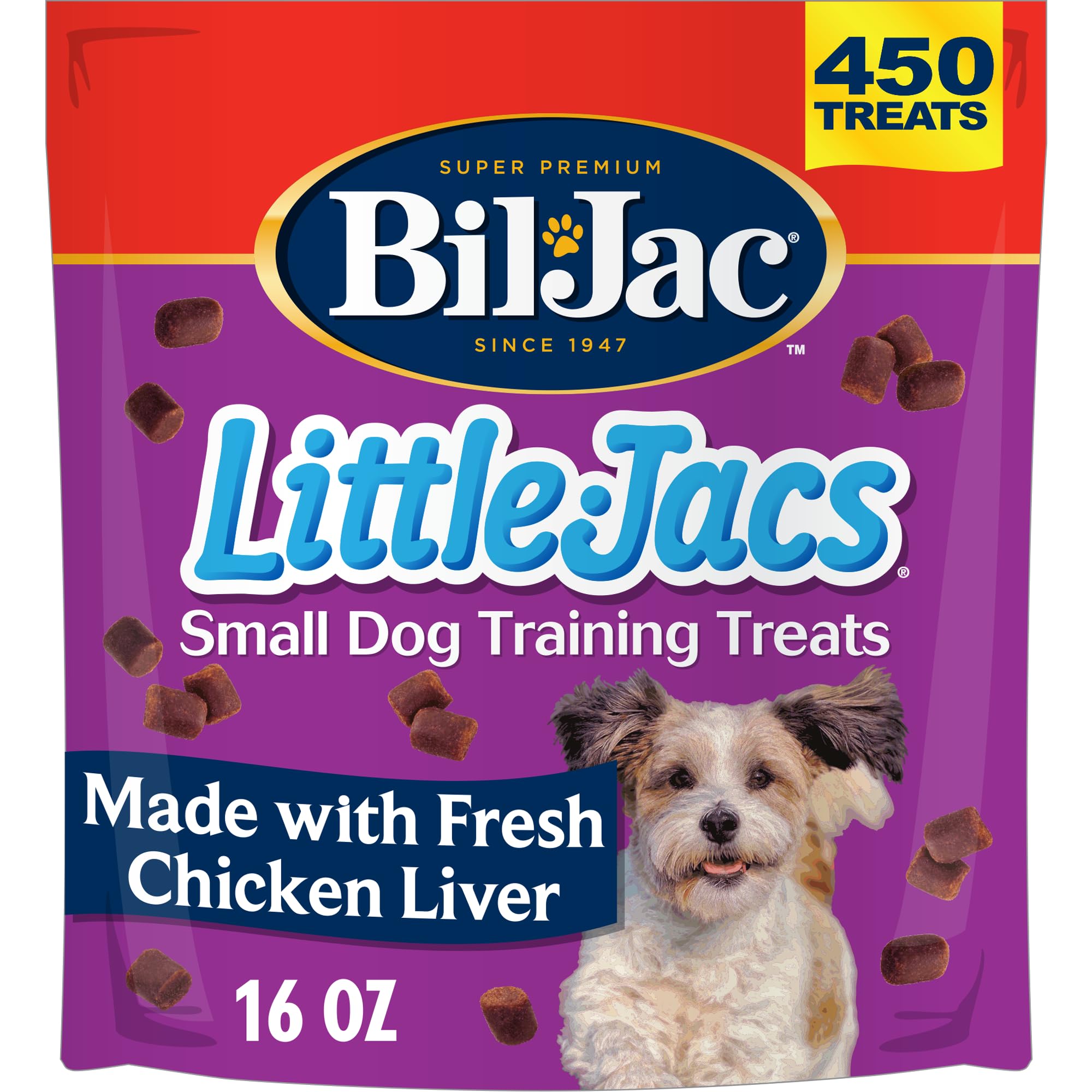
The first thing we do with a new bag is try to snap a piece in half, and the Little-Jacs morsels are small enough that there's no point. They come out as tiny, slightly moist chunks — small enough for a toy-breed puppy's mouth, firm enough that a handful in a pocket doesn't become crumbs — and the chicken liver base gives off a smell that carries across a room. More than once a puppy has snapped to attention before the bag was even open.

At under 3 calories each, this is the bag we reach for with a very young puppy or a small breed, where a reward has to be genuinely little. The 16-ounce bag goes a long way at that size, and the soft texture suits a puppy still working out how to chew. They're also soft enough to press a pill into, which isn't why we bought them but is the reason a bag lives in the kitchen drawer.

Bottom line: The pick for toy breeds and very young puppies: tiny, soft liver morsels that need no breaking and barely register on the calorie count.

2

Baby BLUE Puppy Training Treats

Baby BLUE Puppy Training Treats

New puppy homes

Our Score 9.4/10
Check Price

Worth Noting

  • Flavor is hit or miss with fussy puppies
Texture
Semi-moist
Bag Size
4 oz
Life Stage
Puppy
First Ingredient
Chicken
Read the full review

Four ounces is a small bag, and for a household that brought a puppy home last week, that's the point. Nobody knows in the first days whether their puppy will work for chicken, liver, or nothing but cheese, and a small bag lets you find out without giving shelf space to a food the puppy turns down.

Baby BLUE is a puppy formula rather than an all-life-stages one: real chicken first, DHA added, semi-moist morsels, no corn, wheat, or soy, and no artificial preservatives or colors. The pieces are tender and small enough to hand over whole, with a texture closer to soft kibble than to a chewy stick.

We keep it in the rotation for the first month or two, when what you want is a puppy-labeled treat that fits in a pocket and doesn't need breaking. As with any new food, hand over one piece and wait a day before a handful goes into the training pouch; a puppy's digestion is the least predictable thing in the house during those weeks, and a treat that suits one puppy can loosen another's stools.

Bottom line: A puppy-formula bag in a try-it size: the one we suggest for the first weeks, while you're still learning what your puppy will work for.

3

Pet Botanics Training Rewards

Pet Botanics Training Rewards

High-volume training

Our Score 9.4/10
Check Price

Worth Noting

  • Big bag to commit to before a first try
Flavor
Bacon
Bag Size
20 oz
Treats Per Bag
About 500
Calories Per Treat
3
Read the full review

Twenty ounces, roughly 500 pieces, 3 calories each. Run that arithmetic before the first training class and the appeal is obvious: one bag can carry months of daily sessions, and the calorie count means a puppy can be rewarded often without the treats quietly becoming the meal.

In the pouch the pieces are small — closer to a pea than a marble — which is the size we want for a puppy being rewarded every few seconds. They're soft and a little moist, so they pinch in two when a smaller reward is called for, and the pork liver and bacon base is a high-value smell in a distracting place. This is our bulk pick: the bag we buy when training happens several times a day and the goal is to stop thinking about running out.

Two practical notes. The bacon scent is strong and it lingers on fingers, so a small zip pouch earns its keep if you train before dinner. And a puppy with a sensitive stomach may do better starting on a single-protein treat, which makes this a second bag rather than a first one for a dog with a touchy gut.

Bottom line: The bulk buy: roughly 500 three-calorie pieces per bag, enough to run daily sessions for months without rationing rewards.

4

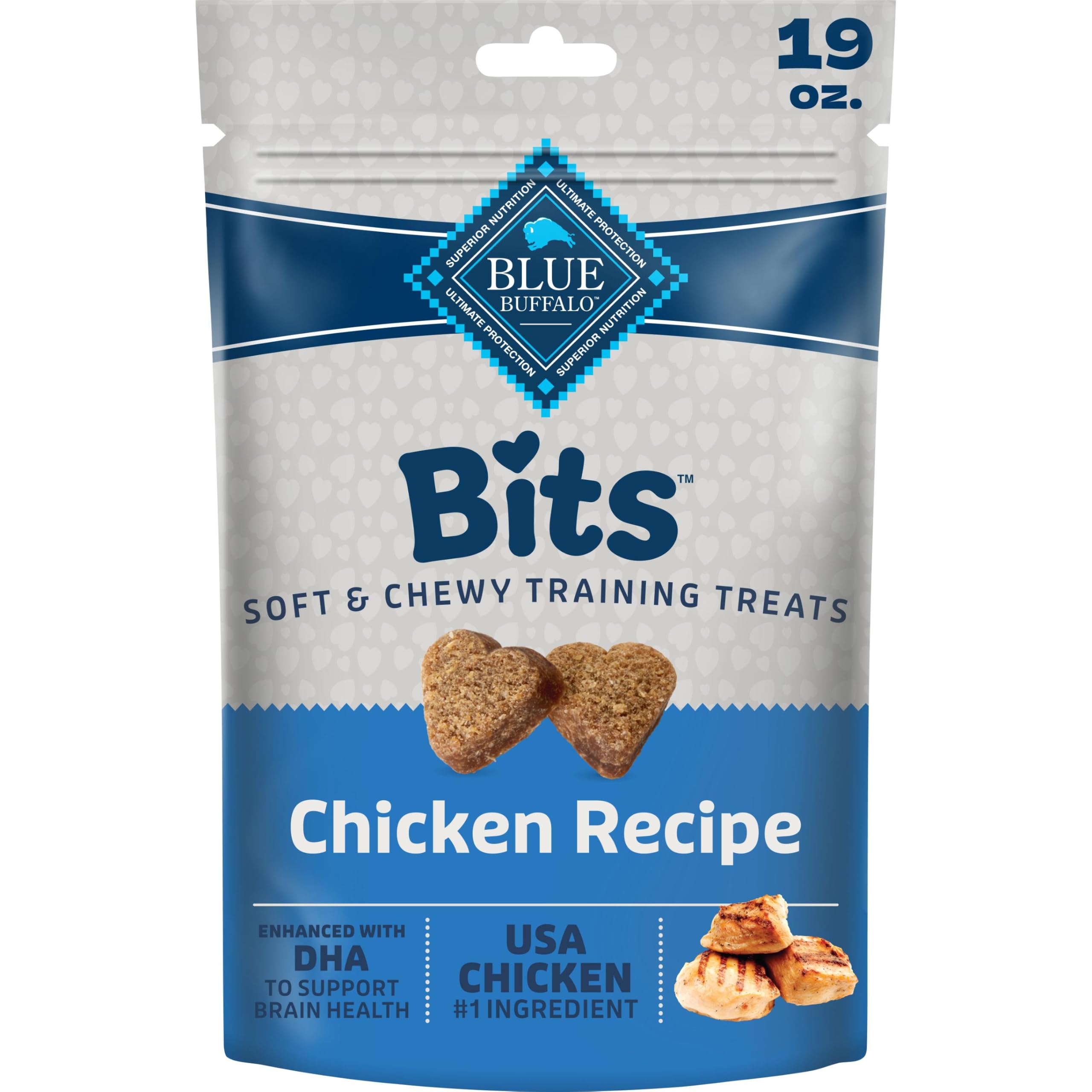
Blue Buffalo Bits

Blue Buffalo Bits

Multi-dog homes

Our Score 9.4/10
Check Price

Worth Noting

  • Strong smell that lingers on hands
Texture
Soft-moist
Bag Size
19 oz
Life Stage
All life stages
First Ingredient
Chicken
Read the full review

Puppyhood is short and a 19-ounce bag is long. Blue Bits is an all-life-stages treat, which means the bag you open for a twelve-week-old puppy is still useful when the same dog is holding a sit-stay at two — a small thing, but it's why this one lives in the cupboard rather than the training pouch.

The pieces are heart-shaped and a little larger than a piece of kibble: hand them over whole to a medium or large puppy, break them for a toy breed. The texture is soft-moist, softer than most small biscuits, so a puppy with a mouth full of baby teeth manages without a struggle.

Real chicken comes first, with DHA for development and flaxseed for omega-3 and -6, and there's no corn, wheat, or soy. It's an all-life-stages formula rather than a puppy one, so it isn't doing anything special for a growing dog beyond a named protein and a soft bite — which is roughly what most puppies need from a treat anyway.

Our pick for a multi-dog household, or for anyone who wants one bag to cover the puppy now and the adult later. The treats run larger than the minis elsewhere in this guide, so we still break them for a small puppy, but at 19 ounces the bag outlasts the stage that makes breaking necessary.

Bottom line: Our pick for a multi-dog household: a 19-ounce bag of soft chicken bits that works for the puppy now and the adult dog later.

5

Charlee Bear Original

Charlee Bear Original

Budget training

Our Score 9.4/10
Check Price

Worth Noting

  • Plain flavor doesn't appeal to every puppy
Flavor
Cheese and egg
Texture
Crunchy wafer
Bag Size
16 oz
Calories Per Treat
Fewer than 3
Read the full review

These are not soft chews. Charlee Bear Original is a flat, dime-sized wafer with a real crunch, closer to an oyster cracker than to the squishy liver bites that fill most training pouches, and that single fact decides whether the bag belongs in your jacket.

Where the crunch works, it works well: no grease, no smell, no crumbs in a pocket, and a puppy has to chew rather than inhale, which buys a second of composure before the next cue. Fewer than 3 calories a wafer means a handful costs almost nothing.

The bag holds up, too. Wafers don't dry out the way a soft chew does, so a pouch left in the car or at the bottom of a bag is still usable weeks later — the opposite of a liver treat that turns hard and gets spat on the floor. At about the size of a dime, they're small enough to hand over without breaking.

It's our budget pick and the one we keep for puppies past the very first weeks. A puppy still learning to manage soft food may do better with a chew, but one already crunching kibble will take these without trouble — and the bag costs less per ounce than anything else here.

Bottom line: Our budget pick for puppies already crunching kibble: a dime-sized wafer that keeps pockets clean and hands grease-free.

6

Wellness Soft Puppy Bites

Wellness Soft Puppy Bites

Most puppies

Our Score 9.2/10
Check Price

Worth Noting

  • 8-ounce bag empties fast in daily training
Texture
Soft wafer
Bag Size
8 oz
Life Stage
Puppy
Key Ingredients
Lamb and salmon
Read the full review

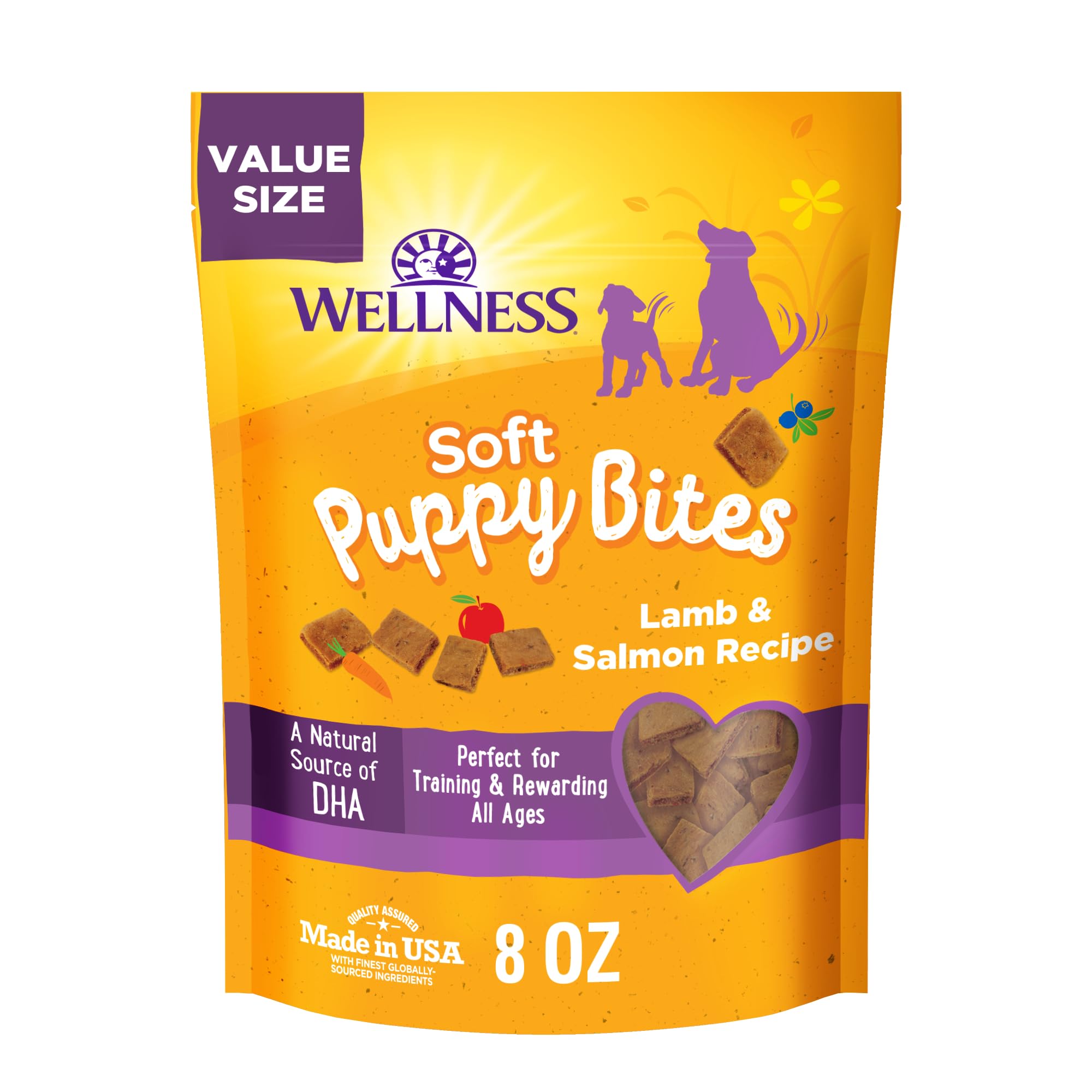
A reward the size of a nickel is too much for an eight-week-old puppy, and that's the first thing we noticed about Wellness Soft Puppy Bites: the wafers come out of the bag bigger than a single reward should be for a small puppy. They also snap along a clean line with a thumbnail, which is why they're still our top pick. Tearing one into halves or thirds turns a modest bag into a long run of rewards, and it takes a second, so the puppy isn't standing there watching you fumble.

The recipe is built for puppies rather than borrowed from an adult line: lamb and salmon, with the salmon carrying DHA, added vitamins, no corn, wheat, or soy, and no artificial colors. We won't pretend a treat is a multivitamin, but a puppy-labeled formula with a named protein is an easier starting point than decoding an all-life-stages bag in the aisle. The texture sits on the soft side of a wafer — firm enough to survive a pouch, soft enough that a puppy working through baby teeth doesn't have to fight it.

What we watch is the swallow rather than the chew. These soften quickly, and a gulper will take one whole and look up for the next, so break each piece smaller for a puppy who inhales. For a food-motivated puppy in a household that wants one bag doing the whole job, from first sits to a recall in the park, that's the combination we keep coming back to.

Bottom line: Our default for most puppies: a soft, puppy-labeled wafer that tears into whatever size the reward needs to be, from the first sit to a reliable recall.

7

Zuke's Mini Naturals

Zuke's Mini Naturals

Frequent rewards

Our Score 9.2/10
Check Price

Worth Noting

  • Some bags arrive dry and hard
  • Pungent smell on hands
Texture
Soft
Bag Size
16 oz
First Ingredient
Chicken
Calories Per Treat
2
Read the full review

Two calories a treat changes how you train. With Mini Naturals we stop doing mental math — a puppy can be rewarded for a sit, a name response, and four steps of loose leash inside a minute, and the piece is small enough that the session doesn't turn into a snack break.

The pieces are mini in the literal sense, so a puppy takes one and is ready for the next almost immediately, which matters with a young dog whose attention is measured in seconds. Real chicken and cherries, no corn, wheat, or soy, and a soft texture that tears if you want it smaller still.

One detail from the bag is worth knowing: this is a small-breed formula, and a large-breed puppy at twelve weeks may want two pieces where a Yorkie wants one, which quietly doubles the calorie math. For a toy or small-breed puppy that's exactly right; for a Labrador it's still fine, you just count two pieces as one reward.

Bottom line: The low-calorie workhorse: two-calorie minis that make a hundred repetitions a day feel reasonable, especially for a small-breed puppy.

8

Pupford Freeze Dried Training Treats

Pupford Freeze Dried Training Treats

Clean pockets

Our Score 9.2/10
Check Price

Worth Noting

  • Priciest per ounce in this group
Form
Freeze-dried
Flavor
Beef liver
Recipe
Three ingredients
Bag Size
4 oz
Read the full review

Freeze-dried liver behaves nothing like a soft chew. The pieces are dry, light, and clean — a handful goes into a jacket pocket in the morning and comes out at the park still crumb-free, with no greasy film on your fingers.

Three ingredients is the whole pitch, and it's the reason this bag stays in the cupboard for a puppy with a sensitive stomach or a household trying to keep treats simple. Puppies take one fast, so the session keeps its rhythm, and because there's no moisture in the piece there's nothing to go stale in a pouch left in the car between walks.

We use it as the high-value option rather than the everyday one. A piece of liver at the park, where a puppy is competing with squirrels and strange dogs, buys more attention than three soft chews at home, and the single-protein recipe makes it easy to keep a limited rotation going while you work out what suits your puppy's digestion.

Bottom line: The clean-pocket pick: three-ingredient freeze-dried liver that survives a jacket pocket and holds a puppy's attention outdoors.

How We Tested Puppy Training Treats

To build our shortlist, we started with puppy-specific formulas sold in resealable bags, read ingredient panels for named proteins and recognizable fillers, and ruled out anything with pieces too large to break cleanly by hand. We also weighed bag size against treat size, since a bag of big biscuits can look generous but deliver far fewer rewards. That left 14 formulas, which we tested over eight weeks.

Testing happened where training actually happens: kitchen sessions before meals, hallway recalls, crate games, and short neighborhood walks. For size, we laid each treat next to a quarter and counted pieces per bag. For softness, we tried tearing one by hand straight from the bag and again after 20 minutes in a treat pouch, noting whether it bent, crumbled, or needed a knife. For scent and odor, we opened each bag and rated how far the smell traveled, then checked whether it lingered on fingers after a session.

Palatability got the simplest test: we offered each treat after a basic sit and recorded whether the puppy took it immediately, sniffed and walked away, or spat it out. We rotated formulas across sessions to see which ones the puppy chose first when two were offered. Training-friendly came down to speed, meaning could we break and deliver a reward before the puppy lost focus. We also checked quality by reading labels, monitored digestibility by introducing one formula at a time and watching stool quality, and left treats in pouches for a couple of hours to see how they held up.

How to Choose Puppy Training Treats

Size is the first thing to get right

Training treats are measured in repetitions, not servings. A reward should be small enough that you can hand over twenty in a five-minute session and still have a puppy who wants the twenty-first — think pea-to-kibble rather than biscuit. Bil-Jac Little-Jacs and Zuke's Mini Naturals need no work; Wellness Soft Puppy Bites and Blue Bits do, because a young puppy needs them halved.

The trap is the phrase bite-sized on the bag, which usually means bite-sized for an adult Labrador. Test it in the store or at home: pinch a piece between two fingers. If it won't snap, it's too big for an eight-week-old, and you'll spend every session breaking treats while the puppy loses focus.

Soft chews versus crunchy bites

Texture changes the rhythm of a session. A soft chew disappears in a second, so the puppy is back on the cue before the reward wears off, which is why most of our picks are soft. A crunchy wafer like Charlee Bear takes a moment to eat, keeps hands and pockets clean, and suits a puppy already handling kibble.

The catch with soft treats is time. They dry out once the bag is open, and a piece that used to flex gets spat on the floor. Reseal the bag between sessions, keep a pouch out of a warm car, and squeeze a piece before you pour a handful.

Do the calorie arithmetic

Three calories sounds like nothing until you multiply. Twenty rewards in a session is 60 calories from a 3-calorie treat, and three sessions a day adds up quickly for a puppy that weighs fifteen pounds. A 2-calorie pick like Zuke's makes frequent rewarding cheap; a larger biscuit turns a training session into a meal.

Count the rewards in one real session — most people underestimate — then decide whether to trim that day's kibble rather than the training. Treats are supposed to be a small slice of the day's food, not a parallel diet.

Puppy formula or all life stages

A puppy-labeled treat is a shortcut, not a requirement. Formulas labeled for puppies, like Wellness Soft Puppy Bites and Baby BLUE, tend to add DHA and vitamins and keep the pieces small, which saves reading three bags in the aisle. All-life-stages treats such as Blue Bits and Bil-Jac Little-Jacs work perfectly well; piece size matters more than the label.

What does matter is protein. Look for one named meat as the first ingredient, and introduce a new treat one piece at a time so a sensitive stomach announces itself early rather than during a class.

Bag size, freshness, and cost per reward

The price on the bag tells you very little; the price per reward tells you what training will cost. A 4-ounce bag is a trial size for a puppy you're still getting to know, and a 16- to 20-ounce bag is a training staple for a household running several sessions a day.

Freshness cuts the other way. Soft treats lose moisture after opening, so a giant bag that takes six months to finish is worse value than a mid-size one you use up while it's still tender. Buy the size you'll finish in a couple of months.

Frequently Asked Questions

Final Verdict

Most puppies do well on Wellness Soft Puppy Bites: puppy-labeled, soft enough for baby teeth, and easy to tear down to the size a five-minute session actually needs. If you're training a toy breed or a very young puppy, Bil-Jac Little-Jacs removes the breaking step entirely, and if your training is high-volume and daily, Pet Botanics Training Rewards gives you the most repetitions per bag.

Start small, find the protein your puppy will work for, and buy the size you'll finish while it's still soft. The treat is the cheapest part of training; the repetitions are what you're actually paying for.