Feeding & Watering

Best Slow Feeder Inserts for Dogs of 2026

My dog once finished a bowl of kibble before I’d set the scoop down. A slow feeder insert is the fix—a patterned tray that drops into his existing bowl and turns dinner into a puzzle—but not every insert stays put, fits your bowl, or slows a determined gulper without frustrating a flat-faced dog. Over the past four months, we tested 14 inserts at morning and evening meals, noting suction on tile and stainless steel, stability under a determined tongue, whether the pattern was deep enough to matter, and how each held up after repeated washes. We also checked size against standard and wide bowls, how easy each was to press in and lift out, and how much scrubbing the corners demanded after wet food.

The best ones let the food move while the bowl stays still; too shallow is pointless, too deep invites quitting. The right pick comes down to your dog’s snout and your bowl size, which is how I’ve organized the picks below.

1

Keegud Slow Feeder Insert

Top Pick
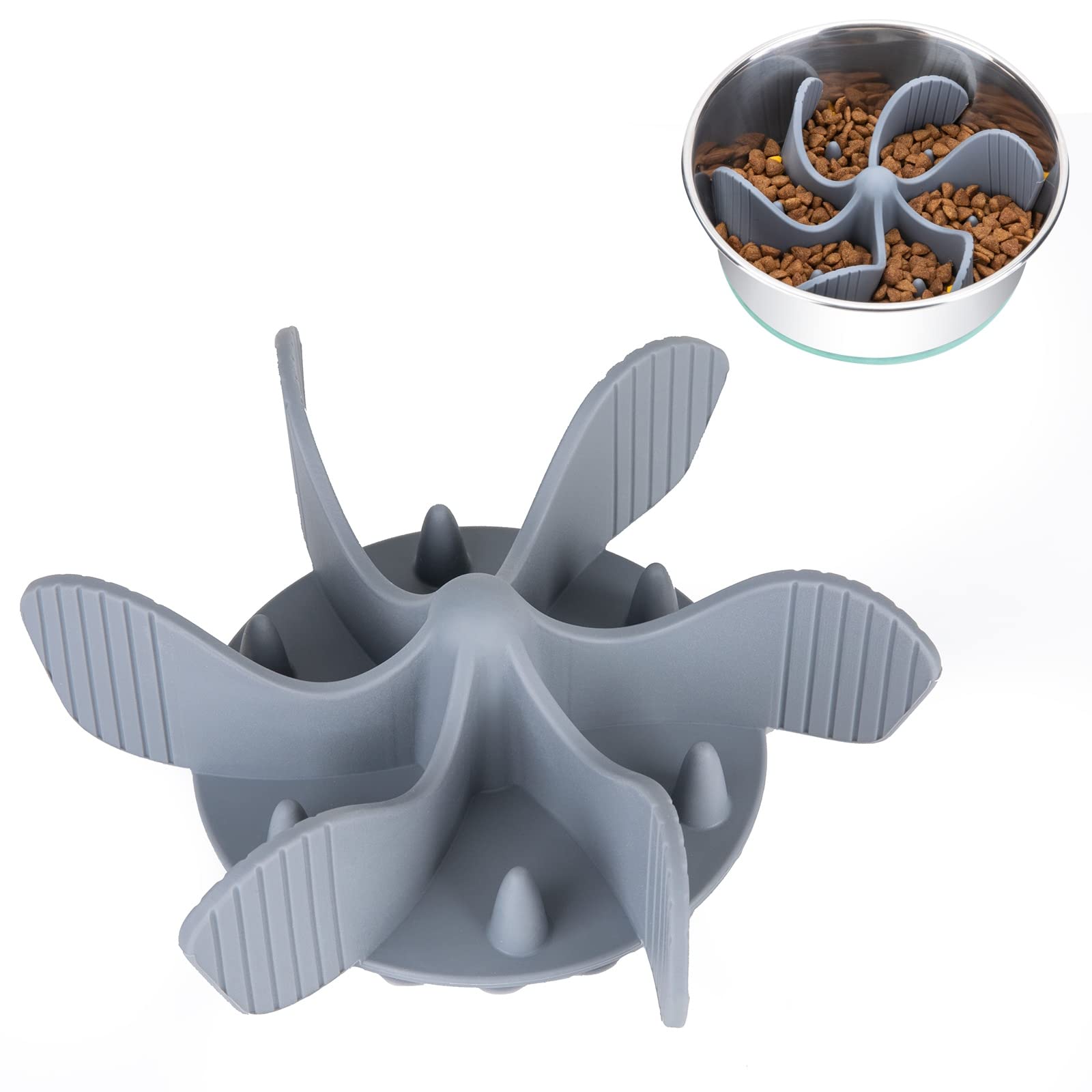
Keegud Slow Feeder Insert

Most regular bowls

Our Score 8.8/10
Check Price

Worth Noting

  • Hand wash only
Height
1.8 in
Suction Cups
36
Trims Down To
4.7 in bottom
Bowl Opening Fit
5.5–8.5 in
Read the full review

Thirty-six suction cups and a blade pattern you can trim to size are the two reasons this Keegud insert is the one we reach for first. It turns a regular bowl into a slow feeder without asking you to give up the dish your dog already knows, and the food-grade silicone is soft enough that a determined muzzle meets some give rather than hard plastic. At 6.7 inches across and 1.8 inches tall, it has enough relief to interrupt gulping without turning a meal into an excavation.

Fit is where this one earns its keep. Keegud lists a usable bowl bottom of 5.5 to 7 inches, an opening of 5.5 to 8.5 inches, and a trim-down minimum of 4.7 inches across the bottom. Measure the flat base, not the rim, because that is where the suction cups get their contact. The outer edge can be cut away for a smaller dish, and the central spiral stays intact, so the part doing the slowing does not change.

The suction is the part that matters at mealtime. Pressed onto a smooth, flat base, the cups hold through a bowl of kibble, and the insert lifts out in one piece for cleaning. A textured or steeply curved bowl gives the cups less to grab, so dry the base and press across the whole disc rather than just the middle. Rinsing the spiral is simple, and the open shape leaves fewer blind corners than compartment-style feeders—the kind of detail that makes daily use easier.

Bottom line: We recommend the Keegud as the default insert: its broad cut-to-fit silicone grip suits most regular bowls, and the soft spiral slows a meal without feeling harsh on a dog's nose.
2

Xiaozhihui Slow Feeder Insert

Xiaozhihui Slow Feeder Insert

Smaller bowls

Our Score 8.6/10
Check Price

Worth Noting

  • Smaller footprint than wide-bowl picks
Height
1.64 in
Suction Cups
36
Bowl Opening Fit
5.5–8.5 in
Trimmable Down To
4.7 in bottom
Read the full review

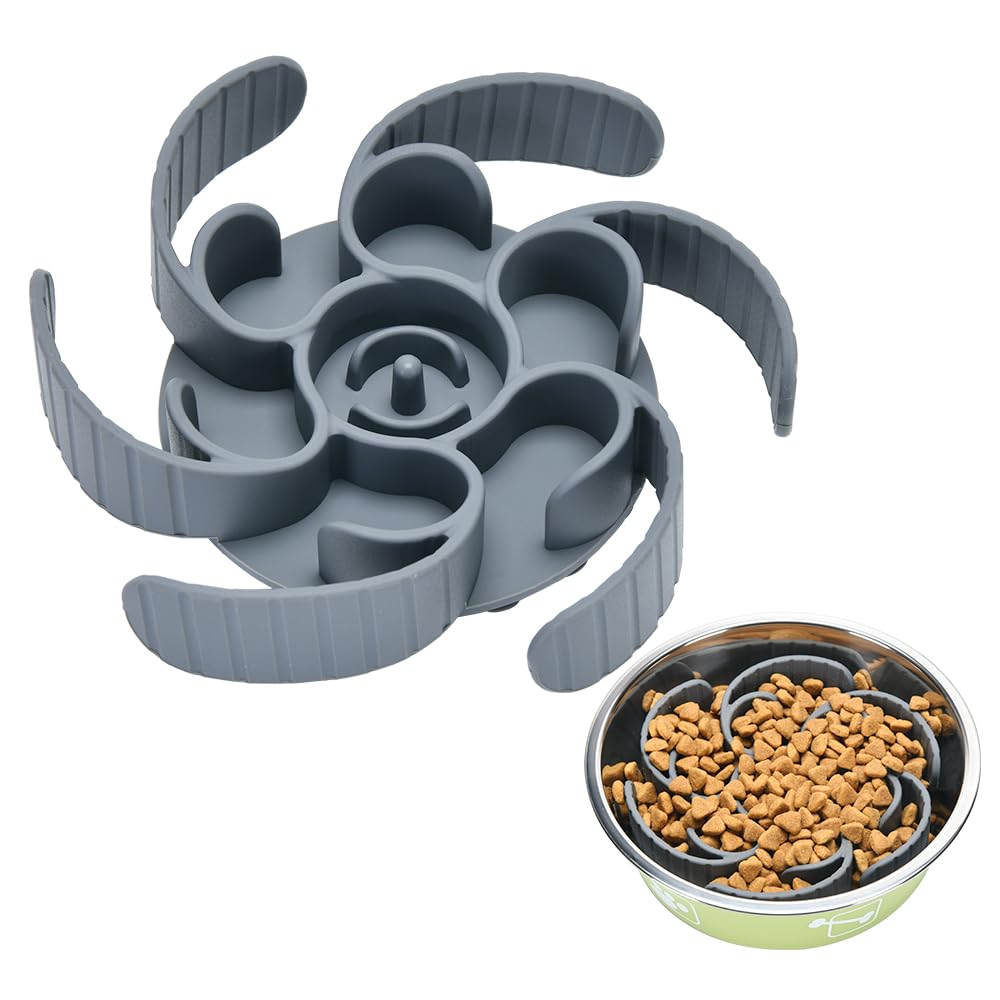
The Xiaozhihui is the insert we point to when the goal is to try slow feeding without committing much. It uses the same basic approach as the Keegud—soft silicone, a spiral pattern, 36 suction cups—in a disc that is 6.89 inches across and 1.64 inches tall. That lower profile is not a small detail: it gives a dog a gentler first challenge and leaves more room around the edge of a compact bowl.

The fit range is familiar: 5.5 to 8.5 inches across the opening, with enough give to trim down to a 4.7-inch bottom. That makes it useful for the regular metal or glass bowl already in the kitchen, and the silicone flexes rather than fighting a slightly oval rim. The outer edge can be trimmed, and the suction cups still sit on the flat part of the base where they can do their job.

At mealtime, the shorter spiral still breaks up a gulper's rhythm, though it is less of a challenge than our top pick or the deeper Bestalk. The silicone rinses easily, and the insert lifts out without a handle or a tool. What stays with us is how little ceremony it adds: the meal lasts longer, and the bowl routine stays the same.

Bottom line: For a smaller bowl and a smaller spend, we reach for the Xiaozhihui: it has the same soft spiral approach and reliable suction in a lower, more compact disc.

3

Bestalk Slow Feeder Insert

Bestalk Slow Feeder Insert

Compact bowls

Our Score 8.6/10
Check Price

Worth Noting

  • Small footprint leaves wide bowls uncovered
  • Deep pattern can challenge flat-faced dogs
Height
1.9 in
Cleaning
Hand wash only
Diameter
5.7 in
Material
Silicone
Read the full review

A compact bowl is where the Bestalk insert makes the most sense. Its 5.7-inch diameter is the smallest in this group, so it settles into a modest bowl without climbing the sides, while the 1.9-inch height gives it the deepest relief here. For a dog that needs a real speed bump in a bowl with no room for a wide disc, that combination is unusually useful.

The deep pattern does the work: food has to travel around the ridges rather than disappearing in a straight line, and the soft silicone is easier on a nose than a hard plastic maze. We like that the height is doing the slowing rather than a cramped pattern of narrow dead ends. The suction cups hold best on a smooth, flat base, so dry the bowl and press the whole insert down before adding food.

The dark blue silicone wipes down easily, and the compact shape is simple to lift out and rinse. Compared with the Xiaozhihui, this one is smaller across but taller, which gives it a different job rather than an upgrade. The deep relief is not a token bump; it makes a determined eater work around the whole pattern.

Bottom line: The Bestalk is our compact-bowl pick, with the deepest relief here and a small diameter that fits where broader inserts crowd the sides.

4

Anipaw Slow Feeder Insert

Anipaw Slow Feeder Insert

Wide shallow bowls

Our Score 8.4/10
Check Price

Worth Noting

  • Can slide on some bowl bases
Height
1.3 in
Diameter
7.4 in
Removal Handles
6 tapered
Bowl Capacity Fit
4–11 cups
Read the full review

The Anipaw is the widest insert here, and that is why it earns a place in a group of otherwise similar discs. At 7.4 inches across and 1.3 inches tall, it covers more of a bowl's flat base while keeping the pattern low enough that a dog can still sweep food toward the edge. The six tapered handles are the detail we appreciate most: when suction has done its job, they give you somewhere to pull.

The listed capacity range is 4 to 11 cups, the broadest fit here, and the flexible silicone is meant for glass, plastic, ceramic, and stainless bowls. Compared with the Keegud, the Anipaw trades a little pattern height for a wider footprint. We choose it when the bowl is wide and shallow enough that a smaller insert leaves a ring of kibble around the edge; the extra coverage is worth more there than a taller maze would be.

The shallow 1.3-inch profile is also the compromise. It slows a fast eater by making the food harder to scoop in a straight line, but a very determined dog will not have to work as hard as it would with a deeper spiral. The low ridges rinse quickly, and dishwasher-safe care is one less chore on a wet-food day. That is a fair trade for the bowls where the extra width matters.

Bottom line: We choose the Anipaw when the bowl is wide: its 7.4-inch footprint covers more of the base, and the six handles make lifting a suctioned insert much less fiddly.

How We Tested Slow Feeder Inserts

We started by pulling every slow feeder insert we could find that was sold as a bowl insert rather than a standalone feeder, then narrowed the list by bowl diameter, pattern depth, material, and whether the suction base was designed to grip smooth surfaces. We ended up with 14 inserts and rotated them through four months of breakfast and dinner with dogs of different sizes and snout lengths, including a flat-faced terrier and a Labrador who eats like the bowl owes him money. Each insert went into a standard stainless bowl and a wide ceramic bowl, with dry kibble, soaked kibble, and wet food.

At each meal we pressed the insert into the bowl on tile and stainless steel, then watched the first minute: did it slide, tip, or lift at the edge when the dog licked? We timed meals against a plain bowl to see whether the pattern added minutes or just annoyance, and noted if the dog quit, pawed at it, or got the food out in one clean sweep. Between meals we lifted each one out, rinsed it, and scrubbed the grooves with a bottle brush after wet food; anything that trapped kibble in a dead corner or tore at the suction base after repeated washes went into the no pile.

By the end, the inserts that earned a place were the ones that stayed planted through a full meal, slowed eating without causing a mid-meal walkout, and came clean without a soak. Size mattered as much as suction: a tray that crowded the bowl left no room for kibble, and one that sat too high was easy for a long-snouted dog to flip.

How to Choose Slow Feeder Inserts for Dogs

Measure the Base, Not the Rim

A bowl can be 8 inches across at the rim and only 5.5 inches across the flat bottom, and the insert only gets useful contact on the flat part. Measure the base and the opening, then compare both with the insert's range. A cuttable edge is handy for a slightly small bowl, but trimming too far can remove the suction cups that hold the disc steady. The Keegud and Xiaozhihui list a 5.5-to-8.5-inch opening and a 4.7-inch trim minimum; the Anipaw is the wide option for 4- to 11-cup bowls, while the Bestalk's 5.7-inch disc suits compact dishes.

Treat Suction as a Surface, Not a Promise

Suction is what separates an insert from a toy your dog can flip. It works best on a clean, flat, smooth base; a textured, scratched, or steeply curved bowl gives the cups less to grip. Press the insert down across its whole base, then give the edge a gentle pull before you add food. If it lifts easily, choose a bowl with more flat contact or a wider insert. Even then, suction is not a lock—some determined dogs can worry at an edge, so watch the first few meals.

Choose a Depth Your Dog Can Work

Pattern height controls the challenge. A taller spiral makes a dog work harder, which helps with a gulper that inhales a bowl in seconds. Too much relief can frustrate a flat-faced dog or one with a short reach, and a dog that gives up is not eating more slowly—it is just not eating. The inserts here run from 1.3 inches on the Anipaw to 1.9 on the Bestalk, with the Keegud and Xiaozhihui in between. We put more faith in the first meal than in a breed label: start lower for a nervous or short-muzzled dog, and go deeper only if the bowl still empties too fast.

Plan for Cleaning Before You Need It

Silicone inserts collect a little food under the edge and in the channels, especially with wet food. A removable one-piece insert is easier to lift and rinse than a bowl with fixed ridges, and dishwasher-safe care saves time. The Anipaw is the one here that lists dishwasher-safe care; the Keegud and Bestalk are hand-wash only. If you feed wet food, rinse the insert before residue dries and lift it out daily rather than waiting for a weekly deep clean. A quick scrub now is easier than chipping dried food out of a spiral later.

Frequently Asked Questions

Final Verdict

The Keegud insert is the one we recommend first. Its cut-to-fit silicone body and 36-cup base give it the most forgiving mix of fit and grip for an ordinary bowl, and the soft spiral is firm enough to slow a meal without making a dog fight for every bite. If your bowl is unusually wide, choose the Anipaw for its larger footprint and removal handles; if you want the least expensive way to try the idea, the Xiaozhihui is the sensible step. Press any of them flat, check the seal, and lift the insert for cleaning after wet food.